LTE Relay Node Reconfiguration Call Flow
LTE Relay Node Reconfiguration is the donor-to-relay control path used when the donor eNB changes relay-node-specific configuration on the RN backhaul control branch.
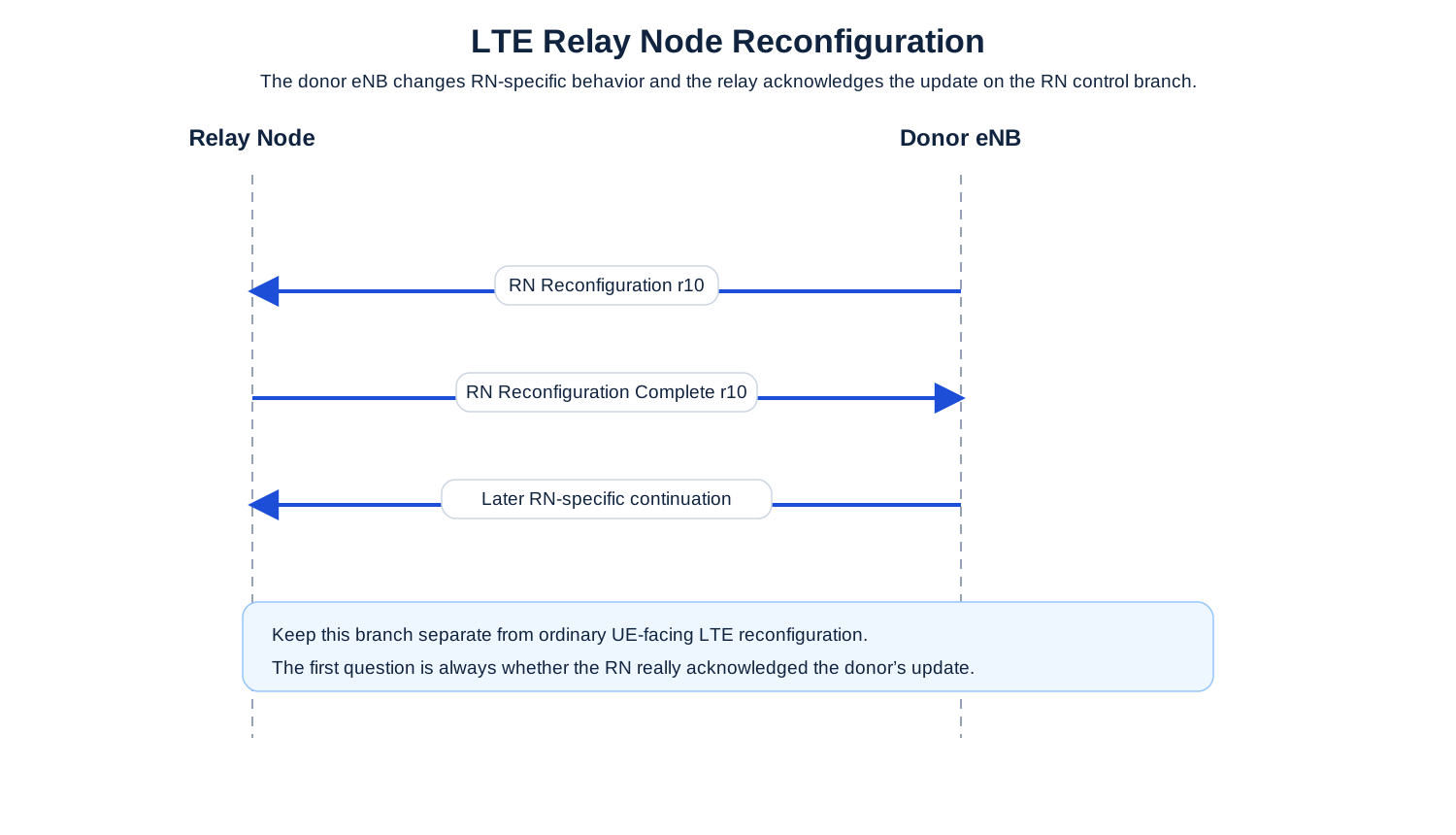
The practical anchors are RN Reconfiguration r10 and RN Reconfiguration Complete r10, which together define the RN-specific configuration update and acknowledgement path.
Introduction
This page is for relay-node-specific control rather than for normal UE-facing connected-mode updates. The trace has to stay on the donor-to-RN branch to make sense of the change.
Use it when the RN-specific system-information or relay-operation behavior changed and the main question is whether the donor commanded the right update and whether the relay acknowledged it.
What Is LTE Relay Node Reconfiguration in Simple Terms?
- What starts the procedure: The donor eNB needs to change relay-node-specific configuration on the RN control branch.
- What the UE and network want to achieve: A relay-node state that matches the donor’s new RN-specific configuration.
- What success looks like: The donor sends the RN update and the relay acknowledges it cleanly.
- What failure means: The relay does not acknowledge the change cleanly or later RN behavior does not reflect it.
Why this procedure matters
Relay-node traces can look deceptively similar to ordinary LTE reconfiguration unless the RN-specific branch is kept in view. This page keeps the analysis on the donor-to-RN control path where the actual change was commanded.
Quick Fact Sheet
| Procedure name | LTE Relay Node Reconfiguration |
|---|---|
| Domain | Relay-node backhaul control |
| Main trigger | Need to change RN-specific system-information or relay operation settings |
| Start state | The relay node is operating under donor control |
| End state | The relay has accepted the new RN-specific configuration or the update remains incomplete |
| Main nodes | Relay node, donor eNB |
| Main protocols | RRC |
| Main success outcome | RN-specific change is acknowledged and reflected later |
| Main failure outcome | RN-specific control update is not completed or not reflected correctly |
| Most important messages | RN Reconfiguration r10, RN Reconfiguration Complete r10 |
| Main specs | TS 36.331 |
Preconditions
- A relay node is operating under donor eNB control.
- The donor needs to update RN-specific configuration or system-information behavior.
- The RN control branch is visible in the trace.
Nodes and Interfaces
Nodes involved
| Node | Role in this procedure |
|---|---|
| Relay node | Receives the RN-specific update and acknowledges it if accepted. |
| Donor eNB | Sends the RN-specific configuration change and expects RN acknowledgement. |
| RN control context | Represents the donor-to-RN branch that should not be confused with ordinary UE-facing updates. |
Interfaces used
| Interface | Path | Role |
|---|---|---|
| RN backhaul control path | Donor eNB <-> Relay node | Carries the RN-specific reconfiguration exchange. |
| RRC | Donor eNB <-> Relay node | Carries the main RN-specific configuration and completion messages. |
End-to-End Call Flow
Relay node              Donor eNB
|<--RN Reconfiguration---|
|--RN Reconfig Complete->|
|==== RN-specific continuation ===>|
Major Phases
| Phase | What happens |
|---|---|
| 1. Decide the RN-specific change | The donor eNB prepares the relay-specific update. |
| 2. Deliver the RN update | The donor sends the RN-specific reconfiguration message. |
| 3. Acknowledge the change | The relay returns the completion message if the update is accepted. |
| 4. Continue with the new RN state | Later relay behavior should now match the updated RN-specific configuration. |
Step-by-Step Breakdown
Send the RN-specific update
Sender -> receiver: Donor eNB -> Relay node
Message(s): RN Reconfiguration r10
Purpose: Carry the relay-node-specific configuration change.
State or context change: The RN now has a pending donor-controlled update to apply.
Note: This is the main message that proves the donor actually commanded a relay-specific change.
Acknowledge the RN update
Sender -> receiver: Relay node -> Donor eNB
Message(s): RN Reconfiguration Complete r10
Purpose: Confirm that the RN applied or accepted the requested update.
State or context change: The RN-specific change is now complete from the message-exchange point of view.
Note: If the acknowledgement is missing, later RN behavior should not be assumed to reflect the new state.
Check later RN-specific behavior
Sender -> receiver: Relay node / donor eNB
Message(s): Later RN control continuation
Purpose: Validate whether the RN behavior now matches the intended donor change.
State or context change: The relay branch is now using the new configuration or is clearly inconsistent with it.
Note: This separates message completion from operational correctness.
Correlate with RN system-information impact if relevant
Sender -> receiver: Relay node
Message(s): RN-specific system-information refresh
Purpose: Check whether RN system-information behavior changed in line with the update.
State or context change: The RN control path is now tied to a visible later effect if one exists.
Note: This is especially useful when the update was mainly about RN-specific system-information behavior.
Important Messages
| Message | Protocol | Direction | Purpose in this procedure | What to inspect briefly |
|---|---|---|---|---|
| RN Reconfiguration r10 | RRC | Donor eNB -> Relay node | Carries the RN-specific configuration update. | Check which RN-specific behavior the donor tried to change. |
| RN Reconfiguration Complete r10 | RRC | Relay node -> Donor eNB | Acknowledges the RN-specific update. | Check whether the relay really acknowledged the exact update being analyzed. |
| RRC Connection Reconfiguration | RRC | eNB -> UE | Useful contrast only when mixed traces risk confusing RN control with ordinary UE control. | Check that the trace branch is really relay-node specific and not a normal UE-facing branch. |
Important Parameters to Inspect
| Parameter | What it is | Where it appears | Why it matters | Common issues |
|---|---|---|---|---|
| RN-specific change scope | The exact relay-specific behavior the donor attempted to change. | RN Reconfiguration r10 | Useful for checking whether later RN behavior should have changed at all. | The wrong later behavior is blamed because the actual RN change scope was misunderstood. |
| Acknowledgement presence | Whether the RN returned the completion message. | RN Reconfiguration Complete r10 | This is the clearest proof that the RN accepted the update. | Later RN behavior is assumed to reflect a change that was never acknowledged. |
| Branch identity | Whether the trace is truly donor-to-RN control and not ordinary UE-facing control. | Whole procedure window | Prevents the RN branch from being mixed with normal LTE control flows. | The wrong control family is being analyzed. |
| Later RN effect | The visible RN-specific behavior that should match the update. | Post-acknowledgement continuation | Separates configuration completion from operational correctness. | The message exchange completed, but the intended RN effect never appeared. |
| System-information impact | Whether the RN update changed relay-specific system-information behavior. | Later RN behavior | Useful when the update was tied to RN system-information handling. | The update is judged without checking the most visible later effect. |
Successful Completion
Success means the donor sends the RN-specific update, the relay acknowledges it, and later RN behavior matches the intended change.
Common Failures and Troubleshooting
| Symptom | Likely cause | Where to inspect | Relevant message(s) | Relevant interface(s) | Likely next step |
|---|---|---|---|---|---|
| The donor sends RN Reconfiguration, but later RN behavior does not match it | The RN may have accepted the update message but still not moved into the intended operational state. | RN Reconfiguration r10, RN Reconfiguration Complete r10, and the first later RN-specific behavior together. | RN Reconfiguration r10, RN Reconfiguration Complete r10 | RN backhaul control | Separate message acknowledgement from actual RN-side effect. |
| The trace looks like a reconfiguration issue, but the wrong branch is being analyzed | A normal UE-facing LTE reconfiguration may be mixed into a relay-node trace. | Branch identity around the message family. | RN Reconfiguration r10, RRC Connection Reconfiguration | RRC | Confirm the branch is donor-to-RN before continuing. |
What to Check in Logs and Traces
- Use RN Reconfiguration r10 as the main donor-side anchor.
- Do not assume later RN behavior changed unless RN Reconfiguration Complete r10 is present.
- Keep ordinary UE-facing reconfiguration separate from donor-to-RN control.
Related Pages
Related sub-procedures
Related message reference pages
Related troubleshooting pages
Notes
This page is RN-specific. Use ordinary LTE reconfiguration pages only when the trace is clearly UE-facing and not donor-to-relay control.
FAQ
What is LTE Relay Node Reconfiguration?
It is the donor-to-relay RRC update path used to change RN-specific behavior on the relay-node control branch.
Which two messages define this procedure?
RN Reconfiguration r10 and RN Reconfiguration Complete r10 are the main relay-node control anchors.