LTE RRC Connection Reject Procedure Call Flow
LTE RRC Connection Reject is the negative radio-side response sent when the eNB does not admit the UE into connected signaling. It appears after RRC Connection Request and usually leaves the UE in idle behavior with retry or wait-time handling.
If this branch appears, the higher-layer procedure that triggered access does not continue through a normal connected path. The most useful checks are the request context, cell conditions, congestion pattern, and any reject wait time.
Introduction
The LTE RRC Connection Reject procedure covers the failure branch where the eNB decides not to grant a fresh connected signaling context. It is still part of LTE access analysis because it explains why later attach, service request, paging response, or other NAS continuation never appears.
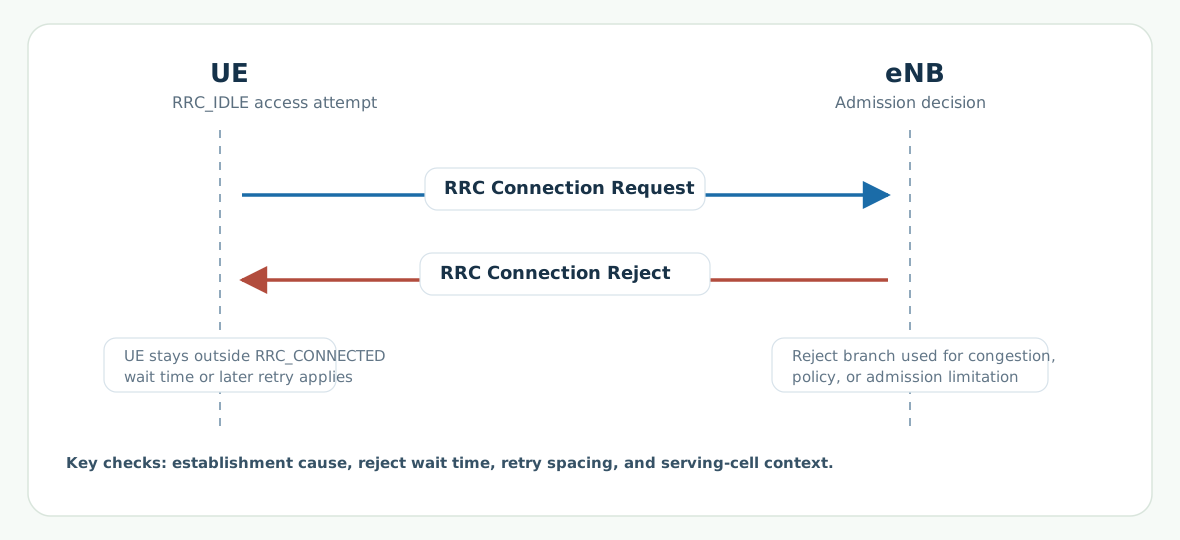
The main nodes are the UE and eNB. The UE sends RRC Connection Request, the eNB evaluates the attempt, and the negative outcome is returned through RRC Connection Reject.
What Is LTE RRC Connection Reject in Simple Terms?
- What starts the procedure: The UE asks for connected signaling, but the network does not accept the attempt.
- What the UE and network want to achieve: The UE wants access to connected signaling, while the eNB applies admission control and cell policy.
- What success looks like: From the network point of view, the reject is delivered cleanly and the UE applies the expected backoff or retry behavior.
- What failure means: The UE keeps retrying unexpectedly, retries too early, or the reject pattern hides a deeper access or load problem.
Why this procedure matters
This branch is one of the clearest reasons why a later LTE procedure never begins. It also separates radio admission failure from NAS or EPC failure very quickly.
Quick Fact Sheet
| Procedure name | LTE RRC Connection Reject Procedure |
|---|---|
| Domain | E-UTRAN radio access rejection |
| Main trigger | The UE requests a new RRC connection, but the eNB does not admit it |
| Start state | UE is in RRC_IDLE and tries to enter connected signaling |
| End state | UE remains in RRC_IDLE and applies wait-time or retry behavior |
| Main nodes | UE, eNB |
| Main protocols | RRC, MAC, PHY |
| Main success outcome | The reject is delivered clearly and the UE follows the expected backoff behavior |
| Main failure outcome | Repeated retries, hidden congestion, or misleading escalation toward later-layer analysis |
| Most important messages | RRC Connection Request, RRC Connection Reject |
| Main specs | TS 36.331, TS 36.321, TS 36.300 |
Preconditions
- The UE has selected a suitable LTE cell and has the system information needed for access.
- The UE has a reason to request connected signaling, such as attach, paging response, or uplink control activity.
- The random-access side of the attempt has progressed far enough for an RRC request to be processed.
- The eNB has enough context to decide whether to admit or reject the attempt.
Nodes involved
| Node | Role in this procedure |
|---|---|
| UE | Requests connected signaling and applies the reject wait-time or retry behavior if the attempt is not admitted. |
| eNB | Evaluates admission, access policy, and load conditions, then returns the reject outcome. |
Interfaces used
| Interface or channel context | Path | Why it matters here |
|---|---|---|
| LTE Uu | UE <-> eNB | Carries the request and reject messages over the radio interface. |
| CCCH | UE <-> eNB | The reject branch happens before a dedicated DCCH path exists. |
| MAC access context | UE <-> eNB | Helps explain whether the request reached the stage where the reject could be generated and delivered. |
End-to-end call flow
UE                          eNB
|                            |
|-- RRC Connection Request ->|
|                            |
|<- RRC Connection Reject ---|
|                            |
|   wait time / retry later  |
This is the negative branch of fresh RRC connection establishment. No dedicated connected signaling path is created.
Major phases
| Phase | What happens |
|---|---|
| 1. Access need appears | The UE decides it must leave idle-only behavior and sends a fresh connection request. |
| 2. Admission decision | The eNB checks load, access policy, barring conditions, and overall request context. |
| 3. Reject delivery | The eNB returns RRC Connection Reject instead of granting RRC Connection Setup. |
| 4. Backoff or retry | The UE remains idle and follows the returned wait-time behavior or later reattempt logic. |
Step-by-step breakdown
Step 1: Access trigger
Sender -> receiver: UE internal trigger
Message(s): No RRC message yet
Purpose: Start the attempt to move from idle monitoring into connected signaling.
State or context change: UE prepares a fresh access attempt from RRC_IDLE.
Note: The later rejected procedure often reflects attach, paging response, or uplink control intent rather than a pure radio-only action.
Step 2: RRC Connection Request
Sender -> receiver: UE -> eNB
Message(s): RRC Connection Request
Purpose: Ask the eNB to create a fresh connected signaling path.
State or context change: The eNB now has enough early request context to evaluate the attempt.
Note: The establishment cause is the fastest clue for what the UE was trying to do next.
Step 3: RRC Connection Reject
Sender -> receiver: eNB -> UE
Message(s): RRC Connection Reject
Purpose: Tell the UE that the current attempt is not being admitted.
State or context change: No connected signaling path is created, and the UE remains outside RRC_CONNECTED.
Note: Wait time is usually the most useful field because it explains when a retry becomes valid.
Step 4: Idle hold or retry
Sender -> receiver: UE internal behavior
Message(s): No immediate follow-up RRC success message
Purpose: Keep the UE from reattempting too early and preserve cell-level stability.
State or context change: UE remains in idle behavior until a later valid attempt is made.
Note: If retries happen too quickly, the problem may be UE-side handling or a trace that combines multiple cells or attempts.
Important messages
| Message | Protocol | Direction | Purpose in this procedure | What to inspect briefly |
|---|---|---|---|---|
| RRC Connection Request | RRC | UE -> eNB | Starts the fresh access attempt. | Establishment cause, retry pattern, and timing of repeated attempts. |
| RRC Connection Reject | RRC | eNB -> UE | Rejects the request instead of granting connected signaling. | Wait time, reject cadence, and whether congestion or barring is likely. |
Important parameters to inspect
| Parameter | What it is | Where it appears | Why it matters | Common issues |
|---|---|---|---|---|
| Establishment cause | The request reason sent by the UE. | RRC Connection Request | Shows which higher-layer path was trying to start. | Unexpected emergency or high-priority access category, wrong test assumption. |
| Wait time | The backoff timer guidance returned by the eNB. | RRC Connection Reject | Explains when the UE is expected to retry. | UE retries too early, field missing in decoded trace, merged attempts. |
| Serving cell identity | The specific LTE cell handling the rejected attempt. | Around the request and reject | Helps separate cell-specific load from broader network behavior. | Wrong-cell correlation, neighbor confusion, reselection during retries. |
| Attempt timing | The spacing between repeated request and reject events. | Whole reject sequence | Shows whether the UE follows the expected idle retry pattern. | Retry storm, missing requests, trace capture gaps. |
| Cell load or barring context | Supporting radio and admission conditions near the reject. | Surrounding radio trace and cell metrics | Often explains why the eNB did not admit the attempt. | Congestion assumed without evidence, barring overlooked, overload hidden in adjacent logs. |
Successful completion of the procedure
The procedure is complete when the reject reaches the UE and the UE applies the expected idle behavior instead of forcing an immediate new access attempt. There is no transition into RRC_CONNECTED.
Common failures in LTE RRC Connection Reject
| Symptom | Likely cause | Where to inspect | Relevant message(s) | Relevant interface(s) | Likely next step |
|---|---|---|---|---|---|
| Repeated reject loop | Persistent congestion, admission policy, or UE retry behavior not honoring wait time. | Reject cadence, wait time, same-cell repeats. | RRC Connection Request, RRC Connection Reject | LTE Uu | Decide whether the loop is network load, barring, or UE retry handling. |
| No later NAS starts | The higher-layer procedure never got a radio path. | Whether any RRC Connection Setup ever appears after the request. | RRC Connection Request, RRC Connection Reject | LTE Uu | Keep analysis on the radio side before checking MME or EPC logs. |
| Reject seen only in one trace layer | Partial capture, decode gap, or timing mismatch. | Air trace completeness and repeated request evidence. | RRC Connection Reject | LTE Uu | Confirm the reject really reached the UE before drawing retry conclusions. |
| Reject appears in unexpected low-load conditions | Cell policy, access class handling, or wrong scenario setup. | Establishment cause, access class, cell policy assumptions. | RRC Connection Request, RRC Connection Reject | LTE Uu | Check admission rules before treating it as unexplained radio instability. |
What to check in logs and traces
- Confirm the request really started from RRC_IDLE and was aimed at fresh connection establishment.
- Inspect the establishment cause before assuming the same root cause for every reject.
- Check the reject wait time and compare it with actual retry behavior.
- Correlate repeated attempts with the same cell and the same paging or uplink trigger context.
- Do not jump into NAS or EPC analysis unless a later successful RRC setup exists.
Related Pages
Related sub-procedures
Related message reference pages
Related troubleshooting pages
Notes
RRC Connection Reject is an access outcome, not a NAS reject. It means the UE never received a fresh connected signaling path in the first place.
The most useful correlation pair is often RRC Connection Request and RRC Connection Reject together with retry timing. That is usually enough to keep the analysis on the radio side.
FAQ
What is LTE RRC Connection Reject?
It is the eNB response that refuses a fresh RRC connection establishment attempt.
Does RRC Connection Reject mean attach failed?
It means attach or another later procedure could not begin through a normal connected radio path.
What should I inspect first?
Start with establishment cause, reject wait time, retry pattern, and cell context.
Does the UE enter RRC_CONNECTED after reject?
No. The UE remains outside a successful connected signaling state.
Why is wait time important?
It tells you when the UE is expected to retry and helps explain retry loops.