LTE RRC Connection Setup Procedure Call Flow
LTE RRC Connection Setup is the radio-side procedure that moves the UE from RRC_IDLE into RRC_CONNECTED and creates the first dedicated signaling path between the UE and the eNB. It is the entry point used before LTE Attach Procedure, service recovery, tracking area update, paging response, and other uplink signaling flows.
If the UE does not complete this exchange cleanly, the NAS or EPC procedure that should follow may never start or may appear incomplete in multi-layer traces.
Introduction
The LTE RRC Connection Setup procedure establishes the first dedicated radio-control context between the UE and the eNB. It gives the UE a usable signaling path for later dedicated RRC exchange and, in many cases, the first NAS delivery toward the EPC through RRC Connection Setup Complete.
The procedure starts when the UE needs dedicated signaling instead of idle-mode monitoring. Common triggers include initial attach, Service Request, Tracking Area Update, paging response, SMS, and other uplink control activity. The main nodes are the UE and eNB, but the last message often becomes the handoff point into the next NAS or EPC sequence.
What Is LTE RRC Connection Setup in Simple Terms?
- What starts the procedure: The UE needs dedicated control signaling and can no longer stay only in idle monitoring.
- What the UE and network want to achieve: A working RRC_CONNECTED signaling path with the initial dedicated signaling resources for control exchange.
- What success looks like: The eNB sends RRC Connection Setup and the UE answers with RRC Connection Setup Complete.
- What failure means: The UE stays outside stable connected signaling, retries later, or receives reject or timeout behavior instead of entering RRC_CONNECTED.
Why this procedure matters
This is the radio-side gate for many LTE control-plane procedures. It also provides one of the clearest correlation points between the air interface and the next NAS or core-network sequence, especially when RRC Connection Setup Complete carries the first NAS payload.
Quick Fact Sheet
| Procedure name | LTE RRC Connection Setup Procedure |
|---|---|
| Domain | E-UTRAN radio access and signaling setup |
| Main trigger | UE needs dedicated signaling for attach, service request, TAU, paging response, SMS, or other control activity |
| Start state | UE is camped in RRC_IDLE with suitable cell access conditions |
| End state | UE is in RRC_CONNECTED with SRB1 active and able to carry later NAS or RRC signaling |
| Main nodes | UE, eNB |
| Main protocols | RRC, MAC, PHY |
| Main success outcome | Dedicated signaling path exists and upper-layer NAS or RRC continuation can proceed |
| Main failure outcome | UE remains in idle behavior, retries access later, or falls into reject, timeout, or reattempt handling |
| Most important messages | RRC Connection Request, RRC Connection Setup, RRC Connection Setup Complete |
| Main specs | TS 36.331, TS 36.321, TS 36.300 |
Preconditions
Before RRC Connection Setup begins, several basic conditions should already be true:
- The UE has selected and camped on a suitable LTE cell.
- The UE has valid system information needed for access behavior on that cell.
- The UE has a reason to move from idle monitoring into dedicated signaling.
- Access conditions such as barring or severe radio failure are not already preventing the attempt.
- The eNB can admit the UE into a connected signaling path for the scenario and load conditions.
Nodes involved
| Node | Role in this procedure |
|---|---|
| UE | Detects the need for connected signaling, performs random access continuation, sends the connection request, applies the setup, and confirms completion. |
| eNB | Evaluates the request, decides whether radio resources can be assigned, sends the setup configuration, and receives the completion message that opens later signaling. |
Interfaces used
| Interface or channel context | Path | Why it matters here |
|---|---|---|
| LTE Uu | UE <-> eNB | Carries the full over-the-air control path for random access continuation and the RRC setup exchange. |
| CCCH | UE <-> eNB | Carries the early common-control RRC setup messages before a dedicated signaling radio bearer is active. |
| SRB1 / DCCH | UE <-> eNB | Becomes active after setup so the UE can send RRC Connection Setup Complete and continue with NAS or later RRC procedures. |
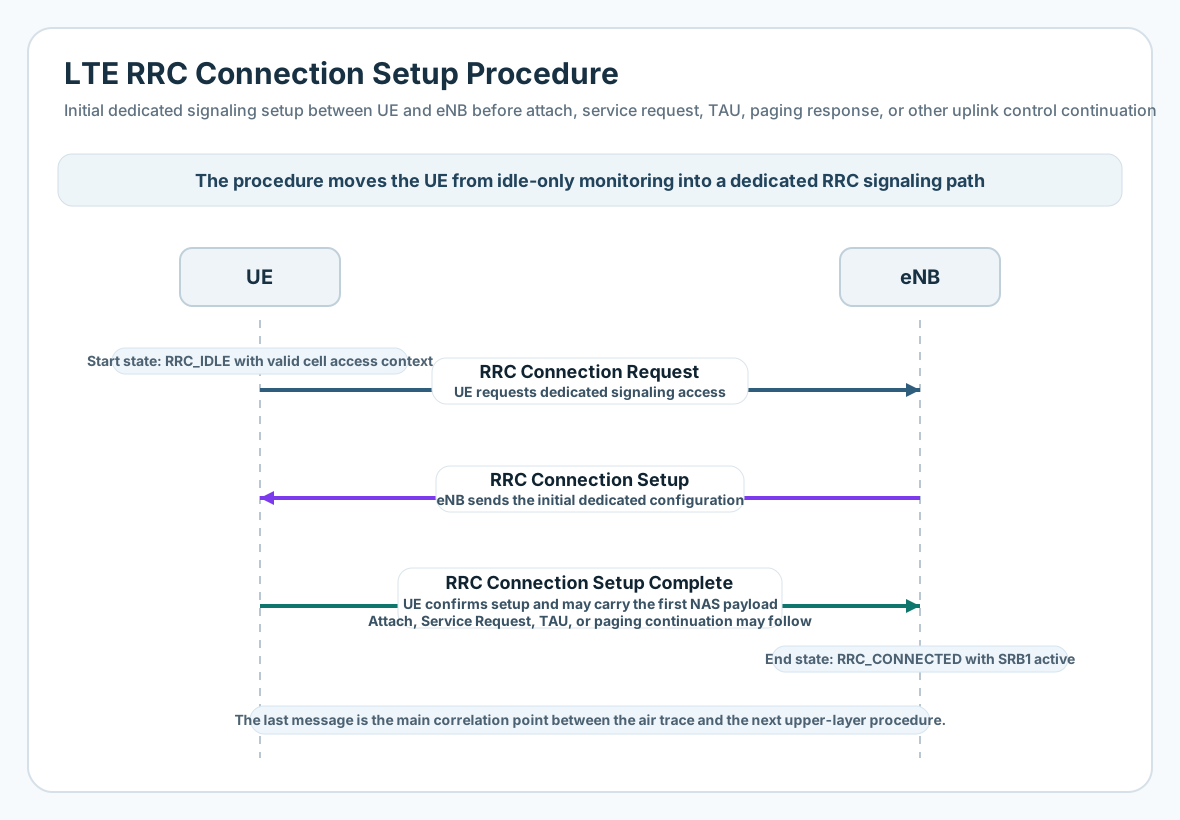
End-to-end call flow
UE                          eNB
|                            |
|-- RRC Connection Request ->|
|                            |
|<- RRC Connection Setup ----|
|                            |
|-- RRC Connection Setup Complete ->|
|                            |
|   later NAS or RRC continuation   |
The procedure is short at message level, but it is strategically important because the last message often becomes the entry point into a much larger workflow such as attach, TAU, or service request.
Major phases
| Phase | What happens |
|---|---|
| 1. Trigger and access entry | The UE has something to signal and cannot stay only in idle monitoring. It first reaches the point where an RRC connection request can be sent after the random access entry conditions are satisfied. |
| 2. Request and admission | The UE sends RRC Connection Request and the eNB decides whether to admit the UE into connected signaling, considering load, access policy, and radio conditions. |
| 3. Dedicated configuration delivery | The eNB sends RRC Connection Setup with the initial dedicated signaling configuration that lets the UE move into connected-mode control handling. |
| 4. Completion and higher-layer handoff | The UE applies the configuration and sends RRC Connection Setup Complete. This is the point where initial NAS or later control continuation becomes available. |
Step-by-step breakdown
Step 1: Connected signaling becomes necessary
Sender -> receiver: UE internal trigger
Message(s): No RRC message yet
Purpose: A service, mobility, paging, or control need tells the UE that it must move out of pure idle monitoring and start a dedicated signaling path.
State or context change: UE is still in RRC_IDLE but is preparing to request connected access.
Note: This is why RRC Connection Setup is not itself an EPC procedure. It is the radio-side doorway that many different higher-layer procedures use.
Step 2: RRC Connection Request
Sender -> receiver: UE -> eNB
Message(s): RRC Connection Request
Purpose: Ask the eNB to establish an RRC connection and indicate the basic reason for access through the establishment cause.
State or context change: The eNB now has an early request context for the UE and decides whether to continue, reject, or wait for retry handling.
Note: The establishment cause is one of the fastest ways to understand what the UE is trying to do next, such as mobile-originated signaling, mobile-terminated access, emergency handling, or high-priority access.
Step 3: Initial RRC configuration
Sender -> receiver: eNB -> UE
Message(s): RRC Connection Setup
Purpose: Deliver the minimum dedicated configuration needed to move the UE into connected-mode signaling.
State or context change: The UE receives the radio configuration that creates the first dedicated signaling bearer context.
Note: When this message is missing or malformed, later NAS analysis is irrelevant because the UE never reached a usable dedicated RRC path.
Step 4: Setup confirmation and upper-layer continuation
Sender -> receiver: UE -> eNB
Message(s): RRC Connection Setup Complete
Purpose: Confirm that the UE applied the configuration and, when relevant, carry the first NAS container for attach, service request, TAU, or other upper-layer continuation.
State or context change: UE is now operationally in RRC_CONNECTED and higher-layer signaling can continue over the dedicated path.
Note: This message is the bridge between LTE radio setup and EPC-side procedures. If it carries NAS, it often becomes the first point where air-interface and core-network traces can be correlated cleanly.
Important messages
| Message | Protocol | Direction | Purpose in this procedure | What to inspect briefly |
|---|---|---|---|---|
| RRC Connection Request | RRC | UE -> eNB | Starts the LTE connected signaling request. | Establishment cause, UE identity choice, retry pattern, and whether the request timing matches the scenario. |
| RRC Connection Setup | RRC | eNB -> UE | Assigns the initial dedicated signaling configuration. | Radio resource configuration, SRB setup details, and whether the message arrives consistently after request handling. |
| RRC Connection Setup Complete | RRC | UE -> eNB | Confirms the setup and optionally carries the first NAS payload. | DedicatedInfoNAS presence, selected PLMN or TAC context, and whether the completion appears quickly enough after setup. |
| RRC Connection Reject | RRC | eNB -> UE | Rejects the attempt when admission is not granted. | Wait time, reject timing, overload patterns, and whether access barring or congestion explains the rejection. |
Important parameters to inspect
| Parameter | What it is | Where it appears | Why it matters | Common issues |
|---|---|---|---|---|
| Establishment cause | The reason the UE gives for requesting connected signaling. | RRC Connection Request | It hints at what higher-layer procedure should follow next. | Wrong test setup assumptions, unexpected emergency or high-priority access category, mismatch with later NAS flow. |
| UE identity | Initial identity field used in the request before full dedicated context exists. | RRC Connection Request | Useful for matching retries and distinguishing fresh attempts from merged trace fragments. | Trace merge confusion, identity reuse assumptions, missing early radio correlation. |
| Cell access and system information context | The serving cell configuration and access conditions used when the UE attempts setup. | Before and around the request | Explains whether the UE was allowed to start and whether the target cell context is sensible. | Access barring, wrong PLMN or TAC, stale system information, unsuitable cell selection. |
| Transaction and timing relation | The message ordering and timing across request, setup, and completion. | Entire setup exchange | Shows whether the procedure was healthy, delayed, retried, or interrupted. | Long gaps, repeated requests, missing setup complete, race with release or reject behavior. |
| SRB1-related configuration | The initial dedicated signaling radio bearer configuration sent by the eNB. | RRC Connection Setup | This is what makes later dedicated control signaling possible. | Malformed config, unsupported handling, UE never confirms completion. |
| DedicatedInfoNAS container | Optional embedded NAS payload carried in the completion message. | RRC Connection Setup Complete | This is often the handoff point into attach, service request, TAU, or paging response continuation. | Missing NAS when expected, wrong NAS message for the scenario, mismatch between air and core traces. |
| Selected PLMN / registered area context | The network identity and location context associated with the attempt. | RRC Connection Setup Complete and related idle context | Helps confirm whether the UE is signaling into the expected network context. | Wrong PLMN selection, TAC mismatch, roaming or neighbor confusion. |
| Reject wait time | Backoff information included when the eNB rejects the setup attempt. | RRC Connection Reject | Explains why the UE pauses before retrying. | Unexpected access delay, congestion interpretation mistakes, test scripts retrying too early. |
Successful completion of the procedure
The success pattern is straightforward: the UE sends RRC Connection Request, the eNB returns RRC Connection Setup, and the UE answers with RRC Connection Setup Complete.
At that point, the UE is in RRC_CONNECTED and the network has a usable dedicated signaling path. If the completion message carries NAS, the next procedure can continue immediately toward the EPC. If it does not, later dedicated RRC signaling may still continue depending on the scenario.
Common failures in LTE RRC Connection Setup
| Symptom | Likely cause | Where to inspect | Relevant message(s) | Relevant interface(s) | Likely next step |
|---|---|---|---|---|---|
| UE keeps requesting but no RRC Connection Setup arrives | Radio issue, access resource problem, scheduling loss, or eNB-side admission failure before setup delivery. | Random access continuation, request repetition pattern, downlink control availability, cell load indicators. | RRC Connection Request | LTE Uu | Treat it as an access-side break point before assuming NAS or EPC failure. |
| eNB returns RRC Connection Reject | Congestion, admission control, barring, or policy-driven access limitation. | Reject cause behavior, wait time, cell-level load context, access class conditions. | RRC Connection Reject | LTE Uu | Check whether the scenario is overload-driven, barring-driven, or a test-environment access policy issue. |
| RRC Connection Setup arrives but no Setup Complete follows | UE failed to apply the configuration, radio quality collapsed, or the completion message was not transmitted successfully. | Setup content, UE capability expectations, uplink radio quality, later retry pattern. | RRC Connection Setup, RRC Connection Setup Complete | LTE Uu | Decide whether the break is in configuration application, UE implementation, or uplink transport. |
| Setup Complete is present but no later NAS or EPC procedure appears | DedicatedInfoNAS was absent when it should have been present, the scenario is pure RRC without NAS, or later forwarding broke outside the radio leg. | Setup Complete contents, expected next procedure, S1AP correlation if NAS should continue. | RRC Connection Setup Complete | LTE Uu, S1-MME if NAS is expected | Use the completion message as the correlation anchor before moving into MME-side analysis. |
| Repeated short setup attempts with no stable connected operation | Weak RF, unstable cell quality, mis-tuned admission behavior, or repeated higher-layer retries. | Request cadence, setup timing, completion timing, release or reject pattern, serving-cell quality. | RRC Connection Request, RRC Connection Setup, RRC Connection Reject | LTE Uu | Look at radio stability and the trigger of each retry instead of only decoding one attempt in isolation. |
What to check in logs and traces
- Confirm the UE was really starting from RRC_IDLE with sane idle cell context.
- Check whether the establishment cause matches the expected scenario such as attach, paging response, or mobile-originated signaling.
- Verify that RRC Connection Setup arrived after the request without abnormal delay or repeated retries.
- Confirm that the UE transmitted RRC Connection Setup Complete and that the timing looks healthy.
- Inspect whether the completion message carried the expected NAS container for the next procedure.
- If NAS should continue, correlate the completion message with the next S1AP or EPC-side message rather than jumping directly to MME blame.
- When the attempt fails repeatedly, compare multiple attempts and look for reject, timeout, or radio-instability patterns instead of analyzing only one attempt.
Related pages
Related sub-procedures
Related message reference pages
Related troubleshooting and state pages
Notes
RRC Connection Setup gives the UE a dedicated signaling connection with the eNB. Once it finishes, the UE leaves idle-only behavior and can continue with the next dedicated procedure, which may be attach, service request, paging response, Tracking Area Update, or another NAS-driven path.
This procedure is not the full end-to-end service workflow. It only establishes the radio-control path. The meaning of the attempt often becomes visible through the establishment cause and through the NAS payload embedded in RRC Connection Setup Complete.
The completion message is often the best pivot point between radio and core traces. A UE can enter RRC_CONNECTED for several different reasons, so the next expected procedure should be validated from context instead of assumed from one message alone.
FAQ
What is LTE RRC Connection Setup?
It is the LTE radio control procedure that moves the UE from idle behavior into a dedicated RRC signaling connection with the eNB.
What usually triggers RRC Connection Setup?
Common triggers are initial attach, service request, TAU, paging response, SMS, or any situation where the UE needs dedicated control signaling.
Which message starts the procedure?
The message-level start is RRC Connection Request, sent by the UE after the access-entry conditions are met.
What confirms success?
RRC Connection Setup from the eNB followed by RRC Connection Setup Complete from the UE is the practical success pattern.
Does RRC Connection Setup always mean attach?
No. Attach is one common follow-on path, but service request, TAU, paging response, SMS, and other signaling may also use the same RRC setup entry.
What state does the UE reach after success?
The UE reaches RRC_CONNECTED and can continue with dedicated signaling.
Why is RRC Connection Setup important for troubleshooting?
Because many problems that look like NAS or core-network failures are actually earlier breaks where the UE never established a clean dedicated radio signaling path.
What should I inspect first in a failed setup?
Start with the request-to-setup-to-complete chain, the establishment cause, and the radio timing before moving into upper-layer analysis.
Which specs matter most?
TS 36.331 defines the RRC procedure, TS 36.321 covers MAC behavior that supports access entry, and TS 36.300 gives the overall E-UTRAN procedure context.