LTE RRC Re-establishment Procedure Call Flow
LTE RRC Re-establishment is the recovery branch used when the UE loses the current connected radio path but still tries to restore the connection without starting a completely fresh access attempt. It is built around RRC Connection Reestablishment Request, RRC Connection Reestablishment, and RRC Connection Reestablishment Complete.
If this branch fails, the UE usually falls back to release, idle return, or a fresh setup attempt.
Introduction
The LTE RRC Re-establishment procedure restores the radio-control path after radio link failure, handover-related break, or similar context disruption. It is a recovery procedure, not a normal access entry procedure.
The main nodes are the UE and eNB. The earlier context matters because the request references the lost connection rather than starting from zero.
What Is LTE RRC Re-establishment in Simple Terms?
- What starts the procedure: The UE loses the connected radio path and tries to recover it.
- What the UE and network want to achieve: Restore the radio connection quickly enough to continue later signaling.
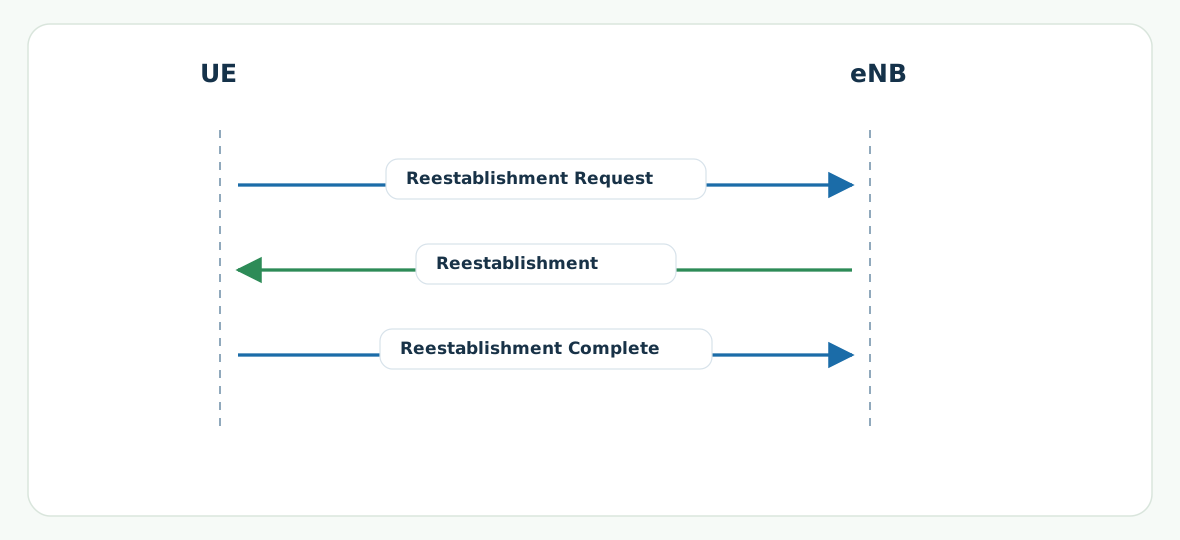
- What success looks like: The UE sends Reestablishment Request, the eNB returns Reestablishment, and the UE confirms with Reestablishment Complete.
- What failure means: The request is rejected, the restore branch does not complete, or the UE falls back to fresh access.
Why this procedure matters
This branch explains why some failures recover without a full new attach or service entry path, and why others collapse back to idle behavior.
Quick Fact Sheet
| Procedure name | LTE RRC Re-establishment Procedure |
|---|---|
| Domain | Radio recovery after connected-path failure |
| Main trigger | Radio link failure, handover-related break, or similar connected-path loss |
| Start state | UE had a connected context but the active radio path is no longer stable |
| End state | Connected radio signaling is restored or the UE falls back to another branch |
| Main nodes | UE, eNB |
| Main protocols | RRC |
| Main success outcome | Re-establishment completes and later signaling can continue |
| Main failure outcome | Re-establishment is rejected or abandoned and recovery moves elsewhere |
| Most important messages | RRC Connection Reestablishment Request, RRC Connection Reestablishment, RRC Connection Reestablishment Complete |
| Main specs | TS 36.331, TS 36.300 |
Preconditions
- The UE had a valid earlier connected context.
- The failure scenario still allows re-establishment rather than immediate fresh setup.
- The eNB can map the request to a recoverable earlier context.
Nodes and Interfaces
Nodes involved
| Node | Role in this procedure |
|---|---|
| UE | Detects the break, sends the recovery request, and confirms restore success if accepted. |
| eNB | Decides whether the earlier context can be recovered and either restores or rejects it. |
Interfaces used
| Interface or channel context | Path | Why it matters here |
|---|---|---|
| LTE Uu | UE <-> eNB | Carries the full recovery branch. |
| CCCH / DCCH transition | UE <-> eNB | Shows the move from early recovery signaling into restored dedicated control. |
End-to-End Call Flow
UE                          eNB
|                            |
|-- Reestablishment Request ->|
|                            |
|<- Reestablishment ---------|
|                            |
|-- Reestablishment Complete ->|
|                            |
|   later resumed signaling   |
Major Phases
| Phase | What happens |
|---|---|
| 1. Failure detection | The UE detects loss of the connected radio path. |
| 2. Recovery request | The UE asks the eNB to restore the earlier context. |
| 3. Context restoration | The eNB either restores the context or rejects the recovery attempt. |
| 4. Completion | The UE confirms the restored branch if recovery succeeded. |
Step-by-Step Breakdown
Step 1: Failure detected
Sender -> receiver: UE internal processing
Message(s): No RRC message yet
Purpose: Decide whether recovery through re-establishment is possible.
State or context change: The connected branch is no longer stable enough for normal continuation.
Note: This is usually the first point where radio link failure becomes operationally important.
Step 2: Reestablishment Request
Sender -> receiver: UE -> eNB
Message(s): RRC Connection Reestablishment Request
Purpose: Ask the eNB to recover the earlier radio context.
State or context change: The eNB now decides whether the request matches a recoverable connection.
Note: Cause and earlier context relation are the most useful checks.
Step 3: Reestablishment or reject
Sender -> receiver: eNB -> UE
Message(s): RRC Connection Reestablishment or RRC Connection Reestablishment Reject
Purpose: Accept or deny the recovery branch.
State or context change: The UE either moves into restoration or falls back to another recovery path.
Note: A reject usually means the earlier context was no longer usable.
Step 4: Reestablishment Complete
Sender -> receiver: UE -> eNB
Message(s): RRC Connection Reestablishment Complete
Purpose: Confirm that the recovered branch is usable.
State or context change: Later dedicated signaling can continue through the restored branch.
Note: This is the best proof that recovery succeeded formally.
Important Messages in This Flow
| Message | Protocol | Direction | Purpose in this procedure | What to inspect briefly |
|---|---|---|---|---|
| RRC Connection Reestablishment Request | RRC | UE -> eNB | Starts the recovery branch. | Failure cause and earlier context relation. |
| RRC Connection Reestablishment | RRC | eNB -> UE | Restores the radio path. | Whether the restore branch was really accepted. |
| RRC Connection Reestablishment Complete | RRC | UE -> eNB | Confirms formal recovery completion. | Completion timing and later continuation. |
| RRC Connection Reestablishment Reject | RRC | eNB -> UE | Rejects the recovery branch. | Whether the UE must move to fresh access instead. |
Important Parameters to Inspect
| Parameter | What it is | Where it appears | Why it matters | Common issues |
|---|---|---|---|---|
| Re-establishment cause | The reason the UE gives for the recovery attempt. | Reestablishment Request | Explains whether the branch is due to radio failure, handover failure, or another recovery trigger. | Wrong scenario assumption. |
| Earlier context reference | The identity relation to the lost connection. | Reestablishment Request | Lets the eNB decide whether recovery is possible. | Stale or mismatched context. |
| Completion continuity | The first later message after Reestablishment Complete. | After recovery completes | Confirms that the restored branch remained usable. | Formal recovery succeeded, but later signaling still breaks. |
Successful Completion
Success means the eNB accepts the recovery branch and the UE returns RRC Connection Reestablishment Complete with stable later signaling.
Common Failures and Troubleshooting
| Symptom | Likely cause | Where to inspect | Relevant message(s) | Relevant interface(s) | Likely next step |
|---|---|---|---|---|---|
| Request appears, but no accept returns | The earlier context is no longer recoverable. | Context relation and later fallback behavior. | Reestablishment Request | LTE Uu | Check whether the UE moved into fresh setup. |
| Reject branch appears | The network cannot restore the lost context. | Reject timing and next access branch. | Reestablishment Reject | LTE Uu | Move into fresh-access analysis. |
| Complete is missing | The UE could not finish the restored branch or uplink transport failed again. | Restore content and radio stability right after acceptance. | Reestablishment, Reestablishment Complete | LTE Uu | Treat it as incomplete recovery. |
What to Check in Logs and Traces
- Confirm that the scenario really used recovery rather than fresh setup.
- Inspect the re-establishment cause first.
- Check whether the branch ended with Reestablishment Complete or fallback to another path.
Related Pages
Related sub-procedures
Related message reference pages
- RRC Connection Reestablishment Request
- RRC Connection Reestablishment
- RRC Connection Reestablishment Complete
- RRC Connection Reestablishment Reject
Related troubleshooting pages
Notes
Re-establishment is a recovery branch, not a fresh-entry branch. The message set is the quickest way to separate the two.
FAQ
What is LTE RRC Re-establishment?
It is the radio recovery procedure used after loss of the connected path.
What confirms success?
RRC Connection Reestablishment Complete is the main success checkpoint.
What happens if recovery fails?
The UE usually falls back to another branch such as fresh setup or idle return.