LTE RRC Resume Procedure Call Flow
LTE RRC Resume is the resume-capable radio procedure used when the UE and eNB try to restore a stored suspended context instead of building a completely fresh connection. It is the shorter return path built around RRC Connection Resume Request-r13, RRC Connection Resume-r13, and RRC Connection Resume Complete-r13.
When this branch works, the UE returns to connected signaling without a full fresh setup. When it fails, the network usually falls back to a new setup path or leaves the UE in retry and recovery handling.
Introduction
The LTE RRC Resume procedure restores a previously suspended radio context in resume-capable LTE variants. It matters because it changes the access pattern, the message set, and the way paging or service return should be correlated in traces.
The main nodes are the UE and eNB. Later NAS continuation may follow after the resume completes, but the core decision in this page is whether the radio context was restored cleanly.
What Is LTE RRC Resume in Simple Terms?
- What starts the procedure: The UE has a stored suspended context and the network chooses resume instead of a fresh setup.
- What the UE and network want to achieve: Restore connected signaling quickly using the previously suspended context.
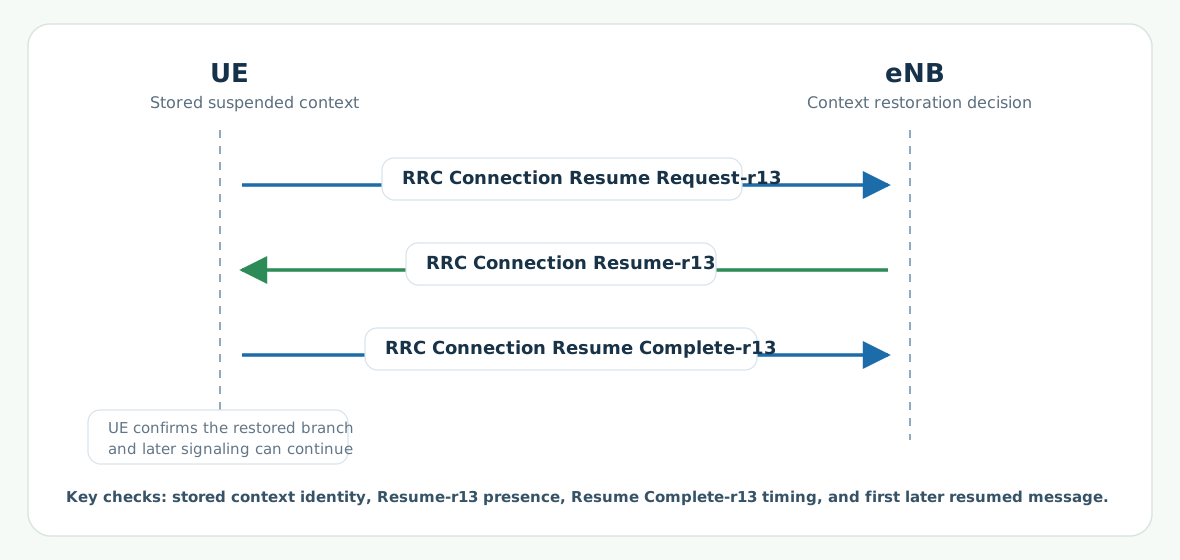
- What success looks like: The UE sends Resume Request, the eNB returns Resume, and the UE confirms with Resume Complete.
- What failure means: The context cannot be restored, the branch is rejected, or the procedure falls back to a new setup attempt.
Why this procedure matters
This branch explains why some LTE returns from idle do not use the full new-setup message sequence. It also explains why later service analysis can look wrong if the trace is interpreted as a fresh setup attempt.
Quick Fact Sheet
| Procedure name | LTE RRC Resume Procedure |
|---|---|
| Domain | Resume-capable LTE radio context restoration |
| Main trigger | Paging, service return, or later signaling with a usable suspended context |
| Start state | UE has a suspended radio context and is outside active connected signaling |
| End state | Suspended context is restored and later dedicated signaling can continue |
| Main nodes | UE, eNB |
| Main protocols | RRC |
| Main success outcome | Resume completes without a fresh full setup |
| Main failure outcome | Resume fails and the flow falls back to setup, reject, or recovery handling |
| Most important messages | RRC Connection Resume Request-r13, RRC Connection Resume-r13, RRC Connection Resume Complete-r13 |
| Main specs | TS 36.331, TS 36.300 |
Preconditions
- A suspended context exists and is still usable for the UE and eNB.
- The scenario allows resume instead of forcing a full fresh setup.
- The UE has enough stored context to build the resume request correctly.
- Radio conditions are stable enough for the restore sequence to finish.
Nodes involved
| Node | Role in this procedure |
|---|---|
| UE | Starts the resume request using the stored suspended context and confirms completion if the context is restored. |
| eNB | Checks whether the stored context can be resumed and either restores it or pushes the flow into fallback handling. |
Interfaces used
| Interface or channel context | Path | Why it matters here |
|---|---|---|
| LTE Uu | UE <-> eNB | Carries the resume request, acceptance, and completion. |
| CCCH / DCCH transition | UE <-> eNB | Shows the move from early resume signaling into restored dedicated signaling. |
End-to-end call flow
UE                          eNB
|                            |
|-- Resume Request-r13 ----->|
|                            |
|<- Connection Resume-r13 ---|
|                            |
|-- Resume Complete-r13 ---->|
|                            |
|   later resumed signaling  |
Major phases
| Phase | What happens |
|---|---|
| 1. Resume trigger | The UE returns using a stored suspended context. |
| 2. Resume request | The UE identifies the resume branch with the stored context reference. |
| 3. Context restoration | The eNB accepts the branch and restores the radio-side context. |
| 4. Completion | The UE confirms the resume so later signaling can continue. |
Step-by-step breakdown
Step 1: Resume trigger
Sender -> receiver: UE internal trigger
Message(s): No RRC message yet
Purpose: Choose the resume branch instead of a fresh new setup.
State or context change: UE prepares to use the stored suspended context.
Note: This branch should be interpreted differently from fresh RRC Connection Setup.
Step 2: Resume Request
Sender -> receiver: UE -> eNB
Message(s): RRC Connection Resume Request-r13
Purpose: Ask the eNB to restore the suspended context.
State or context change: The eNB evaluates whether the stored context is still valid.
Note: Resume identity and context validity are the highest-value checks here.
Step 3: Resume acceptance
Sender -> receiver: eNB -> UE
Message(s): RRC Connection Resume-r13
Purpose: Restore the suspended radio-side context.
State or context change: The UE moves into restored dedicated signaling instead of a fresh new setup state.
Note: If this message is absent, the resume branch never succeeded.
Step 4: Resume Complete
Sender -> receiver: UE -> eNB
Message(s): RRC Connection Resume Complete-r13
Purpose: Confirm that the restored context is usable.
State or context change: The resumed branch is formally complete and later signaling can continue.
Note: This message is the strongest proof that resume really finished.
Important messages
| Message | Protocol | Direction | Purpose in this procedure | What to inspect briefly |
|---|---|---|---|---|
| RRC Connection Resume Request-r13 | RRC | UE -> eNB | Starts the resume branch. | Stored context reference and whether resume is appropriate for the scenario. |
| RRC Connection Resume-r13 | RRC | eNB -> UE | Accepts and restores the suspended context. | Whether the network actually chose resume instead of fallback. |
| RRC Connection Resume Complete-r13 | RRC | UE -> eNB | Confirms the restored branch completed cleanly. | Completion timing and whether later resumed signaling follows. |
Important parameters to inspect
| Parameter | What it is | Where it appears | Why it matters | Common issues |
|---|---|---|---|---|
| Resume identity | The stored context identity used to ask for resume. | Resume Request-r13 | Shows which earlier suspended context the UE is trying to restore. | Stale identity, context mismatch, merged attempts. |
| Transaction timing | The timing across request, resume, and complete. | Whole resume exchange | Shows whether the branch progressed cleanly. | Long gaps, missing complete, fallback hidden by capture gaps. |
| Restored context continuity | The first later signaling after resume completion. | Immediately after Resume Complete-r13 | Confirms whether the restored branch stayed usable. | Completion present but later immediate fallback or failure. |
| Serving cell relation | The cell context around suspend and resume. | Before and during resume | Helps explain whether the suspended context still matches the return path. | Cell change, stale cell assumption, wrong-trace correlation. |
Successful completion of the procedure
A successful resume ends with RRC Connection Resume Complete-r13 and stable later dedicated signaling. The radio branch resumes without forcing a brand-new full setup.
Common failures in LTE RRC Resume
| Symptom | Likely cause | Where to inspect | Relevant message(s) | Relevant interface(s) | Likely next step |
|---|---|---|---|---|---|
| Resume Request appears, but no Resume comes back | Stored context is no longer usable or the network chooses another branch. | Context validity and later fallback behavior. | Resume Request-r13 | LTE Uu | Check whether the flow falls back to fresh setup. |
| Resume arrives, but no Resume Complete follows | The UE could not apply the restored context or the uplink side broke again. | Resume content and later radio behavior. | Resume-r13, Resume Complete-r13 | LTE Uu | Treat it as incomplete context restoration. |
| Resume seems successful, but service still fails | The radio branch resumed, but the later procedure failed for another reason. | First resumed NAS or RRC message after completion. | Resume Complete-r13 and next message | LTE Uu and later relevant interface | Move analysis forward instead of re-debugging the request stage. |
What to check in logs and traces
- Confirm the trace really shows a resume branch and not fresh setup.
- Check the stored context identity in Resume Request-r13.
- Verify that Resume-r13 is followed by Resume Complete-r13.
- Use the first later message after Resume Complete-r13 to confirm stable continuation.
Related Pages
Related sub-procedures
Related message reference pages
Related troubleshooting pages
Notes
Resume and fresh setup are different radio branches. The quickest way to separate them is the message set itself.
If Resume Complete-r13 is present, the resume branch finished formally and the next check should move forward into later signaling.
FAQ
What is LTE RRC Resume?
It is the branch that restores a stored suspended context instead of building a completely fresh connected context.
Which message starts the procedure?
RRC Connection Resume Request-r13 starts the branch.
What confirms success?
RRC Connection Resume Complete-r13 is the practical success checkpoint.
What usually happens on failure?
The flow falls back to fresh setup, reject handling, or another recovery branch.