LTE SCG Failure Recovery Call Flow
LTE SCG Failure Recovery is the recovery path used after the secondary cell group fails while the master side is still present.
The main trace anchors are SCG Failure Information r12, SCG Failure Information NR r15, and the follow-on reconfiguration or release behavior that decides whether the branch is recovered or removed.
Introduction
This procedure begins only after an SCG-capable context already existed. The UE reports the secondary-branch failure, and the master side decides whether to recover that branch, change it, or remove it.
The practical trace question is whether the branch failed because of the secondary side itself, because of an NR secondary branch under LTE master control, or because the wider master connection was already unstable.
What Is LTE SCG Failure Recovery in Simple Terms?
- What starts the procedure: The UE detects failure on the secondary cell group after advanced connected-mode behavior was already active.
- What the UE and network want to achieve: Keep the master connection alive while recovering or cleanly removing the failed secondary branch.
- What success looks like: The branch is recovered or removed without losing the whole master connection.
- What failure means: The branch remains unstable, recovery loops, or the wider connection degrades further.
Why this procedure matters
SCG recovery is one of the main places where advanced LTE traces become hard to read. The master link may look fine while the secondary branch repeatedly fails and reshapes the user experience underneath.
Quick Fact Sheet
| Procedure name | LTE SCG Failure Recovery |
|---|---|
| Domain | Secondary branch recovery |
| Main trigger | UE reports SCG failure after dual-connectivity or related advanced branch use |
| Start state | Master connection is active and a secondary branch has failed |
| End state | Secondary branch is recovered, reconfigured, or released |
| Main nodes | UE, MeNB, SeNB |
| Main protocols | RRC, inter-node coordination |
| Main success outcome | Master connection survives and the failed branch is handled cleanly |
| Main failure outcome | Branch instability repeats or spreads into wider service impact |
| Most important messages | SCG Failure Information, RRC Connection Reconfiguration, RRC Connection Reconfiguration Complete |
| Main specs | TS 36.331, TS 36.300 |
Preconditions
- A secondary branch was active earlier in the trace.
- The UE can still report the failure to the master side.
- The master connection remains available long enough for recovery or release action.
Nodes and Interfaces
Nodes involved
| Node | Role in this procedure |
|---|---|
| UE | Maintains the master LTE connection and applies the added or changed secondary branch configuration. |
| MeNB / master eNB | Keeps the main LTE control anchor and decides when the secondary branch is added, changed, recovered, or removed. |
| SeNB / secondary node | Provides the secondary cell group resources used for extra throughput, split bearer handling, or EN-DC continuation. |
| Core transport | Carries the user-plane or control continuation behind bearer movement and branch release. |
Interfaces used
| Interface | Path | Role |
|---|---|---|
| LTE Uu | UE <-> MeNB / SeNB | Carries the LTE radio-control and user-plane behavior seen by the UE. |
| X2 / inter-node | MeNB <-> SeNB | Carries secondary-node preparation, coordination, and release handling. |
| S1-U / transport | eNB side <-> EPC | Carries the user-plane continuation behind bearer distribution and release. |
End-to-End Call Flow
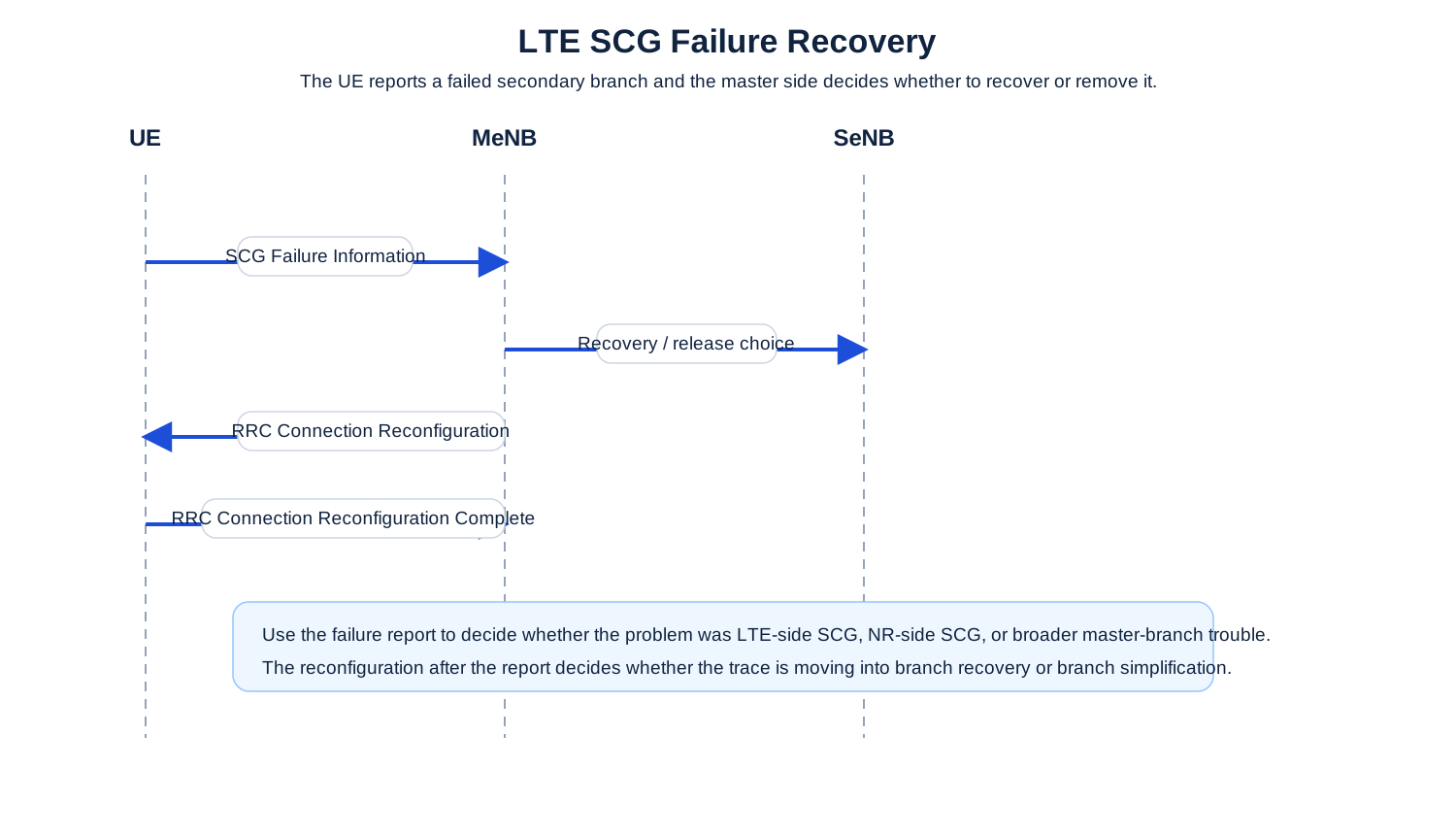
UE                  MeNB                  SeNB
|--SCG Failure------>|                        |
|                    |--recovery / release-->|
|<--RRC Reconfig-----|                        |
|--Reconfig Complete>|                        |
Major Phases
| Phase | What happens |
|---|---|
| 1. Detect and report failure | The UE detects that the secondary branch failed and reports it to the master side. |
| 2. Choose the recovery branch | The master side decides whether to recover, reconfigure, or release the branch. |
| 3. Apply the recovery action | The UE receives the connected-mode update that reflects the recovery decision. |
| 4. Validate the outcome | The trace shows either stable fallback, successful branch return, or repeated failure. |
Step-by-Step Breakdown
Report the failed secondary branch
Sender -> receiver: UE -> MeNB
Message(s): SCG Failure Information r12 or SCG Failure Information NR r15
Purpose: Expose the secondary-branch failure to the master side so the next action can be chosen.
State or context change: The connection is now in a branch-recovery state rather than in normal multi-branch continuation.
Note: This report is the main line between ordinary DC use and explicit SCG recovery handling.
Decide the recovery path
Sender -> receiver: MeNB -> SeNB / internal handling
Message(s): Recovery, branch change, or release decision
Purpose: Choose whether the failed branch should be rebuilt, changed, or removed.
State or context change: The network now has a specific response to the reported secondary-branch problem.
Note: Without this decision point, later reconfiguration can be hard to interpret.
Deliver the chosen action
Sender -> receiver: MeNB -> UE
Message(s): RRC Connection Reconfiguration
Purpose: Tell the UE how to continue after the secondary-branch failure.
State or context change: The UE moves toward recovered branch use or master-only fallback.
Note: The same reconfiguration container can mean recovery, simplification, or release depending on context.
Confirm the new state
Sender -> receiver: UE -> MeNB
Message(s): RRC Connection Reconfiguration Complete
Purpose: Confirm the UE applied the recovery or release action.
State or context change: The connection now continues in its post-failure branch design.
Note: If instability continues immediately, the branch probably was not truly recovered.
Important Messages
| Message | Protocol | Direction | Purpose in this procedure | What to inspect briefly |
|---|---|---|---|---|
| SCG Failure Information r12 | RRC | UE -> MeNB | Reports LTE-side secondary branch failure. | Check the failure type and the exact advanced branch context that existed just before it. |
| SCG Failure Information NR r15 | RRC | UE -> MeNB | Reports NR-side secondary branch failure under LTE master control. | Check whether the failure belongs to the NR secondary side rather than to LTE-only SCG context. |
| RRC Connection Reconfiguration | RRC | MeNB -> UE | Carries the chosen recovery, simplification, or release action. | Check whether the post-failure action rebuilt the branch or removed it. |
| MCG Failure Information r16 | RRC | UE -> MeNB | Useful contrast when the issue is broader than SCG-only failure. | Check whether the trace also shows master-side failure and not only secondary-branch trouble. |
Important Parameters to Inspect
| Parameter | What it is | Where it appears | Why it matters | Common issues |
|---|---|---|---|---|
| Failure family | Whether the failed branch is LTE-side SCG, NR-side SCG, or broader MCG behavior. | Failure report | Keeps recovery analysis on the correct branch family. | The wrong branch is recovered because the failure family was misread. |
| Pre-failure branch state | The exact branch design that existed before the report. | Immediately before failure reporting | Explains what the network is trying to recover or remove. | The branch is treated as if it had already changed before the failure. |
| Recovery action type | Whether the network tried branch rebuild, branch simplification, or full release. | Post-failure reconfiguration | Explains the meaning of the follow-on reconfiguration. | A release action is misread as a recovery action or the reverse. |
| Post-recovery stability | Whether the new state held after recovery or fallback. | After reconfiguration complete | Shows whether the branch problem was really resolved. | The trace stops before proving whether recovery actually worked. |
| Master-link continuity | Whether the master branch stayed healthy during SCG recovery. | Across the whole recovery window | Separates SCG-only failure from broader connection collapse. | A master-link issue is hidden under SCG-only analysis. |
Successful Completion
Success means the SCG failure is handled without losing the whole master connection, either by stable recovery or by clean fallback to a simpler branch design.
Common Failures and Troubleshooting
| Symptom | Likely cause | Where to inspect | Relevant message(s) | Relevant interface(s) | Likely next step |
|---|---|---|---|---|---|
| Recovery action is sent but failure repeats quickly | The branch problem was not truly corrected, or the wrong branch family was targeted. | Failure report type, reconfiguration intent, and the next stability window. | SCG Failure Information r12, SCG Failure Information NR r15, RRC Connection Reconfiguration | LTE Uu | Check whether the next failure matches the same branch or a newly changed one. |
| SCG recovery looks reasonable but service still collapses | The master side may also be unstable, or the bearer path may not tolerate the fallback. | MCG signs, bearer behavior, and the full post-failure period. | MCG Failure Information r16, later reconfiguration | LTE Uu, transport | Expand the analysis beyond SCG-only recovery. |
What to Check in Logs and Traces
- Use the first failure report as the recovery anchor.
- Separate LTE-side SCG failure, NR-side SCG failure, and master-side failure before reading the follow-on action.
- Check whether the post-recovery state really held after reconfiguration complete.
Related Pages
Related sub-procedures
Related message reference pages
Related troubleshooting pages
Notes
SCG recovery should always be read together with the pre-failure branch design. Without that context, the recovery action is easy to misclassify.
FAQ
What starts LTE SCG Failure Recovery?
It starts when the UE reports that the secondary branch failed while the master side is still present.
Does SCG failure always mean the whole LTE connection is lost?
No. Many traces keep the master connection alive and only recover or remove the secondary branch.