LTE SMS over IMS in LTE Call Flow
LTE SMS over IMS is the messaging procedure used when SMS service is carried through the IMS path instead of a legacy SMS path.
This page focuses on the SIP transaction used for IMS-based SMS delivery over LTE and how it relates to IMS registration and service availability.
Introduction
SMS over IMS usually depends on successful IMS registration first. The actual message transaction is then carried through SIP, typically using MESSAGE and the related success or failure responses.
The main nodes are the UE and the IMS path, with LTE access and packet service supporting that SIP transaction underneath.
What Is SMS over IMS in LTE in Simple Terms?
- What starts the procedure: The UE or network needs to send an SMS while IMS service is active over LTE.
- What the UE and network want to achieve: Deliver the SMS through the IMS path instead of a legacy SMS route.
- What success looks like: The MESSAGE transaction is accepted and the IMS SMS service completes cleanly.
- What failure means: IMS SMS service is unavailable, rejected, or incorrectly routed.
Why this procedure matters
SMS over IMS can fail even when LTE data works, so this page helps separate IMS messaging issues from generic LTE access problems.
Quick Fact Sheet
| Procedure name | LTE SMS over IMS in LTE |
|---|---|
| Domain | IMS messaging over LTE |
| Main trigger | An SMS is sent or received through IMS service |
| Start state | IMS registration and LTE packet service are already active |
| End state | IMS SMS transaction completes successfully |
| Main nodes | UE, IMS |
| Main protocols | SIP, IMS SMS signaling |
| Main success outcome | SMS is delivered through the IMS path |
| Main failure outcome | SMS over IMS fails or falls back incorrectly |
| Most important messages | MESSAGE, 200 OK |
| Main specs | TS 24.341, TS 24.229 |
Preconditions
- The UE is IMS-registered over LTE.
- SMS over IMS service is provisioned in the network.
- The IMS packet path is stable at the time of the message transaction.
Nodes and Interfaces
Nodes involved
| Node | Role in this procedure |
|---|---|
| UE | Starts or receives the LTE voice or messaging service and exchanges SIP signaling with IMS. |
| eNB | Carries the LTE radio side used for IMS-capable packet service. |
| MME / EPC | Preserve LTE access, bearer, and paging continuity behind the IMS transaction. |
| P-CSCF / S-CSCF | Handle the SIP signaling path used for registration, call control, and service continuity. |
Interfaces used
| Interface | Path | Role |
|---|---|---|
| LTE Uu | UE <-> eNB | Carries the radio access needed before and during IMS service use. |
| S1-MME | eNB <-> MME | Carries LTE control-plane continuation behind paging, service request, or bearer handling. |
| Gm | UE <-> P-CSCF | Carries SIP requests and responses between the UE and IMS. |
End-to-End Call Flow
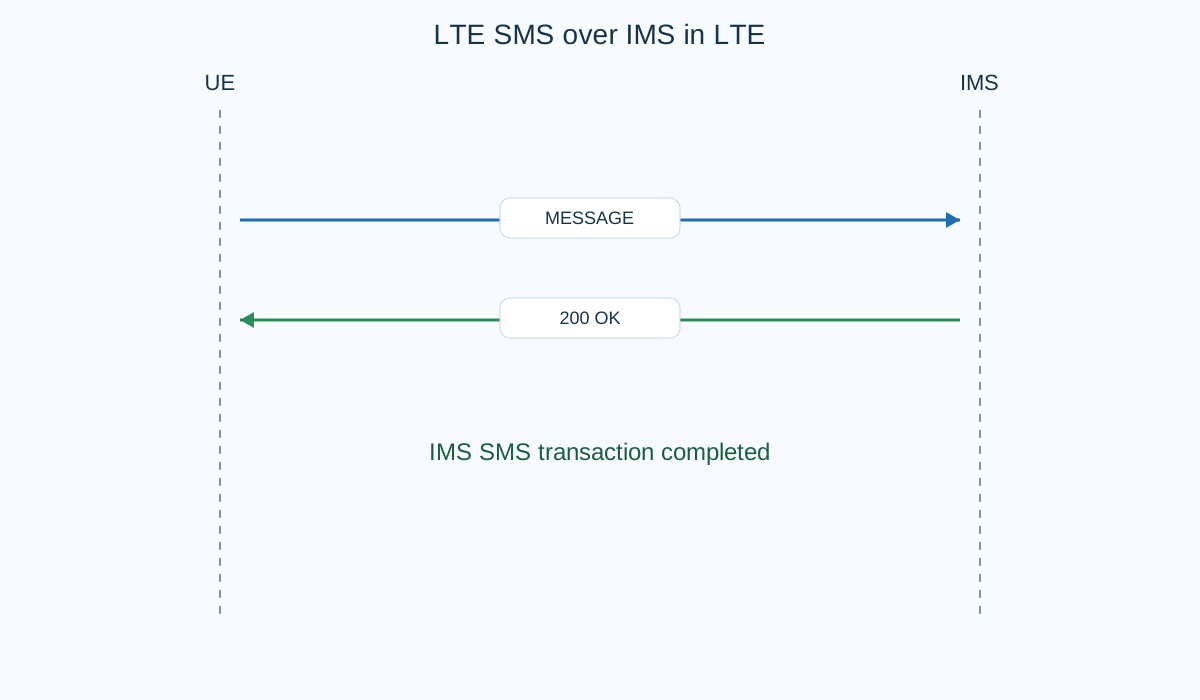
UE                 IMS
|--MESSAGE----------------------->|
|<--200 OK------------------------|
|   IMS SMS transaction complete  |
Major Phases
| Phase | What happens |
|---|---|
| 1. IMS SMS readiness | IMS registration and SMS capability are already active. |
| 2. MESSAGE transaction | The SMS payload is sent through the SIP messaging path. |
| 3. Final response | IMS confirms success or returns a failure response. |
| 4. Service completion | The IMS SMS procedure ends or moves to failure handling. |
Step-by-Step Breakdown
Step 1: Start the IMS SMS transaction
Sender -> receiver: UE or IMS -> other side
Message(s): MESSAGE
Purpose: Carry the SMS transaction through the IMS path.
State or context change: IMS now handles the SMS exchange as a messaging service rather than a voice dialog.
Note: Use MESSAGE as the main pivot when SMS service works inconsistently over LTE.
Step 2: Confirm or reject the SMS transaction
Sender -> receiver: IMS -> UE or peer
Message(s): 200 OK or failure response
Purpose: Show whether the IMS SMS transaction was accepted.
State or context change: The SMS over IMS attempt is now known to be successful or failed.
Note: A clean MESSAGE / 200 OK pair is the basic success pattern for IMS SMS delivery.
Important Messages
| Message | Protocol | Direction | Purpose in this procedure | What to inspect briefly |
|---|---|---|---|---|
| MESSAGE | SIP | UE or IMS -> other side | Carries the IMS SMS transaction. | Check destination identity, transaction timing, and whether the IMS SMS path was actually used. |
| 200 OK | SIP | Other side -> requester | Confirms successful IMS SMS transaction handling. | Check whether the success response follows the correct MESSAGE transaction. |
| 404 Not Found | SIP | IMS -> requester | Useful failure response when the destination or service route cannot be found. | Check whether the destination identity or IMS routing is wrong. |
| 480 Temporarily Unavailable | SIP | IMS -> requester | Useful failure response when the IMS destination or service is temporarily unreachable. | Check whether the destination service is reachable at transaction time. |
Important Parameters to Inspect
| Parameter | What it is | Where it appears | Why it matters | Common issues |
|---|---|---|---|---|
| Destination identity | The SMS target identity. | MESSAGE | Explains where the message is being routed. | Wrong target causes routing failure. |
| IMS registration state | Whether the UE was correctly IMS-registered before the SMS attempt. | Before MESSAGE | SMS over IMS often fails when the registration state is incomplete. | LTE data works, but IMS registration was not stable. |
| Transaction result | The final SIP response to the message transaction. | 200 OK or failure response | Shows whether the transaction was accepted, not found, or temporarily unavailable. | The MESSAGE is sent, but the real result is not checked. |
| Service routing | The IMS path used for SMS service. | MESSAGE and response path | Useful when SMS is misrouted or unexpectedly falls back. | The message uses the wrong service path. |
| Timing and retransmission behavior | The transaction timing around MESSAGE and its response. | SIP ladder | Important when SMS delivery feels delayed or inconsistent. | Repeated MESSAGE attempts are mistaken for multiple user actions. |
Successful Completion
Success means the IMS MESSAGE transaction completes cleanly and the SMS is delivered through the IMS service path.
Common Failures and Troubleshooting
| Symptom | Likely cause | Where to inspect | Relevant message(s) | Relevant interface(s) | Likely next step |
|---|---|---|---|---|---|
| MESSAGE gets no clean success response | IMS messaging path, registration state, or service routing is broken. | MESSAGE and the final SIP response. | MESSAGE, 200 OK, 404 Not Found, 480 Temporarily Unavailable | Gm | Check IMS registration and routing before assuming general LTE failure. |
| SMS falls back unexpectedly | IMS SMS service is not available even though LTE packet service works. | Registration state and the transaction result. | MESSAGE and returned failure response | Gm | Decide whether the problem is service provisioning or IMS reachability. |
| Repeated SMS attempts appear in traces | Retransmission or retry behavior is being confused with separate user actions. | Transaction timing and repeated MESSAGE use. | MESSAGE | Gm | Correlate transaction timing before counting separate attempts. |
What to Check in Logs and Traces
- Confirm IMS registration before troubleshooting the SMS transaction itself.
- Use the MESSAGE / response pair as the main SMS over IMS correlation point.
- Separate IMS SMS routing failures from LTE packet-connectivity failures.
Related Pages
Related sub-procedures
Related message reference pages
Related troubleshooting pages
Notes
SMS over IMS uses the IMS service path rather than a classic voice dialog, so it should be analyzed as an IMS messaging transaction, not as a reduced VoLTE call.
FAQ
What SIP method is used for SMS over IMS?
MESSAGE is the main SIP method used for the IMS SMS transaction.
Can SMS over IMS fail while LTE data still works?
Yes. LTE packet service may be healthy while IMS registration, routing, or IMS messaging service is still broken.