LTE UE Capability Transfer Procedure Call Flow
LTE UE Capability Transfer is the connected-mode RRC procedure used when the eNB needs the UE to report its radio capability information before later control decisions such as configuration, bearer setup, carrier aggregation, or mobility-related behavior.
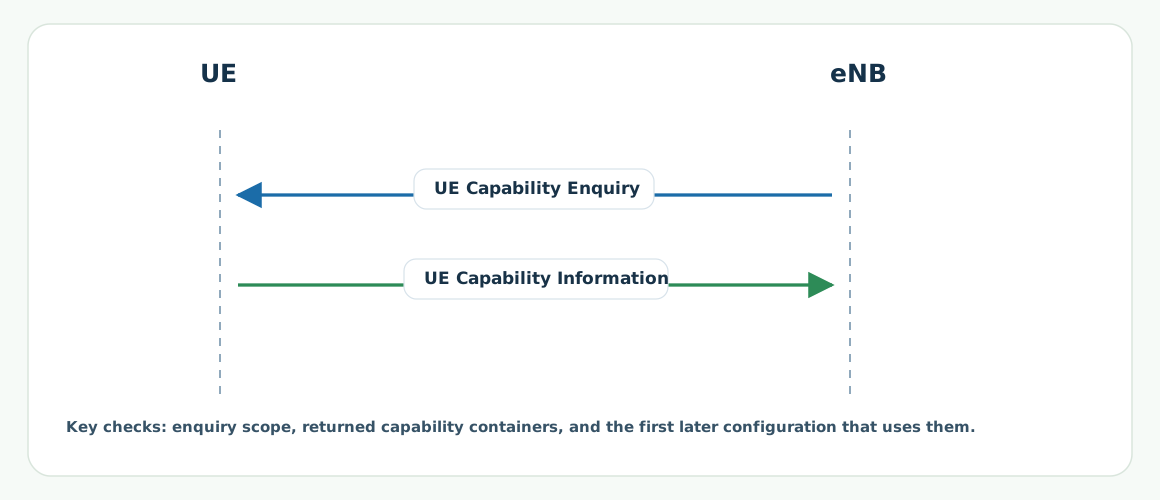
The core message pair is UE Capability Enquiry followed by UE Capability Information.
Introduction
The LTE UE Capability Transfer procedure does not create access or registration by itself. It gives the network the information needed to decide what the UE can actually support before later configuration is pushed.
The main nodes are UE and eNB. The procedure matters because a later configuration failure can begin with wrong, missing, or misread capability information here.
What Is LTE UE Capability Transfer in Simple Terms?
- What starts the procedure: The eNB needs the UE's capability information before later radio decisions.
- What the UE and network want to achieve: Report the supported features accurately so the network configures only what the UE can handle.
- What success looks like: The eNB sends UE Capability Enquiry and the UE returns UE Capability Information.
- What failure means: Capability reporting is missing, incomplete, or later configuration assumes support that was not really present.
Why this procedure matters
This is the reference point behind many later feature-dependent LTE behaviors, especially when configuration looks valid but still fails at the UE side.
Quick Fact Sheet
| Procedure name | LTE UE Capability Transfer Procedure |
|---|---|
| Domain | Connected-mode LTE capability signaling |
| Main trigger | eNB needs UE capability information before later control decisions |
| Start state | UE is already in connected signaling and can exchange dedicated RRC messages |
| End state | eNB has the UE capability report needed for later configuration |
| Main nodes | UE, eNB |
| Main protocols | RRC |
| Main success outcome | The network receives usable capability containers and can continue with capability-aware control |
| Main failure outcome | Later configuration uses wrong assumptions or the capability report is incomplete |
| Most important messages | UE Capability Enquiry, UE Capability Information |
| Main specs | TS 36.331 |
Preconditions
- The UE is already in connected mode and can exchange dedicated RRC messages.
- The eNB has a reason to validate or refresh capability information.
- The UE can build the capability containers requested by the network.
Nodes involved
| Node | Role in this procedure |
|---|---|
| UE | Returns the requested capability information. |
| eNB | Requests and consumes the capability report for later control decisions. |
Interfaces used
| Interface or channel context | Path | Why it matters here |
|---|---|---|
| LTE Uu | UE <-> eNB | Carries the dedicated RRC exchange. |
| DCCH / SRB1 | UE <-> eNB | Provides the connected signaling path used for enquiry and report. |
End-to-end call flow
UE                          eNB
|                            |
|<- UE Capability Enquiry ---|
|                            |
|-- UE Capability Information ->|
|                            |
|   later configuration uses capability result   |
Major phases
| Phase | What happens |
|---|---|
| 1. Network requests report | The eNB asks for the UE capability information it needs. |
| 2. UE builds response | The UE composes the requested capability containers. |
| 3. Capability delivery | The report reaches the eNB for later control use. |
Step-by-step breakdown
Step 1: UE Capability Enquiry
Sender -> receiver: eNB -> UE
Message(s): UE Capability Enquiry
Purpose: Ask the UE for capability information needed before later configuration.
State or context change: The UE knows which capability report the network expects.
Note: The enquiry content explains why later capability exchange appears at that moment.
Step 2: UE Capability Information
Sender -> receiver: UE -> eNB
Message(s): UE Capability Information
Purpose: Return the supported capability containers to the eNB.
State or context change: The eNB can now continue with capability-dependent control decisions.
Note: Later reconfiguration should be read against this message, not in isolation.
Important messages
| Message | Protocol | Direction | Purpose in this procedure | What to inspect briefly |
|---|---|---|---|---|
| UE Capability Enquiry | RRC | eNB -> UE | Requests the UE capability report. | Requested RAT or capability scope and timing within the larger procedure. |
| UE Capability Information | RRC | UE -> eNB | Returns the actual capability containers. | Container presence and whether later configuration matches the reported support. |
Important parameters to inspect
| Parameter | What it is | Where it appears | Why it matters | Common issues |
|---|---|---|---|---|
| Requested scope | The capability area the eNB wants to learn about. | UE Capability Enquiry | Explains why the network requested the report. | Enquiry too narrow for later feature use. |
| Capability containers | The actual reported capability data. | UE Capability Information | Forms the basis of later network decisions. | Missing container, decode gap, unexpected omission. |
| Transaction pairing | The relation between enquiry and information response. | Both messages | Confirms the right report belongs to the right request. | Merged attempts or wrong pairing in long traces. |
| Later configuration relation | The first feature-dependent action taken after the report. | After UE Capability Information | Shows whether the network used the report correctly. | Later configuration assumes unsupported feature. |
Successful completion of the procedure
Success means the capability report reached the eNB and the later LTE control decision is consistent with what the UE actually reported.
Common failures in LTE UE Capability Transfer
| Symptom | Likely cause | Where to inspect | Relevant message(s) | Relevant interface(s) | Likely next step |
|---|---|---|---|---|---|
| Later configuration fails unexpectedly | The network used capability assumptions that do not match the report. | UE Capability Information and later reconfiguration together. | UE Capability Information | LTE Uu | Check whether the feature was really declared as supported. |
| Capability report seems incomplete | Missing container, narrow enquiry, or decode limitation. | Enquiry scope and returned containers. | UE Capability Enquiry, UE Capability Information | LTE Uu | Decide whether the report is truly incomplete or only partially decoded. |
What to check in logs and traces
- Pair the enquiry and information messages correctly.
- Inspect which capability containers were actually present.
- Compare the report with the next configuration or feature action.
Related Pages
Related sub-procedures
Related message reference pages
Related troubleshooting pages
Notes
This procedure is easy to underestimate because it is short. Many later feature and bearer problems only make sense when the capability report is read first.
FAQ
What is LTE UE Capability Transfer?
It is the RRC procedure used to request and return the UE's radio capability information.
Which message starts it?
UE Capability Enquiry starts the exchange.
Why is it important?
Because later LTE configuration depends on what the UE reported here.