LTE VoLTE Mobile Originated Call Procedure Call Flow
LTE VoLTE mobile originated call is the end-to-end procedure used when the UE places a voice call over IMS while already attached to LTE.
This page connects the LTE access state, IMS dialog setup, and the voice-specific bearer branch so the full originating call path can be read in one place.
Introduction
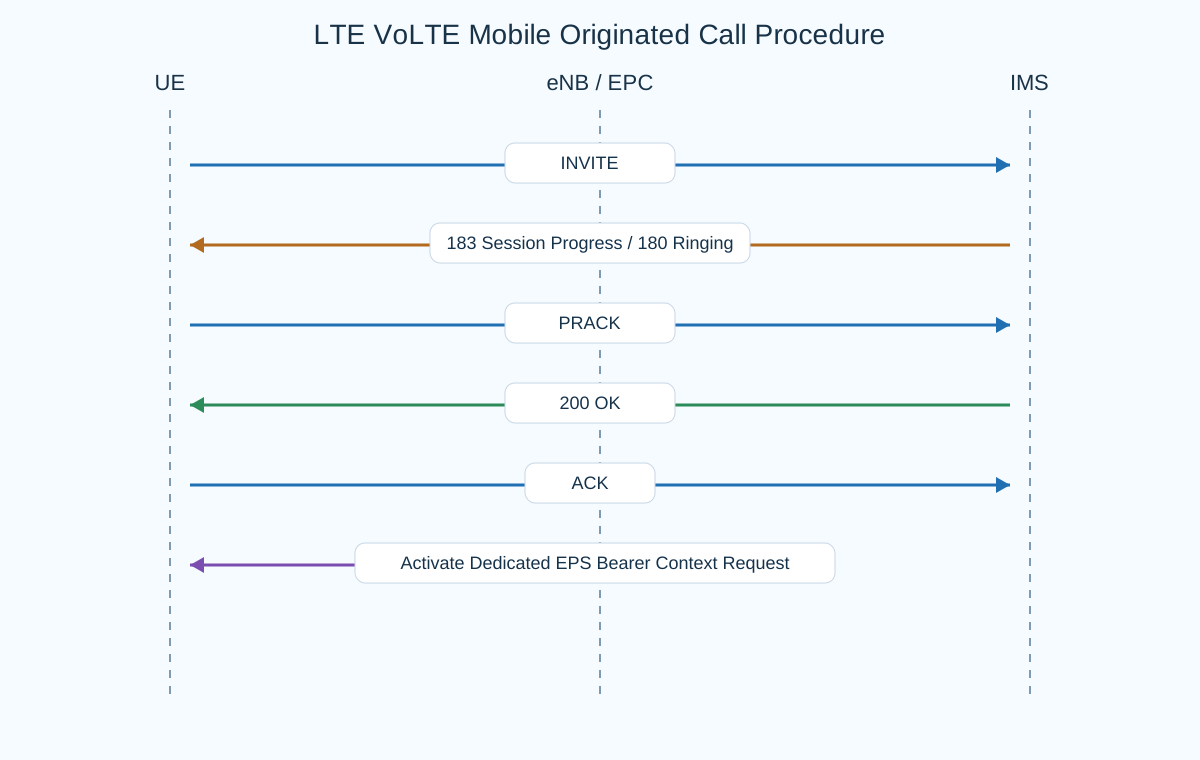
The call usually starts when the UE is already IMS-registered and can send INVITE directly over LTE. IMS returns the normal provisional and final responses, while the LTE side may add the dedicated voice bearer through Activate Dedicated EPS Bearer Context Request.
The main nodes are the UE, eNB, MME / EPC, and the IMS path.
What Is VoLTE Mobile Originated Call Procedure in Simple Terms?
- What starts the procedure: The UE user starts a VoLTE call while IMS registration is already active.
- What the UE and network want to achieve: Create a successful SIP dialog and bring up the bearer context needed for voice service.
- What success looks like: The INVITE ladder succeeds, the voice bearer is ready, and the call enters active state.
- What failure means: The call attempt stops in SIP setup, bearer setup, or early call continuity handling.
Why this procedure matters
This is the most direct VoLTE call flow for correlating IMS signaling with the LTE bearer and access context behind a user-originated call.
Quick Fact Sheet
| Procedure name | LTE VoLTE Mobile Originated Call Procedure |
|---|---|
| Domain | Originating VoLTE call setup |
| Main trigger | UE user starts a voice call over IMS |
| Start state | UE is LTE-attached and IMS-registered |
| End state | Voice call is established over LTE |
| Main nodes | UE, eNB, MME / EPC, IMS |
| Main protocols | SIP, NAS, LTE bearer support |
| Main success outcome | Originating VoLTE call reaches stable active state |
| Main failure outcome | Call fails before stable voice service begins |
| Most important messages | INVITE, 183 Session Progress, 200 OK, ACK, dedicated bearer activation |
| Main specs | TS 24.229, TS 23.228, TS 24.301 |
Preconditions
- The UE is attached to LTE and IMS-registered.
- IMS reachability and policy allow voice service.
- The default bearer is already active before the call starts.
Nodes and Interfaces
Nodes involved
| Node | Role in this procedure |
|---|---|
| UE | Starts or receives the LTE voice or messaging service and exchanges SIP signaling with IMS. |
| eNB | Carries the LTE radio side used for IMS-capable packet service. |
| MME / EPC | Preserve LTE access, bearer, and paging continuity behind the IMS transaction. |
| P-CSCF / S-CSCF | Handle the SIP signaling path used for registration, call control, and service continuity. |
Interfaces used
| Interface | Path | Role |
|---|---|---|
| LTE Uu | UE <-> eNB | Carries the radio access needed before and during IMS service use. |
| S1-MME | eNB <-> MME | Carries LTE control-plane continuation behind paging, service request, or bearer handling. |
| Gm | UE <-> P-CSCF | Carries SIP requests and responses between the UE and IMS. |
End-to-End Call Flow
UE          EPC / eNB          IMS
|--INVITE------------------------>|
|<-183 Session Progress----------|
|--PRACK------------------------->|
|<-200 OK------------------------|
|--ACK--------------------------->|
|<-Dedicated Bearer Request------|
Major Phases
| Phase | What happens |
|---|---|
| 1. Call start | The user starts the voice call and the UE sends INVITE. |
| 2. SIP progress | IMS returns provisional call progress. |
| 3. Session confirmation | The call reaches final SIP success and ACK. |
| 4. Voice bearer readiness | The LTE side confirms the bearer context expected for the voice session. |
Step-by-Step Breakdown
Step 1: Start the originating call
Sender -> receiver: UE -> IMS
Message(s): INVITE
Purpose: Begin the VoLTE call from the UE side.
State or context change: IMS starts call routing and session setup.
Note: This is the top correlation point for a user-originated call attempt.
Step 2: Follow call progress
Sender -> receiver: IMS -> UE
Message(s): 100 Trying, 180 Ringing, 183 Session Progress
Purpose: Show that the call is progressing inside IMS.
State or context change: The call exists but has not yet reached final establishment.
Note: 183 often marks the point where early media or pre-answer voice handling becomes visible.
Step 3: Confirm the session
Sender -> receiver: IMS -> UE and UE -> IMS
Purpose: Confirm the successful voice dialog.
State or context change: The SIP session is established and the call can move into active media service.
Note: A 200 OK without the matching ACK is not a clean final success.
Step 4: Add the voice bearer branch
Sender -> receiver: Network -> UE
Message(s): Activate Dedicated EPS Bearer Context Request
Purpose: Add the dedicated bearer used for the voice-media path when required.
State or context change: The call now has the LTE bearer context expected for voice service.
Note: If SIP succeeds but the voice bearer never appears, the call may still sound like a failure to the user.
Important Messages
| Message | Protocol | Direction | Purpose in this procedure | What to inspect briefly |
|---|---|---|---|---|
| INVITE | SIP | UE -> IMS | Starts the outgoing VoLTE call. | Check the called identity, route path, and SDP offer. |
| 183 Session Progress | SIP | IMS -> UE | Shows call progress before final answer. | Check whether early media or provisional progress appears when expected. |
| 200 OK | SIP | IMS -> UE | Confirms the outgoing call was accepted. | Check the answer timing and whether the call really reached final SIP success. |
| ACK | SIP | UE -> IMS | Completes the successful INVITE transaction. | Check whether ACK follows immediately after 200 OK. |
| Activate Dedicated EPS Bearer Context Request | NAS | Network -> UE | Adds the voice-oriented bearer branch. | Check whether the dedicated bearer appears at the expected point in the call. |
Important Parameters to Inspect
| Parameter | What it is | Where it appears | Why it matters | Common issues |
|---|---|---|---|---|
| Called party identity | The destination identity for the outgoing call. | INVITE | Explains which terminating path IMS tries to reach. | Wrong identity causes routing or service failure. |
| SDP media details | The voice media offer and answer. | INVITE / 200 OK | Show whether codec and media negotiation match the service design. | Call setup succeeds but media handling later fails. |
| P-Preferred-Identity / asserted identity | The originating identity used for the call. | INVITE and IMS path | Important for originating service handling and policy. | Unexpected identity causes service restriction. |
| Dedicated bearer timing | The point where the voice bearer is added. | Bearer activation branch | Shows whether the LTE bearer setup matches the SIP call stage. | The bearer appears too late or never appears. |
| Dialog identifiers | Call-ID, tags, and related SIP dialog values. | INVITE, 200 OK, ACK | Needed to correlate the originating call cleanly through the full dialog. | Wrong dialog matching makes later troubleshooting misleading. |
Successful Completion
Success means the user-originated SIP dialog reaches final confirmation and the LTE bearer path needed for voice service is present.
Common Failures and Troubleshooting
| Symptom | Likely cause | Where to inspect | Relevant message(s) | Relevant interface(s) | Likely next step |
|---|---|---|---|---|---|
| Outgoing call stops before final answer | IMS routing, policy, or terminating-side handling blocks the session. | INVITE and the provisional responses that followed it. | INVITE, 180 Ringing, 183 Session Progress | Gm | Check whether the dialog advanced beyond the provisional stage. |
| SIP succeeds but voice still fails | Dedicated bearer or media-side continuity is missing after dialog success. | 200 OK, ACK, and dedicated bearer activation timing. | 200 OK, ACK, Activate Dedicated EPS Bearer Context Request | Gm, NAS | Separate SIP success from bearer or media failure. |
| Call setup is inconsistent between traces | The SIP dialog and LTE bearer branch are not being correlated at the same time point. | SIP dialog IDs and bearer activation timing. | INVITE, 200 OK, bearer activation | Gm, NAS | Use the final 200 OK as the SIP pivot and compare bearer timing around it. |
What to Check in Logs and Traces
- Start with INVITE and follow the SIP ladder through 200 OK and ACK.
- Check when the dedicated bearer appears relative to the SIP answer.
- Keep SIP and LTE bearer analysis separate until both timelines are clear.
Related Pages
Related sub-procedures
- LTE SIP Session Establishment over IMS
- LTE Dedicated Bearer Setup for VoLTE
- LTE VoLTE Call Release Procedure
Related message reference pages
Related troubleshooting pages
Notes
The SIP dialog and the dedicated bearer branch are related but not identical. A clean SIP answer does not automatically prove that the LTE voice bearer is ready.
FAQ
What is the main success point in an LTE VoLTE MO call?
Does the voice bearer always appear before 200 OK?
No. The exact timing depends on the call and network design, so correlate the bearer branch with the SIP ladder instead of assuming one fixed order.