LTE VoLTE Registration Procedure Call Flow
LTE VoLTE registration is the IMS registration procedure that makes the UE reachable for VoLTE service after LTE packet connectivity is already available.
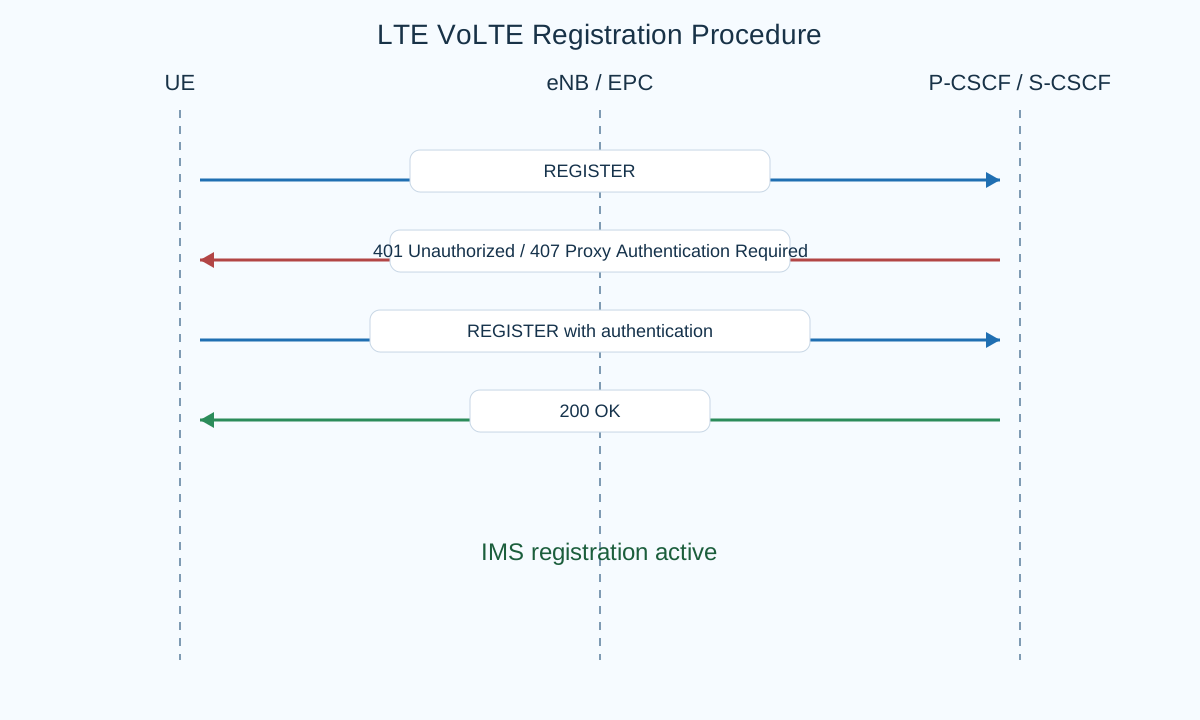
This page follows the SIP REGISTER exchange over LTE and shows where IMS registration succeeds, stalls, or fails before calls can begin.
Introduction
The procedure starts after the UE has LTE connectivity and an IMS-capable PDN path. The UE sends SIP REGISTER toward IMS, handles any challenge such as 401 Unauthorized, and completes registration with a final success response such as 200 OK.
The main nodes are the UE, eNB, MME / EPC, and the IMS core represented here by the P-CSCF and S-CSCF.
What Is VoLTE Registration Procedure in Simple Terms?
- What starts the procedure: The UE already has LTE packet service and needs to register to IMS for VoLTE availability.
- What the UE and network want to achieve: Create an active IMS registration state so the UE can place and receive VoLTE calls.
- What success looks like: The REGISTER exchange completes and the UE becomes IMS-registered.
- What failure means: LTE packet service may exist, but VoLTE service is not usable because IMS registration did not complete.
Why this procedure matters
VoLTE call setup, incoming call reachability, SMS over IMS, and many supplementary services all depend on IMS registration finishing cleanly first.
Quick Fact Sheet
| Procedure name | LTE VoLTE Registration Procedure |
|---|---|
| Domain | IMS registration over LTE |
| Main trigger | UE needs IMS service reachability after LTE data access is available |
| Start state | LTE packet service and IMS APN connectivity already exist |
| End state | UE is registered to IMS and reachable for VoLTE service |
| Main nodes | UE, eNB, MME / EPC, P-CSCF, S-CSCF |
| Main protocols | SIP, LTE access support |
| Main success outcome | IMS registration succeeds and VoLTE service can continue |
| Main failure outcome | IMS registration fails, times out, or stays challenged |
| Most important messages | REGISTER, 401 Unauthorized, 200 OK |
| Main specs | TS 24.229, TS 23.228 |
Preconditions
- The UE already has LTE packet service and the IMS APN path is available.
- The correct IMS credentials and service profile are provisioned.
- The SIP path toward the P-CSCF is reachable.
Nodes and Interfaces
Nodes involved
| Node | Role in this procedure |
|---|---|
| UE | Starts or receives the LTE voice or messaging service and exchanges SIP signaling with IMS. |
| eNB | Carries the LTE radio side used for IMS-capable packet service. |
| MME / EPC | Preserve LTE access, bearer, and paging continuity behind the IMS transaction. |
| P-CSCF / S-CSCF | Handle the SIP signaling path used for registration, call control, and service continuity. |
Interfaces used
| Interface | Path | Role |
|---|---|---|
| LTE Uu | UE <-> eNB | Carries the radio access needed before and during IMS service use. |
| S1-MME | eNB <-> MME | Carries LTE control-plane continuation behind paging, service request, or bearer handling. |
| Gm | UE <-> P-CSCF | Carries SIP requests and responses between the UE and IMS. |
End-to-End Call Flow
UE            eNB / EPC            P-CSCF / S-CSCF
|--REGISTER------------------------------->|
|<--401 Unauthorized-----------------------|
|--REGISTER (with auth)------------------->|
|<--200 OK---------------------------------|
Major Phases
| Phase | What happens |
|---|---|
| 1. IMS access readiness | The UE already has LTE packet connectivity and can reach the IMS edge. |
| 2. Initial REGISTER | The UE sends the first SIP REGISTER request. |
| 3. Challenge handling | IMS may return an authentication challenge that the UE must satisfy. |
| 4. Registration completion | IMS returns success and the UE becomes registered. |
Step-by-Step Breakdown
Step 1: Send initial REGISTER
Sender -> receiver: UE -> P-CSCF / S-CSCF
Message(s): REGISTER
Purpose: Start the IMS registration attempt over the LTE packet path.
State or context change: IMS now evaluates whether the UE can register and whether a challenge is needed.
Note: This is the first SIP transaction to correlate when VoLTE service never becomes available.
Step 2: Receive challenge
Sender -> receiver: IMS -> UE
Message(s): 401 Unauthorized or 407 Proxy Authentication Required
Purpose: Challenge the UE before final registration is accepted.
State or context change: The UE now needs to answer with the correct authentication information.
Note: A challenge here is normal. The problem starts when the response never completes cleanly afterward.
Step 3: Send authenticated REGISTER
Sender -> receiver: UE -> P-CSCF / S-CSCF
Message(s): REGISTER
Purpose: Return the registration request with the required authentication data.
State or context change: IMS can now accept or reject the registration attempt.
Note: Check whether the second REGISTER really contains the expected authorization context.
Step 4: Complete registration
Sender -> receiver: IMS -> UE
Message(s): 200 OK
Purpose: Confirm that IMS registration is active.
State or context change: The UE becomes IMS-registered and VoLTE service can proceed.
Note: This is the clearest confirmation that the UE is ready for later VoLTE call flows.
Important Messages
| Message | Protocol | Direction | Purpose in this procedure | What to inspect briefly |
|---|---|---|---|---|
| REGISTER | SIP | UE -> IMS | Starts the IMS registration exchange. | Check the public identity, Contact, authorization path, and whether this is the initial or challenged REGISTER. |
| 401 Unauthorized | SIP | IMS -> UE | Returns the IMS authentication challenge. | Check whether the challenge appears once and whether the UE answers it correctly. |
| 407 Proxy Authentication Required | SIP | IMS -> UE | Proxy-side challenge on the registration path. | Check whether the UE is challenged by the proxy and whether the next REGISTER answers it. |
| 200 OK | SIP | IMS -> UE | Confirms successful IMS registration. | Check the final success timing and whether registration expiration values look normal. |
Important Parameters to Inspect
| Parameter | What it is | Where it appears | Why it matters | Common issues |
|---|---|---|---|---|
| IMPU / IMPI | Public and private IMS identities used for registration. | REGISTER | They define which subscriber identity is being registered. | Wrong or missing identity leads to repeated challenge or rejection. |
| Authorization | Digest response or other challenge-related data. | Challenged REGISTER | Shows whether the UE answered the challenge correctly. | Challenge loop or mismatch in credentials. |
| Contact | The UE contact binding registered in IMS. | REGISTER / 200 OK | Explains where future requests should be routed. | Registration succeeds with an unexpected or missing binding. |
| Expires | Registration validity timer. | REGISTER / 200 OK | Affects re-registration timing and service continuity. | Unexpected expiry can cause unstable service. |
| P-CSCF path | The IMS edge reached by the UE. | SIP path context | Confirms the correct IMS access path is in use. | The UE reaches LTE data but not the correct IMS edge. |
Successful Completion
Success means the UE receives the final 200 OK for REGISTER and becomes reachable for VoLTE service.
Common Failures and Troubleshooting
| Symptom | Likely cause | Where to inspect | Relevant message(s) | Relevant interface(s) | Likely next step |
|---|---|---|---|---|---|
| Initial REGISTER never gets a useful response | IMS edge reachability, DNS, APN, or policy problems block the SIP path. | The first REGISTER and the path toward the P-CSCF. | REGISTER | Gm, LTE packet path | Confirm IMS APN connectivity before treating it as a SIP-only problem. |
| Registration loops on challenge | Credentials, authentication handling, or security context are wrong. | REGISTER, 401, 407, and the next REGISTER. | REGISTER, 401 Unauthorized, 407 Proxy Authentication Required | Gm | Check whether the UE is answering the challenge with the correct data. |
| Registration succeeds once and drops later | Expiry handling, re-registration, or IMS path continuity is unstable. | 200 OK timing and later re-registration attempts. | 200 OK, later REGISTER | Gm | Move to timer, expiry, and continuity analysis. |
What to Check in Logs and Traces
- Start with the first REGISTER and confirm the challenge-to-success sequence.
- Match the challenged REGISTER with the final 200 OK.
- Separate LTE packet connectivity issues from IMS authentication issues.
Related Pages
Related sub-procedures
Related message reference pages
Related troubleshooting pages
Notes
This page focuses on IMS registration over an already-working LTE packet path. If the UE never reaches the IMS APN cleanly, start earlier in the LTE access and bearer procedures.
FAQ
What confirms LTE VoLTE registration success?
The clearest SIP-side confirmation is the final 200 OK to REGISTER.
Is a 401 Unauthorized always a failure?
No. It is usually part of the normal challenge flow, as long as the next REGISTER completes successfully.