LTE X2 Handover Procedure Call Flow
LTE X2 handover is the intra-LTE mobility variant where the source eNB and target eNB coordinate the move directly over the X2 interface. It is the preferred path when direct X2 connectivity is available and the move can stay local between the two eNBs until the later EPC path switch.
This page focuses on the interface-specific behavior that makes X2 handover different from S1 handover.
Introduction
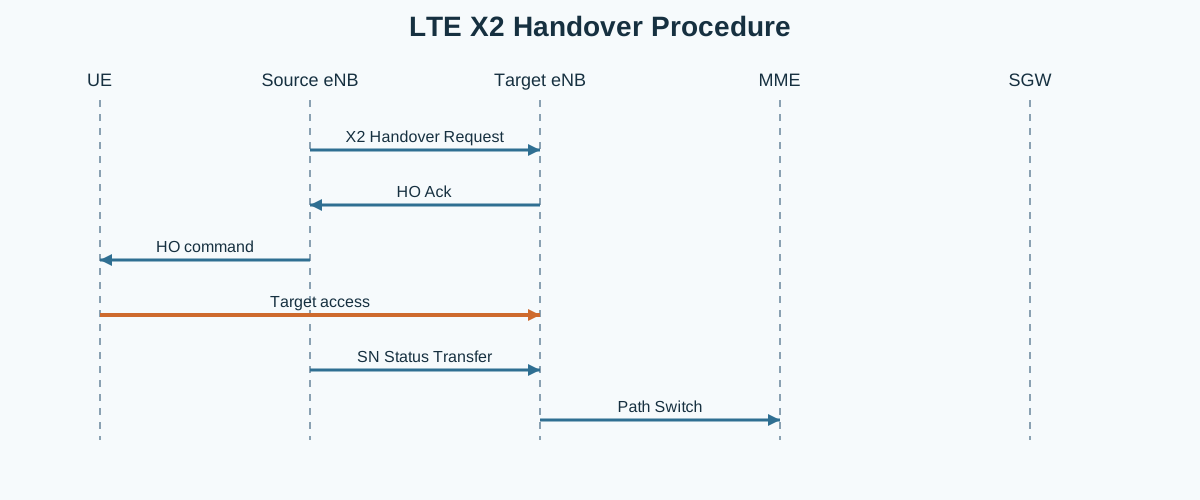
The source eNB uses X2 signaling to prepare the target eNB, then sends the handover command to the UE, and the target side later performs the path switch toward the MME after successful target access.
The main nodes are the UE, source eNB, target eNB, MME, and SGW.
What Is X2 Handover Procedure in Simple Terms?
- What starts the procedure: A connected LTE move is needed and the source and target eNBs have usable X2 connectivity.
- What the UE and network want to achieve: Move the UE to the target eNB with direct source-to-target preparation.
- What success looks like: The target eNB accepts the UE, then performs a path switch toward the EPC.
- What failure means: X2 preparation fails, target access fails, or the path switch does not complete.
Why this procedure matters
This page explains the direct eNB-to-eNB branch of LTE mobility. It is the main reference when the source eNB, not the MME, leads the early handover coordination.
Quick Fact Sheet
| Procedure name | LTE X2 Handover Procedure |
|---|---|
| Domain | Intra-LTE handover using direct X2 coordination |
| Main trigger | Connected LTE mobility with X2 connectivity available |
| Start state | UE is connected on the source eNB |
| End state | UE is connected on the target eNB and the EPC path has switched |
| Main nodes | UE, source eNB, target eNB, MME, SGW |
| Main protocols | RRC, X2AP, S1AP, GTP-U |
| Main success outcome | Direct source-to-target preparation and clean target takeover |
| Main failure outcome | Preparation reject, failed execution, or bad path switch |
| Most important messages | Handover Request, SN Status Transfer, RRC Connection Reconfiguration, Path Switch Request |
| Main specs | TS 36.300, TS 36.423, TS 36.331, TS 23.401 |
Handover Concept
This illustration shows the basic handover concept used in this procedure: the UE leaves the serving side after the mobility decision and continues on the target side once the target path is ready.
Preconditions
- The UE is already connected on LTE.
- Source and target eNBs have usable X2 connectivity.
- The target cell can admit the UE and carry the active bearers.
Nodes and Interfaces
Nodes involved
| Node | Role in this procedure |
|---|---|
| UE | Executes the target move after the X2-prepared handover command. |
| Source eNB | Starts handover and prepares the target directly over X2. |
| Target eNB | Admits the UE and later becomes the active serving side. |
| MME | Handles the later path switch instead of the early preparation leg. |
| SGW | Maintains user-plane continuity after the target takes over. |
Interfaces used
| Interface | Path | Role |
|---|---|---|
| LTE Uu | UE <-> eNB | Carries the handover command and target access. |
| X2 | source eNB <-> target eNB | Carries direct preparation, bearer information, and status transfer. |
| S1-MME | target eNB <-> MME | Carries the later path switch after target access. |
| S1-U | eNB <-> SGW | Carries user-plane forwarding before and after the move. |
End-to-End Call Flow
UE         Source eNB            Target eNB              MME
|             |--X2 Handover Request---->|                   |
|             |<--X2 Handover Ack--------|                   |
|<--HO Cmd----|                          |                   |
|==== target access ====================>|                   |
|             |--SN Status Transfer----->|                   |
|             |                          |--Path Switch Req->|
|             |<--UE Context Release---- |                   |
Major Phases
| Phase | What happens |
|---|---|
| 1. X2 preparation | The source eNB prepares the target directly over X2. |
| 2. UE execution | The source eNB sends the command and the UE moves to the target. |
| 3. Status and path switch | The target side receives remaining state and updates the EPC path. |
| 4. Source release | The source eNB releases its old UE context. |
Step-by-Step Breakdown
Step 1: X2 target preparation
Sender -> receiver: source eNB -> target eNB
Message(s): X2 Handover Request and Handover Request Acknowledge
Purpose: Prepare the target directly without involving the MME in the early leg.
State or context change: The target eNB is ready before the UE moves.
Note: This is the clearest difference from S1 handover.
Step 2: UE receives the move command
Sender -> receiver: source eNB -> UE
Message(s): RRC Connection Reconfiguration
Purpose: Tell the UE to leave the source and access the target cell.
State or context change: The UE starts the execution phase.
Note: If execution fails here, the trace shifts into recovery.
Step 3: Target access and status transfer
Sender -> receiver: UE -> target eNB and source eNB -> target eNB
Message(s): Target access and SN Status Transfer
Purpose: Bring the UE onto the target side and preserve bearer continuity details.
State or context change: The target becomes the active radio side.
Note: Status transfer is useful when packet continuity matters.
Step 4: EPC path switch
Sender -> receiver: target eNB -> MME
Message(s): Path Switch Request
Purpose: Move EPC delivery to the target eNB.
State or context change: The target-side EPC path becomes active.
Note: This step happens after the UE is already on the target side.
Important Messages
| Message | Protocol | Direction | Purpose in this procedure | What to inspect briefly |
|---|---|---|---|---|
| Handover Request | X2AP | source eNB -> target eNB | Starts direct target preparation over X2. | Inspect UE context, bearer list, and admission details. |
| SN Status Transfer | X2AP | source eNB -> target eNB | Preserves bearer sequence context during the move. | Check whether the transfer was present for continuity-sensitive flows. |
| RRC Connection Reconfiguration | RRC | source eNB -> UE | Carries the X2-based handover command. | Inspect target info and execution timing. |
| Path Switch Request | S1AP | target eNB -> MME | Finalizes EPC continuity after target access. | Check target IDs and bearer mapping. |
Important Parameters to Inspect
| Parameter | What it is | Where it appears | Why it matters | Common issues |
|---|---|---|---|---|
| X2 availability | Whether direct source-to-target connectivity exists. | Mobility context and eNB relation data | Explains why X2 rather than S1 is used. | No X2 route or unstable X2 relation. |
| Target admission | Resource acceptance at the target eNB. | X2 Handover Ack | Confirms the target is ready. | Admission reject or partial bearer issue. |
| SN status | Bearer sequence continuity information. | SN Status Transfer | Important for minimizing packet disorder during the move. | Missing or stale status transfer. |
| Path switch state | EPC update after target access. | Path Switch Request | Shows whether the EPC followed the move. | Target access succeeded but EPC remained stale. |
| Source release timing | When the old source context is removed. | Context release handling | Helps detect premature source cleanup. | Source released too early or not at all. |
Successful Completion
Success means the target eNB is prepared over X2, the UE reaches the target, and the later path switch updates the EPC to the new serving side.
Common Failures and Troubleshooting
| Symptom | Likely cause | Where to inspect | Relevant message(s) | Relevant interface(s) | Likely next step |
|---|---|---|---|---|---|
| No X2 preparation possible | Source and target cannot use direct X2 signaling. | Neighbor relation and early mobility branch. | Handover Request missing or rejected | X2 | Use S1 handover if that is the actual path. |
| Target move succeeds but packets stall | The EPC did not follow the move or bearer continuity broke. | Path switch and SN status handling. | SN Status Transfer, Path Switch Request | X2, S1-MME, S1-U | Check both radio execution and bearer continuity together. |
What to Check in Logs and Traces
- Check that the early preparation really used X2 rather than S1.
- Confirm whether SN Status Transfer appeared for active bearers.
- Verify that the target-side path switch happened after successful access.
Related Pages
Related sub-procedures
Related message reference pages
Related troubleshooting pages
Notes
X2 handover keeps the early preparation local between eNBs. The MME becomes active later during the path-switch step rather than at the start of the move.
FAQ
What is X2 handover?
It is intra-LTE handover where source and target eNBs coordinate directly over X2.
Why is it different from S1 handover?
In X2 handover the MME does not relay the early target-preparation signaling.