LTE Architecture Explained (E-UTRAN & EPC Overview)
LTE architecture is built as a packet-switched mobile system inside the Evolved Packet System (EPS). At the highest level, LTE is made up of two major domains: E-UTRAN for radio access and EPC for core-network control and packet connectivity.
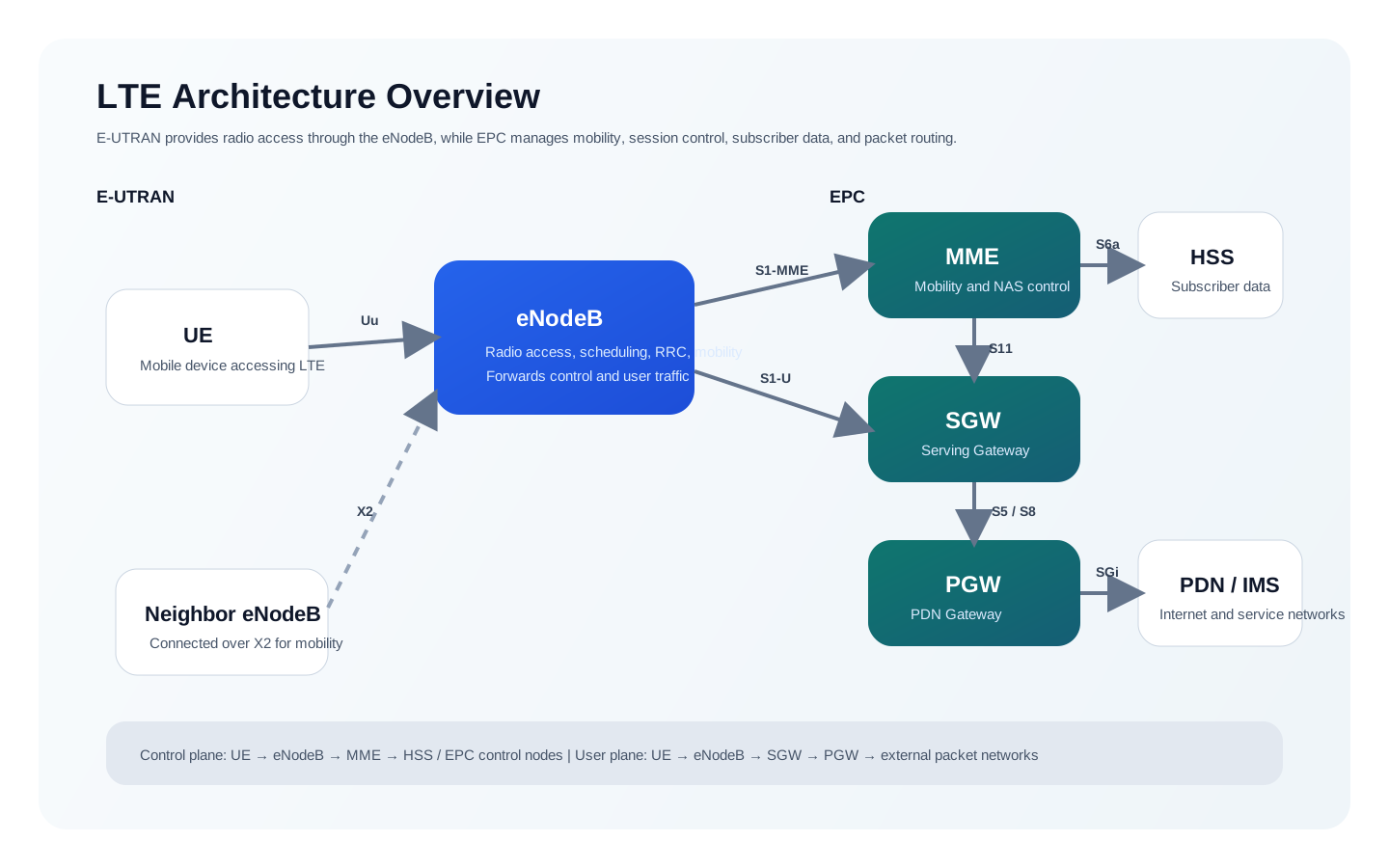
In LTE, the eNodeB (eNB) provides the LTE radio user plane (PDCP, RLC, MAC, PHY) and the radio control plane (RRC) toward the UE. eNBs connect to each other over X2, and they connect into the EPC over S1, split into S1-MME toward the MME and S1-U toward the Serving Gateway. On the EPC side, the non-roaming EPS architecture includes MME, Serving Gateway, PDN Gateway, HSS, PCRF, and operator IP services such as IMS.
LTE architecture diagram
Quick facts
| Parent system | Evolved Packet System (EPS) |
|---|---|
| Main domains | E-UTRAN and EPC |
| Access node | eNodeB (eNB) |
| Main EPC nodes | MME, Serving Gateway, PDN Gateway, HSS, PCRF |
| Key interfaces | LTE-Uu, X2, S1-MME, S1-U, S11, S5/S8, S6a, SGi |
| Architecture style | Flat, all-IP, packet-switched with bearer-based connectivity |
Contents
- LTE architecture diagram
- What this diagram shows
- Why LTE architecture matters
- The two main parts of LTE architecture
- E-UTRAN at a glance
- EPC at a glance
- Key LTE interfaces
- Control plane and user plane
- Bearer-based LTE connectivity
- How LTE works end to end
- Example: LTE attach in the architecture
- LTE architecture and mobility
- LTE architecture and IMS
- Start here: explore LTE architecture by topic
- Related message libraries
- Related procedures
- Key takeaways
- FAQ
What this diagram shows
- The UE reaches LTE service through the eNodeB.
- The eNodeB is the LTE access node in E-UTRAN.
- The MME is the main EPC control-plane node for LTE access.
- The Serving Gateway anchors user-plane transport during mobility.
- The PDN Gateway connects LTE users to packet data networks and operator services.
- The HSS provides subscriber and authentication-related data, while the PCRF supplies policy and charging control functions.
- X2 provides inter-eNB coordination, especially for mobility scenarios.
Why LTE architecture matters
Without the architecture view, attach, service request, paging, bearer setup, and handover all look like isolated message sequences. With the architecture view, they become understandable as paths through real network entities and interfaces. That is why this page should be the starting point before deeper pages on LTE RAN, EPC, interfaces, protocol stack, and VoLTE.
- radio access and RRC handling in the E-UTRAN
- NAS signaling and mobility control in the EPC
- user-plane packet transport through S1-U, S5/S8, and SGi
- policy, authentication, and subscription handling through nodes such as PCRF and HSS
The two main parts of LTE architecture
The E-UTRAN side is organized around eNBs and their S1 and X2 connectivity, while the EPC side defines the core-network control, bearer, subscriber, and external-connectivity model.
| Domain | Main role |
|---|---|
| E-UTRAN | Radio access network between UE and LTE. |
| EPC | Core network for mobility, bearer control, subscriber handling, and packet connectivity. |
E-UTRAN at a glance
The E-UTRAN consists of eNBs. Each eNB terminates the LTE radio stack toward the UE, including PDCP, RLC, MAC, PHY, and the RRC control plane. eNBs are interconnected by X2 and connected to the EPC by S1.
- radio resource management
- radio bearer control
- radio admission control
- connection mobility control
- dynamic resource allocation in uplink and downlink
- routing user-plane data toward the Serving Gateway
EPC at a glance
The core side contains the main mobility, session, policy, and external-connectivity functions. The Serving Gateway acts as the local mobility anchor point for inter-eNodeB handover, while the PDN Gateway sits on the path toward operator IP services and external packet data networks.
| Node | Main architectural role |
|---|---|
| MME | Control-plane node for NAS signaling, mobility management, and security control. |
| Serving Gateway (S-GW) | User-plane anchoring and mobility support. |
| PDN Gateway (P-GW) | Connectivity toward packet data networks and operator IP services. |
| HSS | Subscriber and authentication data. |
| PCRF | Policy and charging rules control. |
Key LTE interfaces
| Interface | Connects | Purpose |
|---|---|---|
| LTE-Uu | UE and eNB | LTE air interface. |
| S1-MME | eNB and MME | Control-plane signaling. |
| S1-U | eNB and S-GW | User-plane transport. |
| X2 | eNB and eNB | Mobility and coordination. |
| S11 | MME and S-GW | Session and bearer control. |
| S5/S8 | S-GW and P-GW | Core bearer transport. |
| S6a | MME and HSS | Authentication and subscription data. |
| SGi | P-GW and packet data networks or operator services | External connectivity. |
Control plane and user plane
On the LTE access side, the eNB terminates RRC toward the UE. On the core side, signaling flows through S1-MME toward the MME, with NAS handled in the EPC control path.
The radio user plane includes PDCP, RLC, MAC, and PHY. Traffic continues from the eNB over S1-U to the Serving Gateway, then across S5/S8 to the PDN Gateway, and finally over SGi to operator services or external packet data networks.
This split is the foundation for understanding why some LTE issues are purely signaling problems while others are user-plane transport problems.
| Plane | Focus | Typical protocols |
|---|---|---|
| Control plane | Signaling and control | RRC, NAS, S1-AP, EPC control signaling |
| User plane | Packet transport | PDCP, RLC, MAC, PHY, GTP-U |
Bearer-based LTE connectivity
LTE uses a bearer model. A default bearer provides the UE with connectivity throughout the lifetime of the PDN connection, which is why it is restricted to Non-GBR. For the hub page, the key idea is that a UE gets packet connectivity through an EPS bearer realized across the radio side and the core side, with different services later using dedicated QoS treatment when needed.
How LTE works end to end
| Path type | Path |
|---|---|
| Signaling path | UE -> eNB -> MME -> HSS / S-GW / P-GW as needed |
| User-data path | UE -> eNB -> S-GW -> P-GW -> operator services / external packet network |
Example: LTE attach in the architecture
- The UE enters through LTE-Uu.
- The eNB handles access-side signaling and forwards toward the EPC.
- The MME takes the control-plane role for mobility and NAS procedures.
- The HSS supports authentication and subscription handling over S6a.
- The S-GW and P-GW establish the packet path.
- The default bearer provides ongoing PDN connectivity for the UE.
LTE architecture and mobility
That is why LTE handover analysis always needs both a RAN view and a core-anchoring view.
- X2 supports inter-eNB coordination.
- S1 connects eNBs into the EPC.
- The Serving Gateway acts as a local mobility anchor for inter-eNB handover.
LTE architecture and IMS
Operator IP services such as IMS sit on the packet-network side of the architecture. That means IMS is not outside LTE architecture; it is reached through the LTE core and packet-data connectivity path.
Start here: explore LTE architecture by topic
Key takeaways
- LTE architecture is built from E-UTRAN + EPC.
- The eNodeB is the main LTE access node and terminates both the LTE radio user plane and RRC toward the UE.
- The EPC architecture includes MME, Serving Gateway, PDN Gateway, HSS, and PCRF.
- S1-MME, S1-U, X2, S11, S5/S8, S6a, and SGi are the key interfaces that make the LTE system work end to end.
- The default bearer provides connectivity for the lifetime of the PDN connection.
FAQ
What are the two main parts of LTE architecture?
LTE architecture is built around E-UTRAN on the access side and EPC on the core side.
What does the eNodeB do in LTE?
The eNB terminates the LTE radio user plane (PDCP, RLC, MAC, PHY) and the radio control plane (RRC) toward the UE, connects to neighbor eNBs over X2, and connects to the EPC over S1.
What is the role of the MME?
The MME is the main EPC control-plane node connected to eNBs over S1-MME and to the HSS over S6a in the reference architecture.
What is the difference between S1-MME and S1-U?
S1-MME is the control-plane side of S1 toward the MME, while S1-U is the user-plane side toward the Serving Gateway.
Why is LTE often called a flat architecture?
Because the eNB directly handles major radio functions and connects to the EPC without an RNC-style controller layer in the LTE access architecture.