S1-MME Interface in LTE Explained
The S1-MME interface is the control-plane side of LTE S1 between the eNodeB in the E-UTRAN and the Mobility Management Entity (MME) in the EPC. In LTE architecture, eNBs connect to the core over S1, with S1-MME used for control signaling and S1-U used for user-plane transport toward the Serving Gateway.
Operationally, S1-MME is where access-side LTE behavior meets EPC control logic. It carries the signaling needed for initial UE access, NAS transport, UE context setup and release, paging, bearer-control coordination, and mobility procedures that require EPC participation.
S1-MME Interface Diagram
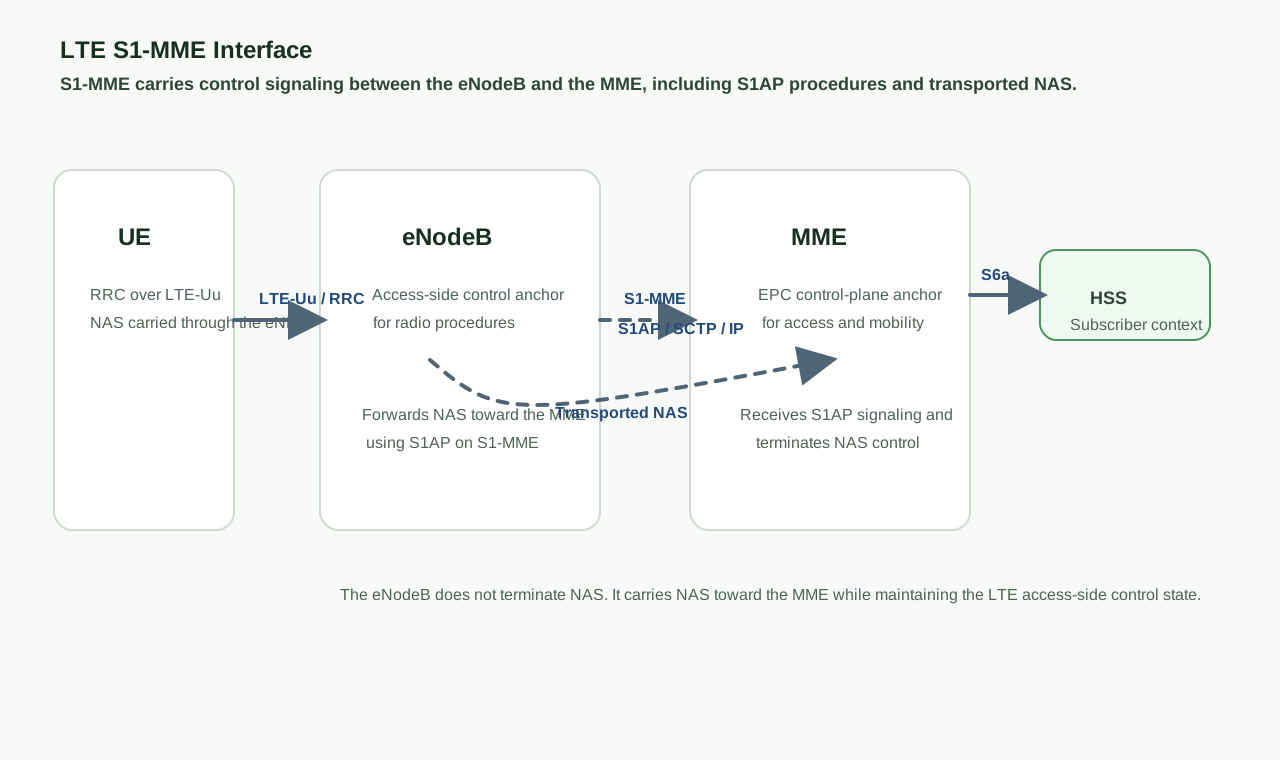
Quick facts
| Connects | eNodeB and MME |
|---|---|
| Plane type | Control plane |
| Main protocol | S1AP over SCTP/IP |
| Carries | NAS transport, UE context signaling, paging, handover-related control |
| Architectural role | Signaling bridge between E-UTRAN and EPC |
| Relationship model | S1 supports many-to-many relations between eNBs and MMEs/SGWs |
Contents
- S1-MME Interface Diagram
- Where S1-MME fits in LTE architecture
- What S1-MME is used for
- S1-MME versus S1-U
- Protocol stack on S1-MME
- S1AP is the main signaling model on S1-MME
- NAS transport over S1-MME
- UE-associated and non-UE-associated signaling
- Key procedure touchpoints on S1-MME
- UE context and S1AP identifiers
- Reset handling and transport troubleshooting
- Related reading
- Key takeaways
- FAQ
Where S1-MME fits in LTE architecture
In LTE, the eNB terminates the radio user plane and the RRC control plane toward the UE, while NAS belongs to the core-network side and is transported through the access network. That makes S1-MME the EPC-facing signaling bridge between the eNB and the MME.
This role is important because it explains why attach, paging, service restoration, and S1-based mobility all expose S1-MME traces even when the root procedure spans the UE, the radio network, and multiple EPC nodes.
| Side | How S1-MME fits |
|---|---|
| UE-facing access side | The eNB handles RRC and forwards access-originated signaling toward the core. |
| EPC control side | The MME receives S1AP signaling and transported NAS through S1-MME. |
| S1 split | S1-MME is the control plane, while S1-U carries user traffic toward the SGW. |
| Deployment model | The S1 interface supports a scalable many-to-many relation between eNBs and MMEs in the EPC. |
LTE Architecture Hub
Return to the top-level LTE architecture map.
LTE Interfaces Hub
See how S1-MME fits with S1-U, X2, S11, S6a, and other interfaces.
LTE RAN Architecture
Pair the interface view with the eNB and E-UTRAN node view.
LTE Core Network Architecture
Pair the interface view with the MME and EPC node view.
What S1-MME is used for
S1-MME is used whenever the LTE access network must exchange control-plane information with the EPC. That includes NAS transport, setup of the S1 relationship, UE context setup and release, paging support, handover-related control signaling, and E-RAB control coordination.
- Transport of NAS signaling between the UE and the MME
- S1 Setup and non-UE-associated interface management
- Initial UE Message and early access-side signaling toward the EPC
- Initial Context Setup, context modification, and context release
- Paging and other reachability-related control signaling
- E-RAB setup, modify, and release control procedures
- Handover-related procedures, reset, and error handling
S1-MME versus S1-U
A common mistake is to treat S1 as one undifferentiated interface. In LTE, the split between control and user plane is explicit. S1-MME carries signaling between the eNB and the MME, while S1-U carries packet traffic between the eNB and the Serving Gateway.
| Interface | Connects | Plane | Main purpose |
|---|---|---|---|
| S1-MME | eNB and MME | Control plane | Signaling between E-UTRAN and EPC |
| S1-U | eNB and SGW | User plane | Packet-data transport toward the EPC |
Protocol stack on S1-MME
On the S1-MME side, the key radio-network-layer protocol is S1AP, and the transport side uses SCTP over IP. This layered model is useful in operations because failures may sit at the S1AP procedure level, at the SCTP association level, or underneath in IP transport.
| Layer | Role on S1-MME |
|---|---|
| S1AP | Main radio-network-layer signaling protocol for S1 control procedures |
| SCTP | Transport association used for reliable signaling delivery |
| IP | Network-layer connectivity between eNB and MME |
| Data link / physical transport | Underlying transport network carrying the S1 control path |
S1AP is the main signaling model on S1-MME
S1-MME is not a generic signaling tunnel. It is structured by S1AP, whose procedures are grouped into UE-associated and non-UE-associated signaling, success and failure outcomes, and reset or error handling. That procedure model is what makes S1-MME traces readable in a disciplined way.
- S1 Setup
- Initial UE Message
- Uplink NAS Transport and Downlink NAS Transport
- Initial Context Setup
- UE Context Release
- E-RAB Setup / Modify / Release
- Paging
- Handover-related procedures
- Reset and Error Indication
NAS transport over S1-MME
One of the most important jobs of S1-MME is to transport NAS signaling between the UE and the MME. The eNB does not terminate NAS. It forwards NAS transparently through S1AP transport procedures so core-network logic can act on attach, TAU, service restoration, authentication, and related EPS control procedures.
That is why many end-to-end LTE procedures touch S1-MME even when the access network is not the node making the final decision. The eNB acts as the access-side transport point, and S1-MME is the control-plane path into the EPC.
Attach Procedure
See how first NAS access is forwarded from eNB to MME.
Tracking Area Update Procedure
Follow NAS mobility-update signaling that traverses S1-MME.
Service Request Procedure
Read how idle-to-active service restoration uses the S1-MME path.
LTE NAS Message Library
Open the NAS messages that are transported over this interface.
UE-associated and non-UE-associated signaling
S1 signaling is modeled as both non-UE-associated logical S1 connections and UE-associated logical S1 connections. This distinction matters because it tells you whether a problem is affecting the whole eNB to MME relationship or only one UE context.
| Connection type | Typical use on S1-MME |
|---|---|
| Non-UE-associated | S1 Setup, Reset, and broader interface management procedures |
| UE-associated | NAS transport, Initial Context Setup, UE Context Release, E-RAB procedures, paging-related context, and handover signaling |
Key procedure touchpoints on S1-MME
Several LTE procedures are easiest to understand by watching where S1-MME becomes visible. Early access uses Initial UE Message. EPC acceptance and radio-side establishment use Initial Context Setup. Idle reachability uses Paging. Mobility with EPC assistance uses S1 handover.
Initial Context Setup Procedure
Shows how EPC control decisions become eNB context and bearer state.
Paging Procedure
Shows how the MME triggers access-side reachability work over S1-MME.
S1 Handover Procedure
Shows mobility signaling when the EPC assists the handover path.
X2 Handover Procedure
Use this to contrast direct eNB mobility with the S1-based path.
UE context and S1AP identifiers
UE-associated signaling on S1-MME uses identifiers such as MME UE S1AP ID and eNB UE S1AP ID. In trace analysis, these IDs are essential because they let the eNB and MME refer to the same UE context consistently across setup, modification, release, and reset handling.
Many difficult S1-MME investigations turn out to be context-association issues rather than missing payloads. A stale or mismatched UE association can make a correct NAS message look broken when the real problem is in the surrounding S1AP context handling.
Reset handling and transport troubleshooting
S1-MME troubleshooting usually starts by separating procedure failures from transport failures. At the procedure layer, you may see Error Indication, Reset, or a failed context procedure. At the transport layer, you may instead have SCTP association loss, IP reachability problems, or wider transport instability underneath the S1 stack.
- S1 Setup failure between eNB and MME
- SCTP association instability or restart
- NAS transport visible at the eNB but not accepted or continued at the MME
- Initial Context Setup failure or incomplete context realization
- Paging triggered by the MME but not completed successfully on the access side
- UE context release mismatches, stale IDs, or partial reset behavior
- S1-based mobility failure during handover preparation or target confirmation
Key takeaways
- S1-MME is the LTE eNB-to-MME control-plane interface.
- It carries S1AP signaling and supports transparent NAS transport between the UE and the MME.
- It is central to initial access, context setup, paging, bearer-control signaling, mobility-related procedures, and reset handling.
- The split between S1-MME and S1-U is one of the clearest examples of LTE control-plane and user-plane separation.
- Understanding S1-MME is essential for reading attach, service request, paging, and S1-based handover traces in LTE.
FAQ
What is S1-MME in LTE?
S1-MME is the control-plane side of the LTE S1 interface between the eNodeB and the MME. It carries signaling between the E-UTRAN and EPC, including S1AP procedures and transported NAS messages.
What protocol runs on S1-MME?
The main radio-network-layer protocol is S1AP, carried over SCTP and IP on the transport side.
Is S1-MME user plane or control plane?
S1-MME is control plane. The matching user-plane side of S1 is S1-U between the eNB and the Serving Gateway.
Does NAS terminate on S1-MME?
No. The eNB transports NAS over S1-MME, but NAS belongs to the core-network side and is mainly terminated in the MME.
What are typical S1-MME procedures?
Typical S1-MME procedures include S1 Setup, Initial UE Message, Uplink and Downlink NAS Transport, Initial Context Setup, paging, E-RAB control procedures, handover-related signaling, and reset or error handling.