S11 Interface in LTE Explained
The S11 interface is the control-plane interface between the Mobility Management Entity (MME) and the Serving Gateway (S-GW) in the LTE Evolved Packet Core (EPC).
S11 is responsible for session management, bearer control, and mobility-related signaling between these two core-network nodes. It connects MME control decisions to S-GW user-plane execution.
S11 Interface Diagram
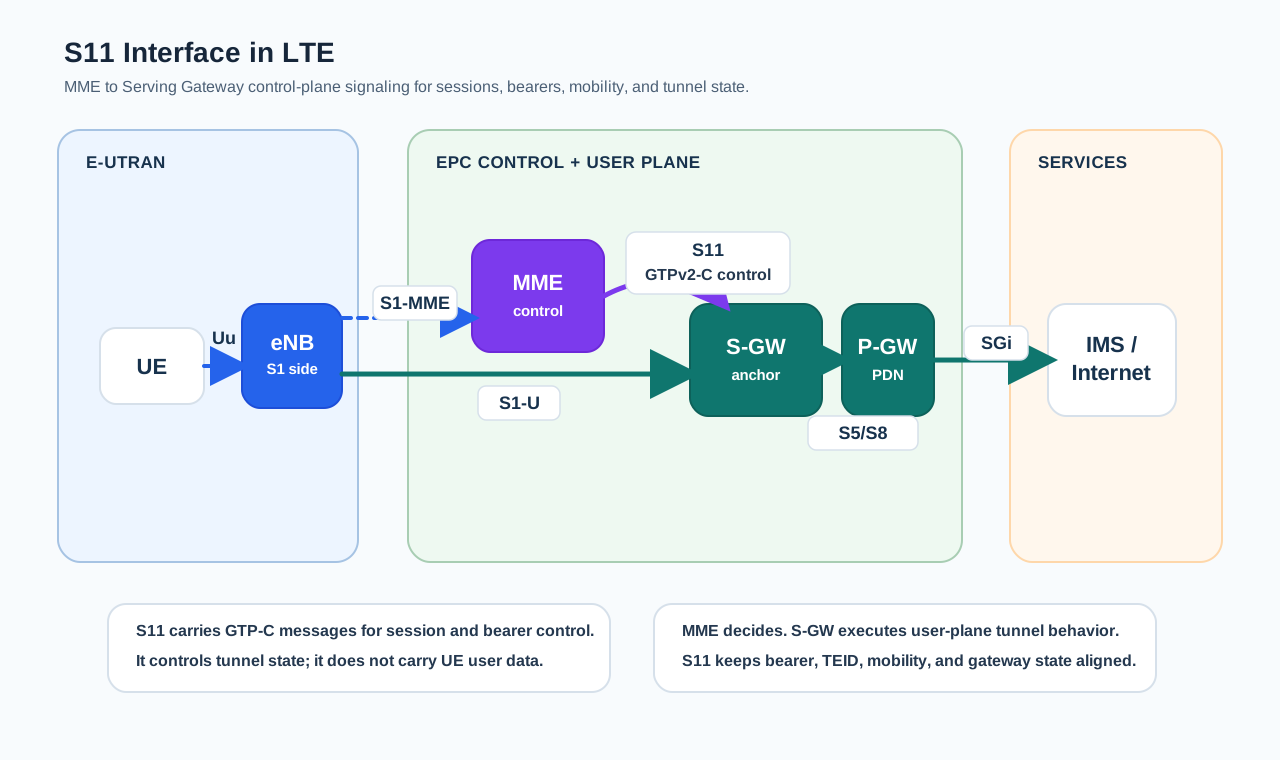
Quick facts
| Connects | MME and Serving Gateway |
|---|---|
| Plane type | Control plane |
| Main protocol | GTPv2-C / GTP-C |
| Controls | Session lifecycle, bearer lifecycle, and tunnel parameters |
| Coordinates with | S1-MME signaling, S1-U tunnels, S5/S8 gateway paths, and mobility updates |
| Operational focus | Attach failures, bearer failures, no-data after attach, S-GW relocation, and GTP-C timeouts |
Contents
- S11 Interface Diagram
- S11 in the LTE Architecture
- What the S11 Interface Is Used For
- S11 Uses GTP-C
- Role of S11 in the Bearer Model
- Key S11 Procedures
- S11 and Mobility Management
- S11 and the Serving Gateway
- S11 and Tunnel Management
- S11 vs Other LTE Interfaces
- S11 and VoLTE / IMS
- Common Troubleshooting Angles for S11
- Related Pages
- Key takeaways
- FAQ
- References
S11 in the LTE Architecture
In LTE architecture, S11 complements S1-MME, which carries control signaling between the eNB and MME, and S1-U, which carries user-plane traffic between the eNB and S-GW.
While S1 handles access-side interaction, S11 is the core-side control interface that coordinates the user-plane path anchored at the S-GW. This makes S11 the internal EPC control-plane link tying MME signaling decisions to S-GW execution.
| Node or interface | Role |
|---|---|
| MME | Control-plane signaling, NAS handling, mobility control, and bearer/session decisions. |
| S-GW | Access-side user-plane anchor and tunnel execution point. |
| S11 | Control-plane coordination between MME decisions and S-GW user-plane behavior. |
| S1-U | User-plane bearer transport between eNB and S-GW. |
What the S11 Interface Is Used For
S11 ensures that when the MME decides something during attach, bearer setup, mobility, or service restoration, the S-GW receives the control-plane instruction needed to apply that decision to the user-plane path.
Without S11, the MME would not be able to control how the S-GW sets up, modifies, or releases the data path.
- EPS bearer management
- Session creation and deletion
- Mobility-related control signaling
- Coordination of user-plane path establishment
- Triggering changes in S1-U and S5/S8 user-plane tunnels
S11 Uses GTP-C
The S11 interface uses GTPv2-C, also called GTP Control Plane or GTP-C. GTP-C carries signaling procedures for session management, bearer management, and tunnel control.
This separation is fundamental in LTE: GTP-C on S11 controls tunnels, while GTP-U on S1-U and S5/S8 carries user data.
| Plane | Protocol | Common LTE interfaces |
|---|---|---|
| Control plane | GTP-C / GTPv2-C | S11, plus control-plane gateway interfaces such as S5/S8-C. |
| User plane | GTP-U | S1-U and user-plane gateway paths such as S5/S8-U. |
Role of S11 in the Bearer Model
S11 is central to the LTE bearer lifecycle. The end-to-end user-plane bearer path runs from UE to eNB, then across S1-U to the S-GW, across S5/S8 to the P-GW, and onward to external networks or operator services.
The MME controls bearer creation and modification over S11, and the S-GW implements the corresponding user-plane tunnel behavior. That makes S11 the control-plane backbone of EPS bearer management.
- Creation of the default bearer
- Creation and modification of dedicated bearers
- Deletion of bearers
- Updating tunnel endpoints and tunnel parameters
Key S11 Procedures
S11 is used heavily during major LTE procedures. It is where the MME and S-GW coordinate the session and bearer actions that turn access signaling into an actual packet path.
| Procedure | How S11 is involved |
|---|---|
| Attach | MME creates session via S11, S-GW allocates user-plane resources, and the default bearer is established. |
| Bearer modification | S11 updates bearer parameters when QoS, policy, or path behavior changes. |
| Bearer release | S11 supports cleanup when a UE detaches or a service/session ends. |
| Tracking Area Update | S11 may coordinate context updates or S-GW relocation. |
| Service Request | S11 helps reactivate user-plane paths for idle UEs returning to connected service. |
S11 and Mobility Management
The MME controls mobility, but the S-GW anchors the user plane. S11 is the control interface that keeps those two roles coordinated during mobility-related changes.
During inter-eNB mobility, S-GW relocation, or idle-to-connected transitions, S11 signaling helps ensure the correct S-GW association, user-plane path, and tunnel endpoints.
- UE moves to a new area or serving cell.
- MME updates mobility and session context.
- S11 signaling coordinates the S-GW association and tunnel state.
- The user-plane path is updated so bearer traffic can continue.
S11 and the Serving Gateway
The S-GW is the endpoint of S1-U from the eNB and S11 from the MME. That makes the S-GW both a user-plane anchor and an execution point for control-plane instructions.
| Function | Node or interface |
|---|---|
| Decision and control | MME |
| User-plane execution | S-GW |
| Coordination interface | S11 |
| Access-side user-plane tunnel | S1-U |
S11 and Tunnel Management
S11 controls the lifecycle of GTP tunnel state. It does not carry the UE user packets itself, but it helps create, update, and release the tunnel information that user-plane interfaces need.
Without correct S11 signaling, GTP-U tunnels may not be established or mapped correctly to bearers. This is why S11 sits at the bridge between control-plane logic and user-plane transport.
- Creation of tunnel endpoints
- Assignment and exchange of TEIDs
- Updating tunnel parameters
- Releasing tunnels during detach, bearer release, or mobility cleanup
S11 vs Other LTE Interfaces
S11 is easiest to place by comparing it with the access-side S1 interfaces and the gateway-side S5/S8 path. S1-MME plus S11 forms much of the control-plane path, while S1-U plus S5/S8 forms the main user-plane path.
| Interface | Role |
|---|---|
| S1-MME | eNB to MME control signaling. |
| S1-U | eNB to S-GW user plane. |
| S11 | MME to S-GW control plane. |
| S5/S8 | S-GW to P-GW gateway path, with control and user-plane aspects. |
S11 and VoLTE / IMS
VoLTE is an IMS service, but its underlying bearer setup still depends on EPC bearer control. Default and dedicated bearers are coordinated through EPC control procedures, and the MME-to-S-GW control path is part of that system.
So while VoLTE signaling happens through IMS, S11 helps ensure that the transport path exists and is correctly configured for the bearer behavior VoLTE depends on.
Common Troubleshooting Angles for S11
S11 troubleshooting sits at the boundary between MME control-plane logic and S-GW user-plane realization. A procedure may look healthy on the radio side while still failing because session creation, bearer update, TEID mapping, or gateway context handling fails on S11.
- Attach failure caused by session creation failure at the S-GW
- Missing or delayed S11 signaling response
- No data after attach because tunnels were not configured correctly
- Mismatch between control-plane bearer state and user-plane tunnel state
- Dedicated bearer not created or modified correctly
- Incorrect QoS or bearer parameters
- S-GW relocation failure
- Stale or inconsistent mobility context
- GTP-C message loss, timeout, or TEID mapping issue
Key takeaways
- S11 is the control-plane interface between MME and S-GW.
- It uses GTPv2-C / GTP-C for signaling.
- It controls bearer lifecycle, session lifecycle, and tunnel management.
- It connects MME decisions to S-GW execution.
- It is critical for attach, mobility, bearer setup, and QoS-driven services.
FAQ
What is S11 in LTE?
S11 is the control-plane interface between the MME and the Serving Gateway, used for session and bearer management.
What protocol is used on S11?
S11 uses GTPv2-C, also called GTP Control Plane or GTP-C, for signaling.
Is S11 user plane or control plane?
S11 is control plane only. User data flows on interfaces such as S1-U and S5/S8.
Why is S11 important?
S11 controls bearer creation, tunnel setup, session lifecycle, and mobility coordination between the MME and S-GW.
What happens if S11 fails?
Attach may fail, data services may not work, bearers may not be created correctly, or mobility updates may leave stale tunnel state.
Related pages
References
- 3GPP TS 23.401 EPS architecture, MME/S-GW roles, bearer handling, and mobility procedures.
- 3GPP TS 29.274 GTPv2-C control-plane protocol used by S11 and related EPC control interfaces.