S5 and S8 Interfaces in LTE Explained
The S5 and S8 interfaces connect the Serving Gateway (S-GW) and the PDN Gateway (P-GW) inside the LTE Evolved Packet Core (EPC).
In the EPS bearer model, the S5/S8 bearer transports packets between the S-GW and P-GW. That makes S5/S8 the gateway-to-gateway segment of the LTE packet path.
S5/S8 Interface Diagram
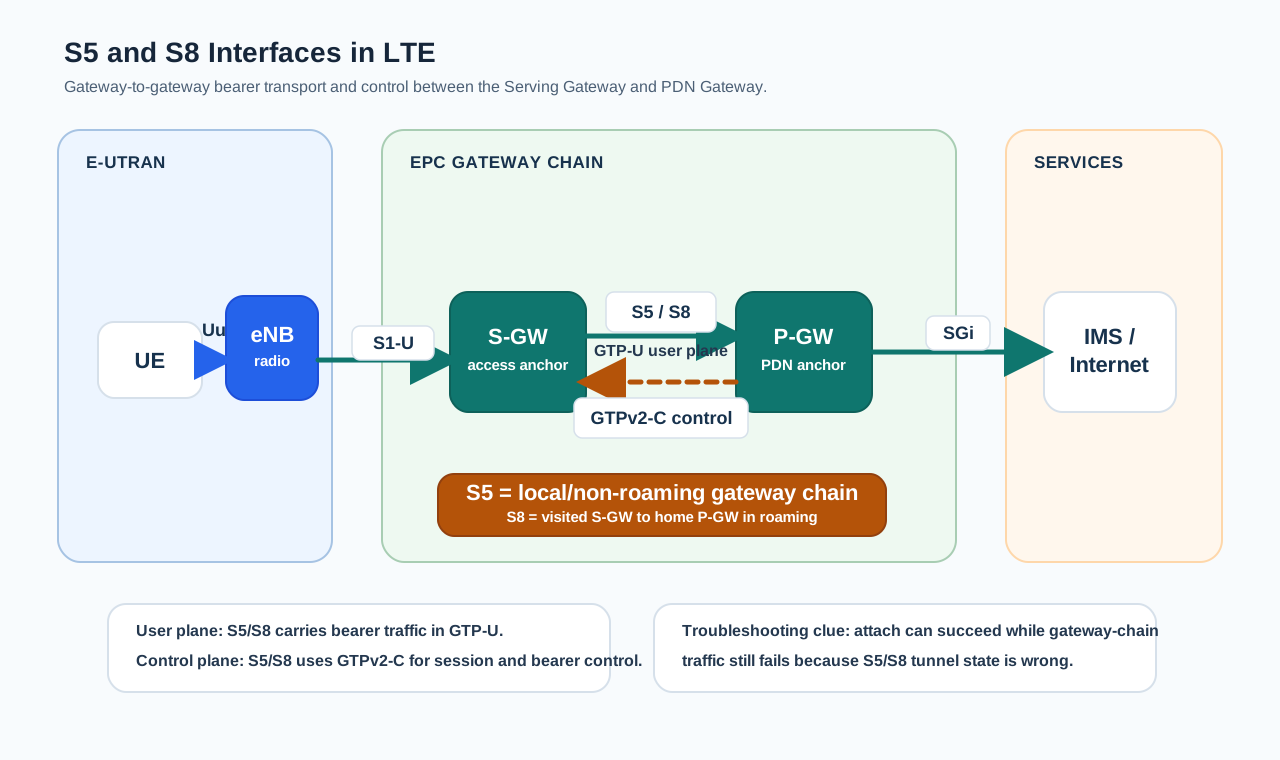
Quick facts
| Connects | Serving Gateway and PDN Gateway |
|---|---|
| S5 usage | Non-roaming or local EPC gateway-to-gateway connectivity |
| S8 usage | Roaming path between visited S-GW and home P-GW roles |
| User plane | GTP-U between S-GW and P-GW |
| Control plane | GTPv2-C / GTP-C for session and bearer control |
| Operational focus | Gateway-chain data failures, bearer mismatch, roaming failures, and tunnel endpoint issues |
Contents
- S5/S8 Interface Diagram
- S5/S8 in the LTE Architecture
- What S5 and S8 Are Used For
- Difference Between S5 and S8
- S5/S8 in the Bearer Model
- User Plane on S5/S8
- Control Plane on S5/S8
- S5/S8 and the S-GW
- S5/S8 and the P-GW
- S5/S8 and Roaming
- S5/S8 and Default / Dedicated Bearers
- S5/S8 and Policy / Charging
- S5/S8 and GTP Tunnel Management
- S5/S8 and Mobility Continuity
- Common Troubleshooting Angles for S5/S8
- Related Pages
- Key takeaways
- FAQ
- References
S5/S8 in the LTE Architecture
S5/S8 is the EPC gateway-chain interface between the access-side gateway and the PDN-facing gateway. It sits between the S-GW, which anchors the access-side user plane, and the P-GW, which provides connectivity to external packet data networks and operator IP services.
A simplified user-data path is UE → eNB → S1-U → S-GW → S5/S8 → P-GW → SGi → external network. S5/S8 is therefore one of the most important links in the LTE user-plane path.
| Segment | Role |
|---|---|
| S1-U | Access-side user-plane segment between eNB and S-GW. |
| S5/S8 | Gateway-to-gateway bearer segment between S-GW and P-GW. |
| SGi | Service-facing path from P-GW toward external networks, IMS, or Internet services. |
What S5 and S8 Are Used For
S5/S8 extends LTE bearer connectivity from the access-side gateway deeper into the EPC. It carries the gateway-chain bearer path and the related control signaling needed to create, update, and maintain that path.
- Transporting the core bearer path between S-GW and P-GW
- Carrying both user-plane traffic and related control-plane signaling
- Supporting packet connectivity from LTE access into external PDNs
- Supporting roaming-aware separation between visited and home network gateways
Difference Between S5 and S8
S5 and S8 are closely related, but they are used in different architecture situations. In both cases the gateway chain is preserved, but S8 explicitly reflects the home/visited split in roaming deployments.
| Interface | Typical use |
|---|---|
| S5 | Non-roaming or local EPC connectivity between S-GW and P-GW. |
| S8 | Roaming connectivity between visited-network S-GW and home-network P-GW. |
S5/S8 in the Bearer Model
The LTE bearer model chains together several bearer segments. A radio bearer carries traffic between UE and eNB, an S1 bearer carries traffic between eNB and S-GW, and an S5/S8 bearer carries traffic between S-GW and P-GW.
S5/S8 is where EPC bearer continuity is extended deeper into the core. Even if the radio bearer and S1 bearer are healthy, the EPS bearer path is not complete unless the S5/S8 segment is correctly established and maintained.
| Bearer segment | Scope |
|---|---|
| Radio bearer | UE to eNB bearer segment. |
| S1 bearer | eNB to S-GW bearer segment over S1-U. |
| S5/S8 bearer | S-GW to P-GW bearer segment inside the EPC gateway chain. |
| EPS bearer | End-to-end bearer context across access and EPC segments. |
User Plane on S5/S8
The user plane on S5/S8 uses GTP-U in the EPS GTP-based model. User packets are encapsulated in GTP-U as they move between the S-GW and P-GW.
This is critical because S5/S8 is where the access-side user-plane anchor in the S-GW connects to the IP-anchor and PDN-facing role of the P-GW.
| Layer | Role on S5/S8 user plane |
|---|---|
| GTP-U | User-plane tunneling between S-GW and P-GW. |
| UDP | Transport for GTP-U packets. |
| IP | Network-layer connectivity between gateways. |
| Transport network | Underlying EPC transport path. |
Control Plane on S5/S8
The control plane on S5/S8 uses GTPv2-C in the GTP-based model. This means S5/S8 carries gateway-to-gateway control signaling as well as user traffic.
That is why S5/S8 is not a pure transport link. It is also part of LTE bearer-control logic for session and bearer management between the S-GW and P-GW.
| Layer | Role on S5/S8 control plane |
|---|---|
| GTPv2-C | Session and bearer control signaling between gateways. |
| UDP | Transport for GTP-C messages. |
| IP | Network-layer gateway connectivity. |
| Transport network | Underlying EPC control-plane transport path. |
S5/S8 and the S-GW
The S-GW is the access-side gateway on the S5/S8 path. It anchors the user plane toward E-UTRAN and connects onward to the P-GW over S5/S8.
Without S5/S8, the S-GW could anchor access-side traffic, but it could not complete the packet path toward the PDN-facing side of the EPC.
S5/S8 and the P-GW
The P-GW is the PDN-facing gateway on the S5/S8 path. It connects the EPS bearer path to external packet data networks and operator IP services through SGi.
S5/S8 links the S-GW access-side mobility anchor role to the P-GW IP-anchor and service-connectivity role. This is why S5/S8 is so important to LTE service continuity.
- The S-GW keeps the access-side anchor stable.
- The P-GW keeps the IP/session side stable.
- S5/S8 bridges those two gateway roles.
S5/S8 and Roaming
S8 is especially important in LTE roaming. It is the interface between the visited-network S-GW and the home-network P-GW.
This allows the subscriber service and IP-anchor behavior to remain tied to the home network while the access-side mobility anchor can reside in the visited network.
- The visited side can support access and local gateway functions.
- The home side can still control packet-data connectivity and service anchoring.
- S8 reflects the gateway ownership and bearer-path split in roaming.
S5/S8 and Default / Dedicated Bearers
Both default bearers and dedicated bearers rely on S5/S8 for their gateway-to-gateway path. The default bearer cannot provide full packet connectivity unless S5/S8 is active, and dedicated bearers also depend on S5/S8 to extend service-specific treatment into the gateway chain.
This is why failures on S5/S8 can show up as attach succeeds but no real packet service, dedicated bearer policy looks correct but traffic never reaches the PDN side, or QoS/service continuity degrades deeper in the EPC.
S5/S8 and Policy / Charging
Policy and charging decisions are made elsewhere, but S5/S8 is still part of the actual gateway-chain path over which policy-controlled traffic must travel. PCRF/PCEF behavior can decide how traffic should be treated, but that treatment still depends on the bearer path existing correctly across S1-U, S5/S8, and SGi.
This is why S5/S8 problems can sometimes look like QoS or service-policy failures from the subscriber point of view, even when the root cause is gateway-chain transport or control failure.
S5/S8 and GTP Tunnel Management
Because S5/S8 uses both GTP-U and GTPv2-C, it is one of the clearest examples of LTE control/user-plane separation.
Control-plane failure may prevent bearer creation or update, while user-plane failure may prevent actual traffic delivery even when signaling succeeded. That distinction is central to EPC troubleshooting.
| Side | What it does |
|---|---|
| User plane | Carries packet traffic in GTP-U. |
| Control plane | Manages session and bearer signaling in GTPv2-C. |
S5/S8 and Mobility Continuity
S5/S8 also matters during mobility because the bearer path must stay continuous as the UE moves. The S-GW serves as the access-side mobility anchor, while the P-GW remains the IP-facing anchor toward external networks.
If the S5/S8 gateway path is not aligned with current bearer state, user-plane continuity can break even when radio and S1 signaling look correct.
Common Troubleshooting Angles for S5/S8
S5/S8 troubleshooting usually means separating gateway control state from user-plane delivery. Gateway signaling may succeed while GTP-U traffic is blackholed, or user-plane tunnels may exist while control-plane bearer state is stale or inconsistent.
- Attach succeeds but there is no end-to-end data path
- S-GW and P-GW bearer state mismatch
- GTPv2-C control issues preventing session or bearer updates
- GTP-U user-plane issues causing traffic blackholing
- Roaming path failure on S8
- Dedicated bearer behavior fails between gateways
- Default bearer exists but PDN-side reachability fails
- Incorrect tunnel endpoint or TEID handling between S-GW and P-GW
Key takeaways
- S5/S8 is the interface between the S-GW and P-GW in LTE EPC.
- It carries the S5/S8 bearer, the gateway-chain segment of the EPS bearer path.
- S5 is typically used in non-roaming architecture, while S8 is used in roaming.
- The user plane on S5/S8 uses GTP-U, and the control plane uses GTPv2-C.
- Understanding S5/S8 is essential for diagnosing gateway-chain data problems, bearer issues, and roaming path failures in LTE.
FAQ
What are S5 and S8 in LTE?
S5 and S8 are interfaces between the Serving Gateway and the PDN Gateway in LTE EPC. S5 is typically used in non-roaming architecture, while S8 is used in roaming architecture.
What is the difference between S5 and S8?
The main difference is architectural context: S5 is used for non-roaming or local EPC gateway chaining, while S8 is used across visited and home network gateway roles in roaming.
What protocol runs on S5/S8?
S5/S8 uses GTPv2-C on the control plane and GTP-U on the user plane in the GTP-based EPS model.
Is S5/S8 user plane or control plane?
It is both. S5/S8 carries user-plane traffic in GTP-U and related control-plane signaling in GTPv2-C.
Why is S5/S8 important?
Because it is the gateway-to-gateway bearer path between the S-GW and P-GW, and it is essential for end-to-end packet connectivity, bearer continuity, and roaming architecture.
Related pages
References
- 3GPP TS 23.401 EPS architecture, bearer model, roaming reference models, and S-GW/P-GW roles.
- 3GPP TS 29.281 GTP-U user-plane protocol used on S5/S8 and related EPS user-plane interfaces.
- 3GPP TS 29.274 GTPv2-C control-plane protocol for S5/S8 and other EPC control interfaces.