S6a Interface in LTE Explained
The S6a interface is the control-plane interface between the Mobility Management Entity (MME) and the Home Subscriber Server (HSS) in the LTE Evolved Packet Core (EPC).
S6a is responsible for authentication, subscriber data retrieval, mobility management support, and location updates. It is the EPC interface that lets the MME ask the HSS for subscriber truth.
S6a Interface Diagram
Quick facts
| Connects | MME and HSS |
|---|---|
| Plane type | Control plane only |
| Main protocol | Diameter S6a application |
| Core functions | Authentication, subscriber data retrieval, location update, and mobility support |
| Different from | GTP-based bearer interfaces such as S11 and S5/S8 |
| Operational focus | Attach authentication, subscriber profile, roaming permission, HSS reachability, and Diameter peer issues |
Contents
- S6a Interface Diagram
- S6a in the LTE Architecture
- What the S6a Interface Is Used For
- S6a Uses Diameter Protocol
- Authentication and Security
- Subscriber Data Retrieval
- Location Management
- Mobility Support
- Subscription Updates
- Key S6a Procedures
- S6a and the Attach Procedure
- S6a and Security Architecture
- S6a and Roaming
- S6a vs Other LTE Interfaces
- S6a and Diameter Stack
- Common Troubleshooting Angles for S6a
- Related Pages
- Key takeaways
- FAQ
- References
S6a in the LTE Architecture
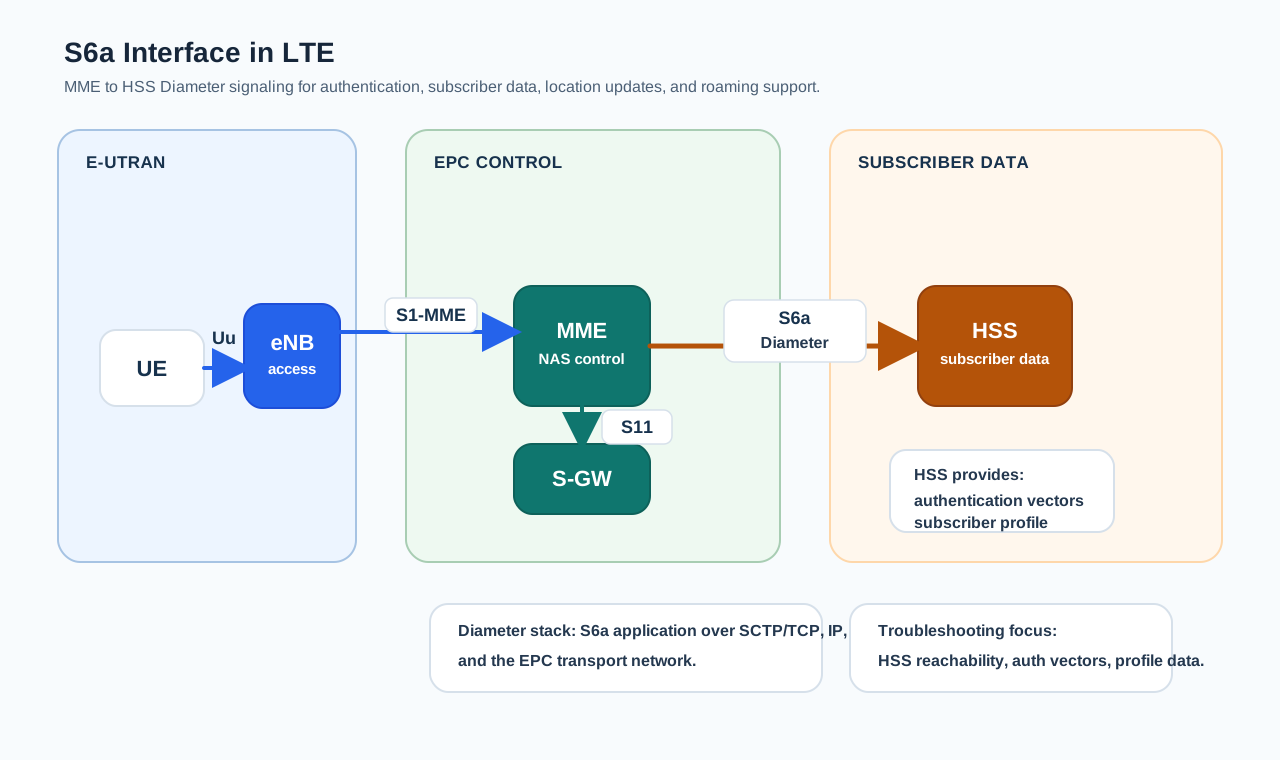
In LTE architecture, the UE reaches the EPC control plane through the eNodeB and S1-MME. The MME then uses S6a to reach the HSS for authentication and subscriber-related operations.
This makes S6a the identity and authentication backbone of LTE EPC. It does not carry user packets. It gives the MME the subscriber and security information needed before LTE service can proceed safely.
| Node or interface | Role |
|---|---|
| MME | Handles NAS signaling, mobility control, authentication coordination, and session control. |
| HSS | Stores subscriber data and authentication credentials. |
| S6a | Diameter-based control interface for subscriber, authentication, and location operations. |
| S11 | Bearer/session control between MME and S-GW after subscriber checks allow service to proceed. |
What the S6a Interface Is Used For
S6a is used whenever the MME needs subscriber-aware information from the HSS. In simple terms: the MME asks questions, and the HSS provides subscriber truth.
- Authentication of the UE
- Retrieval of subscriber profile
- Mobility management support
- Tracking area updates and location management
- Subscription data updates
- Roaming-related subscriber validation
S6a Uses Diameter Protocol
The S6a interface uses the Diameter protocol, not GTP. It is a message-based request/answer interface that runs over IP transport, typically using SCTP or TCP underneath Diameter.
That makes S6a fundamentally different from bearer-related GTP interfaces. S6a is about identity, authentication, and subscriber state, while S11 and S5/S8 are about session, bearer, and tunnel control.
| Interface | Main protocol | Main purpose |
|---|---|---|
| S11 | GTPv2-C | MME to S-GW bearer and session control. |
| S5/S8 | GTPv2-C and GTP-U | S-GW to P-GW control and user-plane gateway path. |
| S6a | Diameter | MME to HSS authentication and subscriber-data exchange. |
Authentication and Security
S6a is used to authenticate the UE using credentials associated with the subscriber in the HSS. The MME requests authentication information, the HSS provides authentication vectors, and the MME uses those values to authenticate the UE and derive access security context.
Typical authentication-vector fields include RAND, AUTN, XRES, and KASME. This is one of the most critical functions in LTE security because it establishes whether the UE should be trusted by the network.
- MME requests authentication vectors.
- HSS generates or provides vectors using subscriber credentials.
- MME uses the vectors in the NAS authentication procedure.
- Successful authentication allows secure access and later session handling to proceed.
Subscriber Data Retrieval
When a UE attaches, the MME uses S6a to retrieve subscriber profile information from the HSS. This profile determines which services the UE is allowed to access and how those services should be configured.
- APN configuration
- QoS profiles
- Roaming restrictions
- Subscription permissions
- Service restrictions and subscriber-specific access data
Location Management
The HSS tracks the subscriber location at a high level. S6a supports update-location behavior so the HSS knows which MME is currently serving the UE.
The key request/answer pair is Update Location Request (ULR) and Update Location Answer (ULA). This helps route later signaling and service behavior toward the correct serving control-plane node.
Mobility Support
When a UE moves between MME areas or when roaming conditions apply, S6a helps keep HSS subscriber location state aligned with the current serving MME. The HSS may also cancel old location information when the subscriber moves.
This supports inter-MME mobility, roaming scenarios, and subscriber reachability. Without correct S6a behavior, the network can end up with stale subscriber location or authorization state.
Subscription Updates
The HSS can push subscriber profile changes to the MME using S6a procedures. This allows changes in subscription, service restrictions, or policy-relevant subscriber data to be reflected in the serving network.
- Changes in subscription data
- Service restriction updates
- Subscriber profile changes
- Updates needed while the UE is already registered
Key S6a Procedures
S6a is built around Diameter request/answer procedures between the MME and HSS. These procedures support authentication, location management, subscriber profile delivery, and context cleanup.
| Procedure | Main messages | Purpose |
|---|---|---|
| Authentication Information Exchange | AIR / AIA | MME obtains authentication vectors from the HSS. |
| Location Update | ULR / ULA | MME updates the HSS with serving MME and subscriber location information. |
| Cancel Location | CLR / CLA | HSS cancels old subscriber location or context information at an MME. |
| Insert Subscriber Data | IDR / IDA | HSS updates subscriber data at the MME. |
| Purge UE | PUR / PUA | MME informs HSS that UE context has been purged. |
S6a and the Attach Procedure
S6a is heavily used during LTE attach. After the UE reaches the MME through the access path, the MME contacts the HSS to retrieve authentication information, obtain subscription data, and update the subscriber location.
Without S6a, the UE cannot be authenticated, the network cannot determine the subscription profile, and the attach procedure cannot complete correctly.
- UE connects to the network through LTE access.
- MME contacts HSS over S6a.
- Authentication vectors are retrieved.
- Subscriber profile is downloaded.
- Location is updated in the HSS.
S6a and Security Architecture
S6a is part of the LTE security framework because it enables authentication vector delivery and subscriber verification. It supports the network-side material needed for authentication and key derivation, including KASME-related handling.
Without S6a, the EPC cannot perform secure access control or verify that the subscriber is authorized to use the LTE network.
S6a and Roaming
S6a is also important in roaming scenarios. The visited MME needs to validate subscriber identity and permissions against the home subscriber database. S6a-based Diameter signaling supports that subscriber validation and restriction handling.
This allows global mobility while keeping subscriber management centralized in the home network.
- Visited MME communicates with the subscriber database in the home-network architecture.
- Subscriber identity and permissions are verified remotely.
- Roaming restrictions can be enforced before service proceeds.
S6a vs Other LTE Interfaces
S6a is easiest to understand by separating identity/subscriber control from bearer/session control. S6a answers who the subscriber is and what they are allowed to do. S11 and S5/S8 then help build the session and bearer path that carries service.
| Interface | Role |
|---|---|
| S1-MME | eNB to MME access signaling and NAS transport. |
| S11 | MME to S-GW session and bearer control. |
| S5/S8 | S-GW to P-GW gateway path with control and user-plane aspects. |
| S6a | MME to HSS subscriber data, authentication, and location management. |
S6a and Diameter Stack
S6a uses a Diameter application on top of transport and IP networking. This is different from GTP-based interfaces and reflects the use of Diameter for subscriber and control-plane signaling.
| Layer | Role on S6a |
|---|---|
| Diameter S6a application | Authentication, subscriber data, location, and mobility-related messages. |
| SCTP / TCP | Transport for Diameter signaling. |
| IP | Network-layer connectivity between MME and HSS/Diameter routing environment. |
| Transport network | Underlying EPC control-plane transport path. |
Common Troubleshooting Angles for S6a
S6a troubleshooting usually starts when radio access looks healthy but attach, authentication, subscriber validation, or roaming authorization fails. The problem may be subscriber data, Diameter routing, transport connectivity, or stale location state.
- Attach failure caused by authentication-vector issues
- No response from HSS or Diameter peer timeout
- Incorrect APN, QoS profile, or roaming restriction in subscriber data
- Missing subscription data
- Incorrect location update or stale MME association in HSS
- Subscriber not allowed to roam
- HSS not reachable from visited-network Diameter routing
- SCTP/TCP transport failure
- Diameter peer connectivity, timeout, or routing problem
Key takeaways
- S6a connects the MME and HSS.
- It uses the Diameter protocol, not GTP.
- It handles authentication, subscriber data, location update, and mobility support.
- It is critical for attach, mobility, and roaming.
- S6a forms the identity and subscriber-control backbone of LTE EPC.
FAQ
What is S6a in LTE?
S6a is the interface between MME and HSS, used for authentication and subscriber data exchange.
What protocol does S6a use?
S6a uses the Diameter protocol and the Diameter S6a application.
Is S6a control plane or user plane?
S6a is control plane only. It does not carry UE user data.
Why is S6a important?
S6a enables authentication, subscriber data retrieval, mobility tracking, location update, and roaming support.
What happens if S6a fails?
The UE may not authenticate, attach may fail, subscriber services may not be authorized, or roaming and location handling may break.
Related pages
References
- 3GPP TS 23.401 EPS architecture, MME/HSS roles, authentication, subscriber handling, and mobility support.
- 3GPP TS 29.272 Diameter-based S6a/S6d protocol procedures, message parameters, and application behavior.