SGi Interface in LTE Explained
The SGi interface is the service-facing interface between the PDN Gateway (P-GW) in the LTE Evolved Packet Core (EPC) and external packet data networks (PDNs).
SGi is where LTE packet connectivity stops being only an EPC bearer topic and becomes end-to-end IP service delivery toward the public Internet, enterprise networks, and operator IP services such as IMS.
SGi Interface Diagram
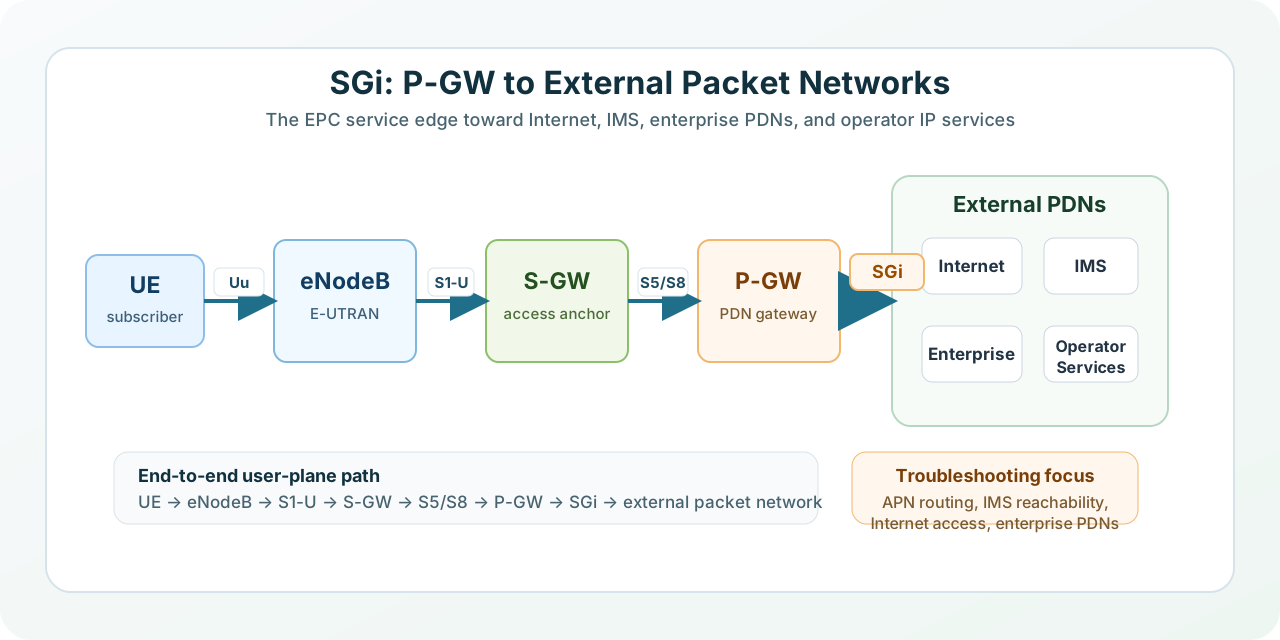
Quick facts
| Connects | P-GW to external packet data networks and operator IP services |
|---|---|
| EPC position | Service-facing edge of the EPC |
| Typical destinations | Internet, IMS, enterprise/private PDNs, and operator service platforms |
| Depends on | P-GW routing, APN/PDN selection, service reachability, and policy behavior |
| Different from | S5/S8, which is the S-GW to P-GW gateway-chain interface inside EPC |
| Operational focus | Internet reachability, IMS access, APN-specific failures, enterprise PDN access, and EPC edge routing |
Contents
- SGi Interface Diagram
- SGi in the LTE Architecture
- What the SGi Interface Is Used For
- SGi and the P-GW
- SGi and PDN Connectivity Service
- SGi and External Networks
- SGi and VoLTE / IMS
- SGi and Gi/SGi Interworking
- SGi and External Service Authorization
- SGi and APN-Based Service Reachability
- SGi and Policy / Charging Effects
- SGi vs S5/S8
- Common Troubleshooting Angles for SGi
- Key takeaways
- FAQ
- References
SGi in the LTE Architecture
SGi sits after the P-GW in the LTE packet path. The UE reaches the EPC through LTE radio access, traffic crosses S1-U and S5/S8, and the P-GW then hands packets toward the selected external service network over SGi.
A simplified LTE packet path is UE → eNodeB → S1-U → S-GW → S5/S8 → P-GW → SGi → external PDN. This makes SGi the EPC exit point toward the wider IP world.
| Path segment | Role |
|---|---|
| S1-U | Access-side EPC user plane between eNodeB and S-GW. |
| S5/S8 | Gateway-chain bearer path between S-GW and P-GW. |
| SGi | Service-facing path from P-GW toward Internet, IMS, enterprise networks, or other PDNs. |
What the SGi Interface Is Used For
SGi connects the LTE EPC to the actual service network selected by the PDN connection. In architecture terms, this is where LTE PDN connectivity becomes usable service access.
- Public Internet access
- Operator IP services such as IMS
- Enterprise or private packet data networks
- APN-specific service platforms
- Other packet-based services reachable beyond the P-GW
SGi and the P-GW
The P-GW is the EPC node directly attached to SGi. It faces the EPC bearer path over S5/S8 and faces external packet networks over SGi.
This makes the P-GW the boundary between LTE/EPC bearer handling and external service routing. If SGi is unavailable or misrouted, the UE may have a valid bearer and IP address but still fail to reach the intended service.
SGi and PDN Connectivity Service
EPS provides IP connectivity between a UE and an external packet data network. That connectivity is only complete when traffic can move from the UE through the EPC and out from the P-GW toward the selected PDN.
In simple terms: S1-U brings user-plane traffic into the EPC, S5/S8 carries it through the gateway chain, and SGi delivers it to the external packet data network.
SGi and External Networks
On the SGi side, the P-GW may connect to several different kinds of service networks. The exact destination depends on the APN/PDN selected for the subscriber session and on operator design.
| SGi destination | Typical use |
|---|---|
| Public Internet | Web, cloud, application, and general IP connectivity. |
| IMS | Operator IP multimedia services such as VoLTE registration and SIP signaling reachability. |
| Enterprise/private PDNs | Corporate access, managed private services, and APN-specific networks. |
| Operator service platforms | Provider-managed packet services beyond the EPC gateway edge. |
SGi and VoLTE / IMS
VoLTE is a useful example of why SGi matters. IMS sits beyond the P-GW on the packet-network side of the EPC, so a VoLTE UE must be able to reach IMS through LTE radio access, EPC bearers, the P-GW, and SGi-side service connectivity.
That means VoLTE failures can sometimes look like IMS registration or SIP reachability failures even when the radio and EPC-internal bearer path are healthy. The missing piece may be the SGi-side path toward IMS.
SGi and Gi/SGi Interworking
SGi belongs to the broader PLMN-to-PDN interworking model. Gi/SGi behavior covers how packet-core gateway functions connect toward packet data networks and how service-facing procedures may be handled beyond basic forwarding.
This is useful because SGi is not only a diagram label. In real deployments, it may involve routing, addressing, screening, charging, AAA, enterprise access, tunneling, or service-specific interworking depending on the APN and operator design.
SGi and APN-Based Service Reachability
Because LTE PDN connectivity is tied to a selected APN/PDN, SGi problems are often APN-specific. One APN may route users to the Internet, another may route to IMS, and another may route to a corporate network.
This is why one service can work while another fails even though the radio access and core bearer setup look normal. The service-facing path behind the P-GW can differ by APN.
- Internet APN works, but IMS APN is unreachable.
- Corporate APN fails while generic data service works.
- P-GW bearer state is correct, but external routing beyond SGi is broken.
- Service-side authorization fails after LTE attach succeeds.
SGi and Policy / Charging Effects
SGi is not the PCRF decision interface, but policy-controlled traffic ultimately needs working service reachability beyond the P-GW. Correct QoS or charging decisions do not help if SGi routing or external service access is broken.
This is why some policy or P-GW problems appear to the subscriber as SGi-side service failures: the bearer exists, but the intended service cannot be reached through the EPC edge.
SGi vs S5/S8
A common architecture confusion is the difference between S5/S8 and SGi. S5/S8 is still inside the EPC gateway chain, while SGi is the edge toward external packet networks.
| Interface | Connects | Main role |
|---|---|---|
| S5/S8 | S-GW ↔ P-GW | Gateway-to-gateway bearer and control path inside EPC. |
| SGi | P-GW ↔ external packet networks | EPC service edge toward Internet, IMS, enterprise networks, or other PDNs. |
Common Troubleshooting Angles for SGi
SGi is often checked when LTE attach and bearer setup succeed, but real service access still fails. The fault may be beyond the P-GW rather than in the radio or EPC-internal tunnel path.
- UE attaches successfully but cannot access Internet services.
- IMS or VoLTE service platform is unreachable from the P-GW side.
- One APN works while another APN fails.
- External routing beyond the P-GW is broken.
- Enterprise or private PDN reachability fails while generic EPC behavior looks normal.
- Service-side authentication, authorization, or accounting fails.
- Policy appears correct but real service access still fails.
Key takeaways
- SGi is the LTE/EPC interface between the P-GW and external packet data networks.
- It is the service-facing edge of the EPC, where LTE connectivity becomes real end-to-end service access.
- SGi can lead to the Internet, IMS, enterprise networks, and other operator IP services.
- SGi failures often appear as Internet, IMS, APN-specific, or enterprise reachability issues after attach succeeds.
- Understanding SGi completes the S1-U, S5/S8, P-GW, and external-service view of LTE packet delivery.
FAQ
What is the SGi interface in LTE?
SGi is the service-facing interface between the P-GW and external packet data networks such as the Internet, IMS, enterprise networks, and operator IP services.
What connects to SGi?
The P-GW connects to external packet data networks and operator IP services over SGi. The actual destination depends on the selected APN or PDN.
Is SGi inside the EPC?
SGi is best understood as the edge of the EPC. It is the interface where traffic leaves the P-GW toward external service networks.
What is the difference between S5/S8 and SGi?
S5/S8 is the internal gateway-chain interface between S-GW and P-GW, while SGi is the interface between P-GW and external packet networks.
Why is SGi important for VoLTE?
IMS is reached beyond the P-GW on the packet-network side, so VoLTE depends on SGi-side service connectivity to reach IMS for registration and SIP signaling.
Related pages
References
- 3GPP TS 23.401 / ETSI TS 123 401 - E-UTRAN access architecture EPS architecture reference for PDN connectivity, P-GW placement, operator IP services, and external packet data network access.
- 3GPP TS 29.061 / ETSI TS 129 061 - PLMN to PDN interworking Interworking reference for PLMN packet services and packet data networks, including Gi/SGi-related behavior.