LTE RAN (E-UTRAN) Architecture Explained
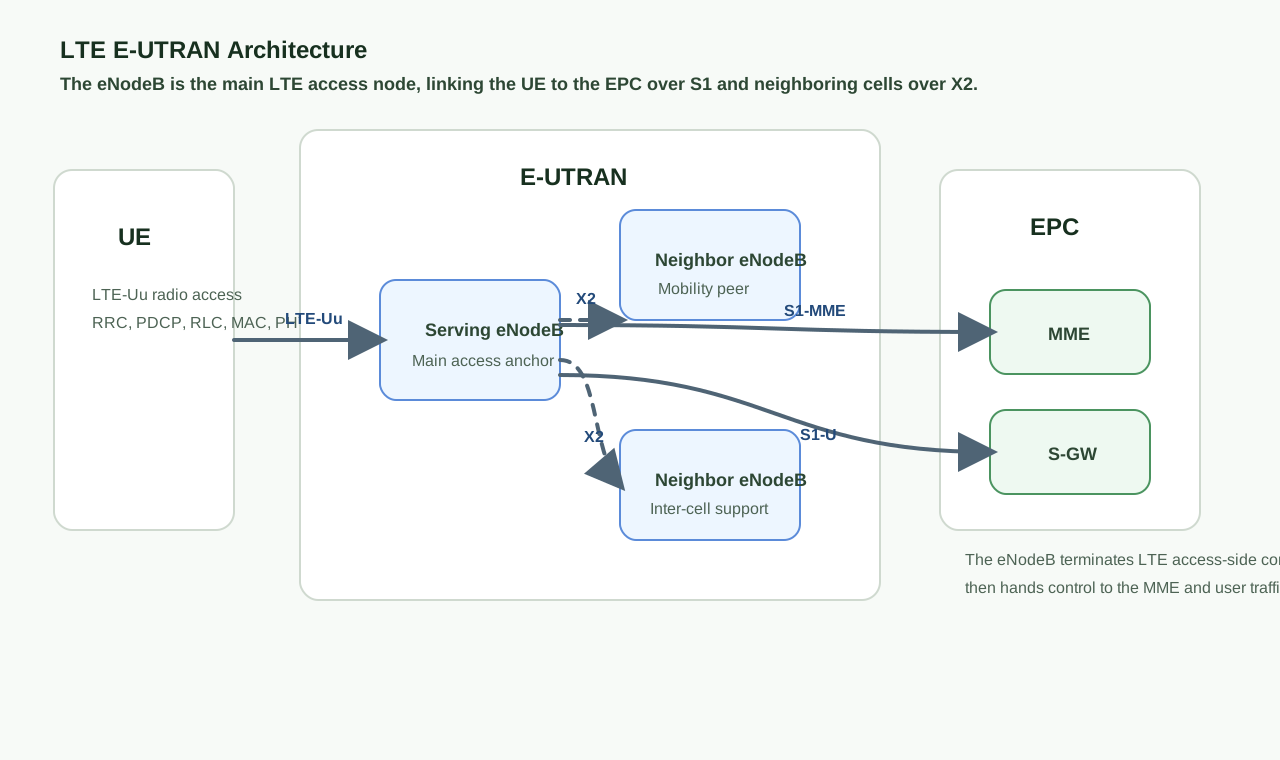
The LTE Radio Access Network (RAN) is called the Evolved Universal Terrestrial Radio Access Network (E-UTRAN). In 3GPP architecture terms, the E-UTRAN consists of a set of eNodeBs (eNBs) that provide the LTE user plane toward the UE through PDCP, RLC, MAC, and PHY, and the LTE control plane through RRC. eNBs are interconnected over X2 and connected to the EPC over S1, split into S1-MME toward the MME and S1-U toward the Serving Gateway.
The LTE RAN is one of the biggest architectural changes from earlier 3G systems. Instead of using a separate Radio Network Controller, LTE places more radio-control intelligence directly in the eNB, which is one reason LTE is commonly described as having a flatter architecture. This page is the right starting point when the question is access-side: radio control, mobility, bearer realization, and how S1 and X2 connect the LTE radio network to the EPC.
LTE E-UTRAN Architecture Diagram
Quick facts
| Domain | E-UTRAN |
|---|---|
| Primary node | eNodeB |
| Access-side protocol terminations | RRC, PDCP, RLC, MAC, PHY |
| Key interfaces | LTE-Uu, S1-MME, S1-U, X2 |
| Core responsibilities | Radio resource management, radio bearer control, mobility, scheduling, EPC-facing transport |
| Mobility ownership | RRC connection mobility is controlled by E-UTRAN |
| Typical fault domains | RRC setup, measurements, handover execution, bearer activation, radio quality, paging delivery |
Contents
- LTE E-UTRAN Architecture Diagram
- LTE RAN architecture at a glance
- What is E-UTRAN in LTE?
- Main LTE RAN node: eNodeB
- LTE RAN functional split
- Key LTE RAN interfaces
- Why X2 matters in the LTE RAN
- LTE RAN and radio bearers
- LTE RAN mobility architecture
- LTE RAN states and signaling context
- Architectural principles behind LTE RAN design
- Shared and flexible LTE RAN deployments
- Positioning and special LTE RAN cases
- How the LTE RAN fits into end-to-end LTE operation
- Start exploring LTE RAN topics
- Related procedures
- Related message libraries
- 3GPP reference points
- Common troubleshooting notes
- Related reading
- Related pages / next steps
- Key takeaways
- FAQ
LTE RAN architecture at a glance
The LTE RAN is built around the eNodeB. Each eNB terminates the LTE access protocols toward the UE, exchanges signaling with the EPC over S1-MME, forwards user traffic over S1-U, and coordinates with neighboring eNBs over X2 for mobility, load management, and inter-cell coordination.
- The UE reaches LTE service through the eNodeB.
- The eNodeB is the main LTE access node in E-UTRAN.
- S1-MME carries control-plane signaling toward the MME.
- S1-U carries user-plane traffic toward the Serving Gateway.
- X2 connects neighboring eNBs for mobility and coordination.
What is E-UTRAN in LTE?
The E-UTRAN is the LTE access network layer between the UE and the EPC. In practical terms, it is the part of the system that handles radio access over the LTE air interface, RRC signaling with the UE, radio bearer setup and release, mobility and handover at the radio level, scheduling, radio resource control, and forwarding user traffic toward the packet core.
This makes the LTE RAN the bridge between radio procedures and core-network procedures. When you analyze attach, service request, handover, paging, or bearer setup, the E-UTRAN is the access-side system that translates those procedures into real radio and transport actions.
Main LTE RAN node: eNodeB
The eNodeB is the central logical node of the LTE RAN. It is not just a radio transmitter and receiver. It is the access-side control point for bearer handling, radio admission, paging, mobility decisions, and traffic scheduling.
- Radio Resource Management, including Radio Bearer Control, Radio Admission Control, Connection Mobility Control, and dynamic allocation of uplink and downlink resources
- IP and Ethernet header compression, uplink data decompression, and encryption of the user data stream
- MME selection at UE attachment when routing cannot be determined from UE-provided information
- Routing of user-plane data toward the Serving Gateway
- Scheduling and transmission of paging messages originated by the MME
eNodeB
Deep dive into eNodeB functions, interfaces, and access-side responsibilities.
RRC Context
See how the eNodeB stores and uses UE-specific control state.
Radio Bearers
Follow how bearer intent is realized on the radio side.
Mobility
Read how measurements and handover fit into E-UTRAN operation.
LTE RAN functional split
From an architectural viewpoint, the LTE RAN terminates both the user plane and the access-side control plane. The important design point is that the LTE RAN handles RRC, but NAS still terminates in the core network. The eNB carries NAS signaling transparently between the UE and the EPC over the access stratum path.
| Plane | LTE RAN termination in eNB | Main purpose |
|---|---|---|
| User plane | PDCP, RLC, MAC, PHY | Packet transport over radio. |
| Control plane | RRC | Radio connection control and access-side signaling. |
Key LTE RAN interfaces
The LTE RAN is easiest to understand through its interfaces. LTE-Uu is the air interface between the UE and the eNB. S1-MME connects the eNB to the MME for control-plane signaling. S1-U connects the eNB to the Serving Gateway for user-plane traffic. X2 interconnects eNBs for inter-eNB signaling and data-forwarding support, especially around mobility.
| Interface | RAN-side role |
|---|---|
| LTE-Uu | LTE air interface between the UE and the eNB. |
| S1-MME | Control-plane signaling between eNodeB and MME for UE context, paging, and NAS transport. |
| S1-U | User-plane transport between eNodeB and Serving Gateway. |
| X2 | Inter-eNB signaling and data-forwarding interface for mobility and coordination. |
Why X2 matters in the LTE RAN
The X2 interface is one of the defining features of LTE RAN architecture. In practice, it supports radio-interface mobility, context transfer from source eNB to target eNB, control of user-plane transport bearers, handover cancellation, UE context release, load management, inter-cell interference coordination, and self-optimization data exchange.
This is why LTE handover analysis often starts in the RAN. The handover path is not just a core-network event; it is deeply rooted in how neighboring eNBs exchange context and coordinate resources over X2.
LTE RAN and radio bearers
The LTE RAN is where radio bearers are actually realized on the access side. In the end-to-end bearer model, the E-RAB spans the radio side and the S1 side, but on the RAN side the eNB is responsible for the radio-bearer part and its associated resource management.
That makes the RAN the place where QoS intent from the core becomes actual radio treatment. The core may decide that a bearer should exist, but the eNB is the node that must map that into radio resources and enforce it on the access side.
Radio Bearers
Access-side bearer structure, SRBs, DRBs, and radio resource mapping.
Protocol Stack
See how the LTE layers support bearer handling in practice.
Default EPS Bearer Establishment
Follow bearer setup across access and core domains.
Initial Context Setup
See how radio and S1 bearer context are created together.
LTE RAN mobility architecture
The LTE RAN controls mobility for the RRC connection. In practice, this means the E-UTRAN owns measurement-driven mobility decisions, handover preparation and execution on the access side, transfer of UE context between eNBs, coordination of forwarding paths during handover, and radio reconfiguration before, during, and after mobility procedures.
This is also why LTE mobility cannot be understood only from NAS signaling. The decisive radio actions sit in the E-UTRAN.
- measurement-driven mobility decisions
- handover preparation and execution on the access side
- transfer of UE context between eNBs
- coordination of forwarding paths during handover
- radio reconfiguration before, during, and after mobility procedures
LTE RAN states and signaling context
The LTE RAN behavior changes depending on the UE connection state. Paging, context handling, bearer availability, and handover behavior depend heavily on whether the UE has an active RRC connection and whether the EPC still has an associated context.
That is why access-side troubleshooting has to account for RRC_IDLE, RRC_CONNECTED, and the presence or absence of active eNB UE context rather than treating all signaling failures as the same class of problem.
Architectural principles behind LTE RAN design
The E-UTRAN is also layered into a Radio Network Layer (RNL) and a Transport Network Layer (TNL). The logical nodes and interfaces belong to the RNL, while the TNL provides services for user-plane and signaling transport.
These principles explain why LTE RAN design is both flexible and interoperable. The radio-network logic stays cleanly separated from transport realization, which makes it easier to scale deployments and support multi-vendor interworking.
- logical separation of signaling and data transport networks
- full separation of E-UTRAN and EPC functions from transport functions
- mobility for the RRC connection fully controlled by the E-UTRAN
- interface definitions with as few functional-division options as possible
- a logical model where one physical network element can implement multiple logical nodes
Positioning and special LTE RAN cases
The E-UTRAN may also include Location Measurement Units (LMUs) used for uplink positioning, and the wider spec family also covers specialized deployment options such as HeNB-related architecture and collocated gateway variations.
For this main RAN page, the key point is that the E-UTRAN is broader than just “eNB plus UE”; it can also include architectural support for positioning and deployment variants.
How the LTE RAN fits into end-to-end LTE operation
That is why almost every LTE call flow begins in the RAN even when the final outcome depends on core-network signaling. Attach starts with radio access, paging ends in radio reactivation, and handover is largely orchestrated from the access side.
- Admits the UE onto the radio network
- Maintains the RRC connection and radio context
- Maps bearer requirements into radio resources
- Forwards signaling and user traffic toward the EPC
Start exploring LTE RAN topics
eNodeB and Radio-Side Control
Start with the main LTE access node and its control responsibilities.
Radio Bearers and Protocol Layers
See how bearers and lower layers support LTE service delivery.
Mobility and Interfaces
Read the access-side mobility model and its relationship to X2 and S1.
Related Core-Network Context
Jump to EPC architecture when the issue extends beyond the access side.
3GPP reference points
- 3GPP TS 36.300 for the overall E-UTRA and E-UTRAN description
- 3GPP TS 36.401 for E-UTRAN architecture principles and interface behavior
- 3GPP TS 36.420 for X2 general aspects and principles
Common troubleshooting notes
- Persistent setup failures usually mean the UE never built a stable access context, so later NAS signaling is secondary.
- Handover problems should be separated into measurement trigger, preparation signaling, and execution phases.
- Low throughput or service drops after successful setup often need radio-bearer, scheduler, RF quality, and transport inspection together.
- When debugging VoLTE quality, include measurement behavior and handover continuity, not only SIP or NAS traces.
Related pages / next steps
eNodeB in LTE Explained
Node-level deep dive into the LTE base station.
LTE Radio Bearers
Follow SRB and DRB structure inside the access network.
LTE RRC Context
Focus on UE-specific control state in the RAN.
LTE Mobility and Measurement Architecture
Focus on event-based mobility and measurement design.
Key takeaways
- The LTE RAN is the E-UTRAN, built around eNodeBs.
- The eNB terminates the LTE user plane (PDCP/RLC/MAC/PHY) and control plane (RRC) toward the UE.
- The LTE RAN connects to the EPC over S1-MME and S1-U, and neighboring eNBs interconnect over X2.
- The eNB is responsible for radio resource management, bearer control, scheduling, paging, and routing user-plane traffic toward the Serving Gateway.
- Mobility for the RRC connection is controlled by the E-UTRAN, and X2 provides key mobility and coordination functions.
- The LTE RAN is the access-side foundation for LTE call flows, bearer handling, and radio troubleshooting.
FAQ
What is the LTE RAN?
The LTE RAN is the E-UTRAN, the LTE radio access network built from eNodeBs that provide the E-UTRA user plane and RRC control plane toward the UE.
What does an eNodeB do in LTE?
An eNodeB handles radio resource management, radio bearer control, radio admission control, mobility control, scheduling, user-plane routing toward the Serving Gateway, and paging transmission originated by the MME.
What is the difference between S1 and X2 in LTE?
S1 connects the eNB to the EPC, with S1-MME for control plane and S1-U for user plane. X2 connects eNBs to each other for mobility, coordination, and related functions.
Is mobility controlled by the LTE RAN?
Yes. Mobility for the RRC connection is controlled by the E-UTRAN, which is why access-side measurements and handover logic are central to LTE mobility analysis.
Why is LTE RAN called flatter than 3G RAN?
Because LTE places more control functions directly in the eNodeB and does not use a separate RNC-style controller in the access architecture.