eNodeB in LTE Explained
The eNodeB (eNB) is the central radio-access node in the LTE E-UTRAN. In LTE architecture, the eNB provides the E-UTRA user plane toward the UE through PDCP, RLC, MAC, and PHY, and the control plane through RRC. It connects to neighboring eNBs over X2 and to the EPC over S1, split into S1-MME for control-plane signaling and S1-U for user-plane traffic.
Unlike earlier 3G systems, LTE does not use a separate Radio Network Controller. More radio-control intelligence is placed directly in the eNB, which is one of the main reasons LTE is often described as a flatter radio architecture. This page focuses on the eNB as the main LTE access-side control point for radio resource management, paging, bearer realization, mobility execution, and access-to-core packet forwarding.
Quick facts
| Node type | Primary LTE access-side radio node |
|---|---|
| Domain | E-UTRAN |
| Terminates toward UE | RRC, PDCP, RLC, MAC, PHY |
| Main EPC-facing interfaces | S1-MME and S1-U |
| Peer-RAN interface | X2 |
| Key responsibilities | RRM, bearer control, mobility, paging, user-plane routing, MME selection at attach when required |
Contents
- eNodeB in the LTE architecture
- What does the eNodeB do?
- eNodeB control plane and user plane role
- Main interfaces of the eNodeB
- eNodeB and radio resource management
- eNodeB and RRC
- eNodeB and bearer handling
- eNodeB and paging
- eNodeB and mobility
- eNodeB and EPC anchoring decisions
- eNodeB context handling and deployment flexibility
- How the eNodeB fits into end-to-end LTE procedures
- Related reading
- Key takeaways
- FAQ
eNodeB in the LTE architecture
At a high level, the eNB sits between the UE and the EPC. This placement is important because the eNB is where LTE radio procedures become actual network behavior. It terminates the LTE access protocols, manages radio resources, forwards NAS signaling toward the EPC, and routes user traffic toward the Serving Gateway.
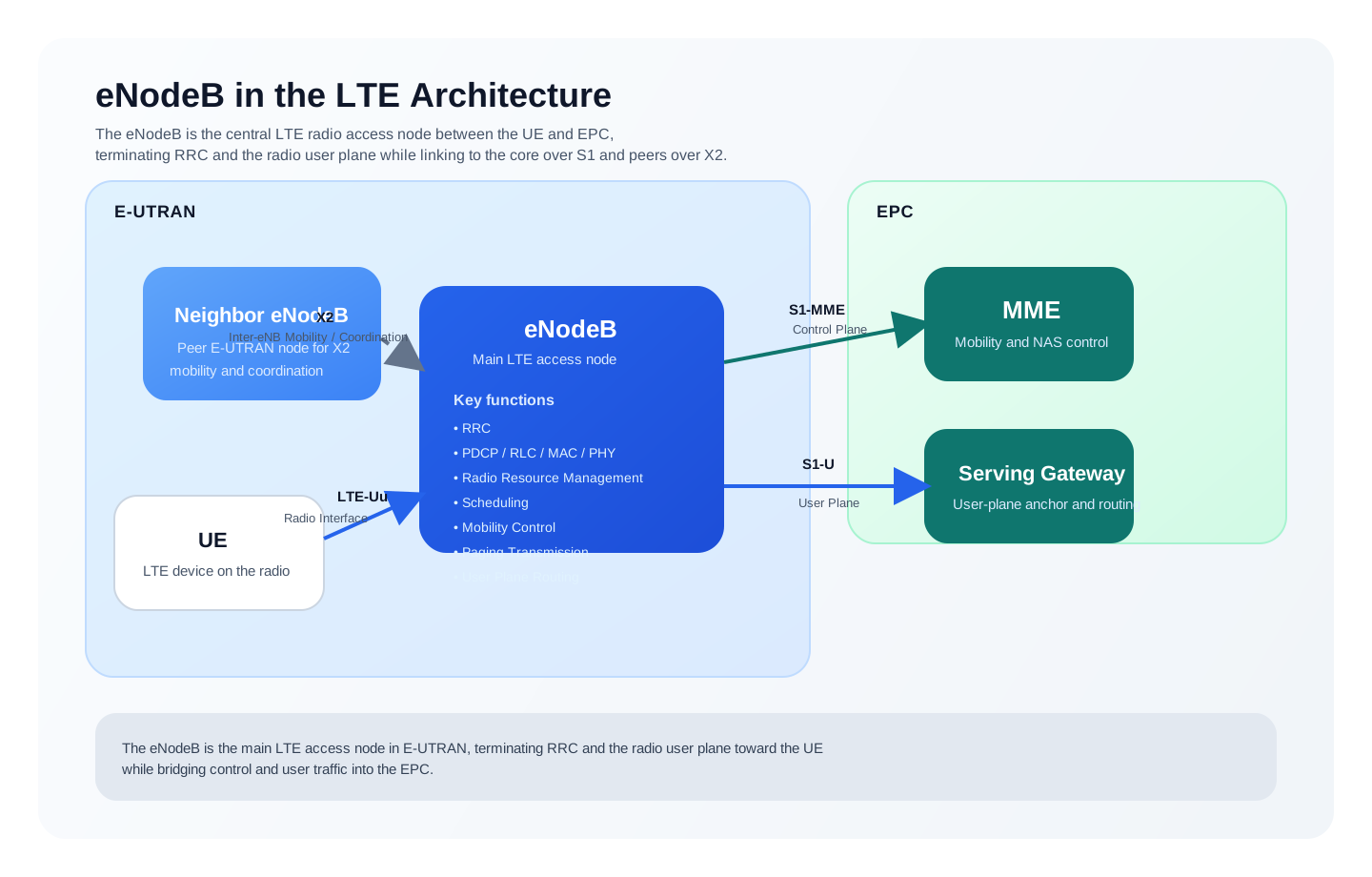
| Architecture position | Why it matters |
|---|---|
| UE-facing side | Terminates the LTE access protocols and controls radio behavior toward the device. |
| EPC-facing control side | Uses S1-MME to carry access-side control signaling toward the MME. |
| EPC-facing user side | Uses S1-U to forward user-plane traffic toward the Serving Gateway. |
| Neighbor eNB side | Uses X2 for mobility coordination, context transfer, and inter-eNB support functions. |
What does the eNodeB do?
3GPP assigns the eNB a broad set of functions. Architecturally, it is not just a base station in the narrow RF sense. It is the main LTE access-side control point for radio admission, bearer realization, mobility execution, paging delivery, and packet forwarding.
- Radio Resource Management, including Radio Bearer Control, Radio Admission Control, Connection Mobility Control, and dynamic allocation of uplink and downlink resources
- IP header compression and encryption of the user data stream
- Scheduling and transmission of paging messages that originate from the MME
- Routing user-plane data toward the Serving Gateway
- Selection of an MME at UE attachment when no routing information is available from UE-provided information
eNodeB control plane and user plane role
The eNB terminates both LTE access-side planes toward the UE. This is a key architectural point: the eNB handles RRC, but does not terminate NAS. NAS belongs to the core-network side, while the eNB transports it between the UE and the EPC.
| Plane | eNodeB role |
|---|---|
| Control plane | Terminates RRC toward the UE. |
| User plane | Terminates PDCP, RLC, MAC, and PHY toward the UE. |
Main interfaces of the eNodeB
| Interface | Role for the eNodeB |
|---|---|
| LTE-Uu | Connects the UE and the eNB and carries the LTE radio user plane and RRC control plane. |
| S1-MME | Connects the eNB to the MME for control-plane signaling. |
| S1-U | Connects the eNB to the Serving Gateway for user-plane traffic. |
| X2 | Connects one eNB to another eNB for inter-eNB signaling, mobility support, and related coordination. |
eNodeB and radio resource management
One of the most important eNB responsibilities is Radio Resource Management (RRM). In practical terms, this means the eNB decides how radio resources are assigned, whether new bearers can be admitted, how mobility is executed at the radio level, and how users are scheduled across time and frequency resources.
- Radio Bearer Control
- Radio Admission Control
- Connection Mobility Control
- Dynamic resource allocation in uplink and downlink
eNodeB and RRC
The RRC protocol belongs to the access-side control plane and is terminated in the eNB. This makes the eNB the node that controls connection setup, reconfiguration, measurement configuration, mobility-related RRC signaling, and radio-bearer-related configuration at the access side.
That makes the eNB the operational decision point for many radio-side mobility actions, even when EPC signaling is also involved in the wider procedure.
- RRC connection setup
- RRC connection reconfiguration
- measurement configuration
- mobility-related RRC signaling
- radio-bearer-related configuration at the access side
LTE RRC Overview
Protocol-level context for the control functions the eNB terminates.
RRC States
Read how idle and connected behavior shape access-side control.
RRC Timers and Constants
Follow timing behavior behind setup, mobility, and release.
LTE RRC Messages
Browse the message set the eNB exchanges with the UE.
eNodeB and bearer handling
The eNB is central to how LTE bearers are realized on the radio side. This is important architecturally because it shows that the eNB is where core-network bearer intent becomes real radio treatment. The EPC may decide that a bearer exists, but the eNB has to map that bearer into actual radio resources and maintain the access-side part of the bearer path.
Default EPS Bearer Establishment
See how access and core work together to build connectivity.
Initial Context Setup
Follow radio and S1 bearer creation around access context setup.
E-RAB Setup Procedure
Look at bearer setup where access-side and EPC intent meet.
LTE RAN Hub
Return to the broader E-UTRAN architecture page.
eNodeB and paging
The eNB is also involved in paging delivery. The EPC decides that paging is needed, but the eNB performs the radio-side work to deliver the paging message in the LTE access network. That split explains why paging troubleshooting often requires both EPC-side and radio-side investigation.
eNodeB and mobility
Mobility is one of the defining architectural responsibilities of the eNB. LTE handover is not just a core-network procedure. The eNBs themselves coordinate key access-side mobility actions, especially over X2.
- radio-interface mobility
- context transfer from source eNB to target eNB
- control of user-plane transport bearers
- handover cancellation
- UE context release
- load management
- inter-cell interference coordination
- self-optimization data exchange
X2 Handover Procedure
See how eNB-to-eNB coordination works during handover.
S1 Handover Procedure
Compare EPC-assisted handover against the X2 path.
Intra-LTE Handover Procedure
Follow the broader connected-mobility path across cells.
Measurement Reporting Procedure
See how mobility decisions begin with measurement behavior.
eNodeB and EPC anchoring decisions
The eNB is responsible for routing user-plane data toward the Serving Gateway. This pairing matters because the eNB forwards the radio-side user plane into the EPC, while the Serving Gateway provides continuity for that traffic during mobility. Together, they define the access-to-core user-plane transition in LTE.
The eNB can also participate in access-side control decisions that affect how the UE is anchored into the core network at attach time, including MME selection when routing cannot be determined from UE-provided information.
eNodeB context handling and deployment flexibility
The architecture defines an eNB UE context for a UE in ECM-CONNECTED, and that context may continue to exist after the S1 logical connection has been removed in certain cases. This matters for troubleshooting because not every connection release means that every piece of UE context disappears immediately.
The eNB can also participate in shared and flexible deployments. In shared cells, system information can contain multiple PLMN IDs, and E-UTRAN selects an appropriate MME for the PLMN indicated by the UE.
How the eNodeB fits into end-to-end LTE procedures
This is why the eNB is one of the most important reference nodes in LTE. It is the point where radio protocols, transport connectivity, bearer handling, and mobility all meet.
- Attach: provides radio access and forwards signaling toward the EPC
- Service Request: re-establishes active signaling and user-plane paths
- Paging: delivers radio-side paging messages
- Handover: coordinates context and bearer transition across cells
- Bearer establishment and release: realizes access-side bearer behavior
Key takeaways
- The eNodeB is the central access node in LTE E-UTRAN.
- It terminates the LTE radio user plane (PDCP, RLC, MAC, PHY) and RRC control plane toward the UE.
- It connects to the EPC over S1-MME and S1-U, and to neighboring eNBs over X2.
- Its functions include radio resource management, bearer control, paging transmission, MME selection, mobility control, and user-plane routing toward the Serving Gateway.
- The eNB is a core reference point for understanding LTE attach, paging, bearer handling, and handover behavior.
FAQ
What is an eNodeB in LTE?
The eNodeB is the main radio-access node in the LTE E-UTRAN. It terminates the LTE radio user plane and RRC control plane toward the UE, connects to the EPC over S1, and connects to neighboring eNBs over X2.
Does the eNodeB handle NAS?
No. The eNB handles RRC and transports NAS signaling between the UE and the EPC, but NAS itself belongs to the core-network side.
What are the main interfaces of the eNodeB?
The main eNB interfaces are LTE-Uu toward the UE, S1-MME toward the MME, S1-U toward the Serving Gateway, and X2 toward neighboring eNBs.
Does the eNodeB control mobility?
Yes. For the RRC connection, mobility is controlled by the E-UTRAN, and the eNB is a central decision point for access-side mobility behavior.
Why is the eNodeB important in LTE?
Because it combines radio protocol termination, radio resource management, bearer control, paging delivery, mobility execution, and user-plane forwarding in one main access-side node.