LTE Measurement Events Explained
LTE measurement events define when a UE reports radio conditions to the eNodeB. They are configured through RRC signaling and evaluated by the UE against measured radio conditions such as RSRP and RSRQ.
These events matter because they are one of the main inputs to LTE mobility decisions. The UE measures serving and neighbor cells, checks the configured event logic, sends a Measurement Report, and the eNB decides whether to trigger handover, prepare for mobility, or simply keep monitoring.
Quick facts
| Main event family | A1, A2, A3, A4, A5 for intra-LTE measurement reporting |
|---|---|
| Configured by | RRCConnectionReconfiguration and measurement configuration objects |
| Measured quantities | RSRP and RSRQ in common LTE deployments |
| Main consumers | eNodeB mobility logic and optimization rules |
| Most common handover trigger | Event A3 |
| Stability controls | Offset, hysteresis, and time-to-trigger |
Contents
- Where measurement events fit in LTE
- Why measurement events matter
- Measurement configuration through RRC
- Event A1: serving becomes better than threshold
- Event A2: serving becomes worse than threshold
- Event A3: neighbor becomes better than serving by an offset
- Event A4: neighbor becomes better than threshold
- Event A5: serving becomes bad and neighbor becomes good
- A1 to A5 at a glance
- Thresholds, offsets, hysteresis, and time-to-trigger
- Measurement quantities behind the events
- How measurement events drive mobility
- Measurement events and RRC context
- How this differs from idle mode
- Common troubleshooting notes
- Optimization strategies
- Typical procedures or call flows using measurement events
- Related pages / next steps
- Key takeaways
- FAQ
Where measurement events fit in LTE
Measurement events are the decision input layer between radio observation and mobility action. The UE measures the serving cell and neighbors, evaluates the configured event conditions, reports when the condition is met, and the eNB uses that report as one input to its mobility logic.
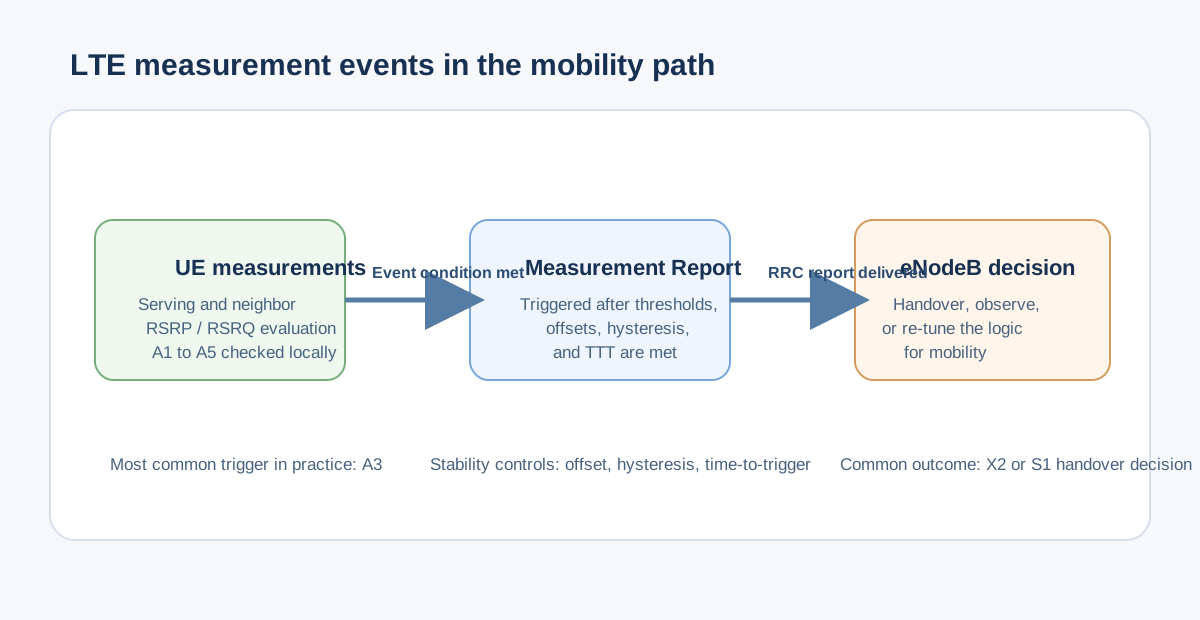
| Step | What happens |
|---|---|
| UE measures | The UE measures serving and neighbor-cell conditions such as RSRP or RSRQ. |
| Event condition checked | The UE compares the measurement result with the configured event logic. |
| Measurement Report sent | The UE sends a report when the configured event condition persists as required. |
| Mobility decision | The eNB decides whether to trigger handover, continue observation, or adjust the configuration. |
Why measurement events matter
Without measurement events, LTE mobility would be less adaptive and more brittle. The network needs a structured way to know when the serving cell is weak, when a neighbor is promising, and when a move is truly justified.
- trigger handover decisions before the serving link degrades too far
- support cleaner mobility and lower drop rates
- help avoid unnecessary handovers through controlled thresholds
- allow the network to react to changing radio conditions instead of using fixed assumptions
- support load-aware and optimization-aware mobility strategies
Measurement configuration through RRC
Measurement behavior is configured through RRC, commonly through RRCConnectionReconfiguration. The network tells the UE what to measure, what event logic to apply, and how stable the condition must be before a report is sent.
- measurement objects for frequencies or cells
- report configuration such as A1 to A5
- measurement identity mapping
- thresholds and offsets
- hysteresis
- time-to-trigger
Event A1: serving becomes better than threshold
A1 means the serving cell becomes better than a configured threshold. In practice, it is often used to confirm that radio conditions have recovered or are comfortably within the desired operating range.
Engineers often read A1 as a “serving is good again” event rather than a handover trigger. It can be useful for controlling reporting behavior and reducing unnecessary continued reporting once conditions improve.
Event A2: serving becomes worse than threshold
A2 means the serving cell becomes worse than a configured threshold. This is one of the main ways the UE signals that the current serving link is degrading and that more attention may be needed.
A2 is often used to open the door for further mobility logic, measurement expansion, or preparation behavior when the current cell no longer looks comfortably healthy.
Event A3: neighbor becomes better than serving by an offset
A3 is the classic LTE handover event. It means a neighbor becomes better than the serving cell by a configured offset. Because it compares relative quality rather than only absolute thresholds, it adapts well to real radio conditions.
This is why A3 is the most common trigger for connected-mode handover in LTE. It expresses the practical question the network cares about most: “Is there now a better cell than the one we are serving from?”
Event A4: neighbor becomes better than threshold
A4 means a neighbor becomes better than a configured threshold. Unlike A3, it is not directly comparing the neighbor against the current serving cell with an offset. Instead, it checks whether a neighbor is strong enough on its own to matter.
A4 is useful when the network wants to detect promising neighbors, including inter-frequency or broader measurement situations, without requiring the full A3 relative comparison model.
Event A5: serving becomes bad and neighbor becomes good
A5 is a dual-condition event. It requires the serving cell to become worse than one threshold and a neighbor to become better than another threshold. This makes it a more controlled trigger than a simple one-sided event.
A5 is often used when engineers want a stronger handover case and more stability before the network reacts. It helps reduce unnecessary mobility by demanding both a weak serving condition and a sufficiently attractive target.
A1 to A5 at a glance
| Event | Meaning | Typical role |
|---|---|---|
| A1 | Serving becomes good | Reduce or stop extra reporting when conditions recover. |
| A2 | Serving becomes bad | Flag serving degradation and prepare for stronger mobility attention. |
| A3 | Neighbor better than serving by offset | Main LTE handover trigger in many deployments. |
| A4 | Neighbor better than threshold | Detect promising neighbors for mobility logic. |
| A5 | Serving bad and neighbor good | More controlled and stable handover trigger. |
Thresholds, offsets, hysteresis, and time-to-trigger
The event label alone does not decide mobility behavior. The practical behavior depends on the tuning around the event, especially thresholds, offsets, hysteresis, and time-to-trigger (TTT).
These parameters are what separate a stable mobility design from a noisy one. Poor tuning can create ping-pong handovers, late handovers, or reports that are too frequent to be useful.
| Parameter | Why it matters |
|---|---|
| Threshold | Defines what level is considered good or bad for serving or neighbor conditions. |
| Offset | Used especially in A3 to require the neighbor to be sufficiently better than the serving cell. |
| Hysteresis | Adds stability so small fluctuations do not trigger reports too easily. |
| Time-to-trigger | Requires the condition to remain true for a defined time before reporting. |
Measurement quantities behind the events
LTE measurement events are commonly evaluated using RSRP and RSRQ. Those quantities give the UE a practical view of signal power and signal quality, which the event logic then turns into structured reporting behavior.
The network does not directly act on raw signal values alone. It acts on the event outcome after those values are processed through the configured event rules.
How measurement events drive mobility
This is the practical link between measurement events and connected-mode mobility. Events do not hand over the UE by themselves. They create the evidence the eNB uses to decide whether handover should happen.
- the UE measures serving and neighbor cells
- the configured event condition becomes true
- the UE sends a Measurement Report
- the eNB evaluates the report together with topology and policy context
- the eNB may trigger handover or continue monitoring
Measurement events and RRC context
Measurement configuration is part of the RRC context. The eNB keeps track of the UE-specific configuration, the UE evaluates the configured logic while connected, and that mobility-related state needs to remain coherent across reconfiguration and handover.
This is why broken measurement behavior is often an RRC-context problem as much as a radio problem. A missing report may come from a bad threshold, but it may also come from incomplete context setup or transfer.
How this differs from idle mode
A1 to A5 are primarily associated with connected-mode measurement reporting. Idle mode uses its own cell-selection and reselection logic, which is still measurement-based but is UE controlled rather than driven by the connected-mode event framework.
That is why engineers should keep idle reselection and connected handover logic separate even though both depend on radio measurements.
Common troubleshooting notes
These problems typically show up as handover failures, dropped calls, poor throughput near cell edges, or unstable mobility behavior that looks random until the event configuration is inspected.
- thresholds are too aggressive or too conservative
- A3 offset is too small, causing ping-pong handovers
- time-to-trigger is too short or too long
- neighbor definitions are missing or incorrect
- reports arrive too late to protect the link
- measurement configuration is not aligned with the real RF environment
Optimization strategies
Operators tune measurement behavior by adjusting A3 offsets, thresholds, hysteresis, and TTT values, and by improving neighbor relations. The goal is to reduce ping-pong behavior while still handing over early enough to protect service continuity.
Good mobility optimization is not only about choosing the “best” event. It is about matching the event logic and tuning to the deployment, RF environment, traffic profile, and user-mobility pattern.
Typical procedures or call flows using measurement events
- Measurement reporting is the direct procedure path for A1 to A5 evaluation.
- X2 handover often uses measurement-event-driven reporting as the handover trigger input.
- S1 handover also depends on the same measurement-driven trigger logic when EPC assistance is needed.
Key takeaways
- LTE measurement events turn UE measurements into structured mobility input for the eNodeB.
- A3 is the main LTE handover event in many deployments.
- A5 is a more controlled trigger because it requires both a weak serving cell and a good neighbor.
- Thresholds, offsets, hysteresis, and time-to-trigger are critical for stable mobility behavior.
- Measurement events matter because they drive measurement reporting, handover decisions, and mobility optimization.
- Broken measurement-event tuning often shows up as ping-pong handovers, late handovers, or unnecessary reports.
FAQ
What are LTE measurement events?
LTE measurement events are configured conditions that tell the UE when to send a measurement report to the eNodeB.
Which LTE event is most commonly used for handover?
Event A3 is the most common handover trigger because it compares the neighbor against the current serving cell by an offset.
What is Event A5 in LTE?
Event A5 is a dual-condition event where the serving cell becomes worse than one threshold and a neighbor becomes better than another threshold.
What do RSRP and RSRQ do in measurement events?
RSRP and RSRQ are common LTE measurement quantities used by the UE to evaluate whether the configured event condition is met.
What is time-to-trigger in LTE measurement reporting?
Time-to-trigger means the event condition must stay true for a configured period before the UE sends the report, which helps reduce unstable mobility behavior.