LTE NAS Overview
LTE NAS is the Non-Access Stratum signaling layer between the UE and the EPC control plane. It sits above the radio access signaling path and carries EPS mobility and session-control procedures such as attach, tracking area update, service request, detach, authentication, security handling, and bearer-related signaling.
NAS does not build the radio connection by itself. It relies on the LTE RRC path to carry its messages, then controls what the UE is allowed to do in EPS once that access path exists. Many live behaviors visible in tracking area update, paging return, service continuity, bearer setup, and security handling depend on NAS state and message flow.
Quick facts
| Technology | LTE / EPS |
|---|---|
| Protocol | NAS |
| Main spec | 3GPP TS 24.301 |
| Architecture context | 3GPP TS 23.401 and 3GPP TS 36.300 |
| Release | Release 18 |
| Above NAS | Core-network service and mobility logic in EPS |
| Below NAS | LTE RRC and the radio access path that carries NAS messages |
| Core topics | EMM, ESM, attach, TAU, service request, detach, bearer context control, paging relation, and security |
NAS topics
LTE NAS Messages | Timers and Constants | EMM Cause Values | ESM Cause Values | EMM and ECM States | LTE RRC | Tracking Area Update | Paging | Security | Initial Access | EPS Fallback | LTE Reference Hub
Contents
Overview
LTE NAS is the control layer that manages EPS registration-style behavior, mobility update logic, service return, detach, authentication, security context handling, and bearer-session signaling after the access path is available. It is broader than a single attach procedure and should be read as the control plane that keeps the UE known, reachable, and service-capable inside EPS.
The useful reading pattern is: first identify whether the active branch is mobility-oriented EMM or session-oriented ESM, then identify the live procedure, then inspect the specific NAS messages and their result. A failed attach, a repeated TAU, and an unstable service request are all NAS-visible problems, but they are not the same branch.
Position in the stack
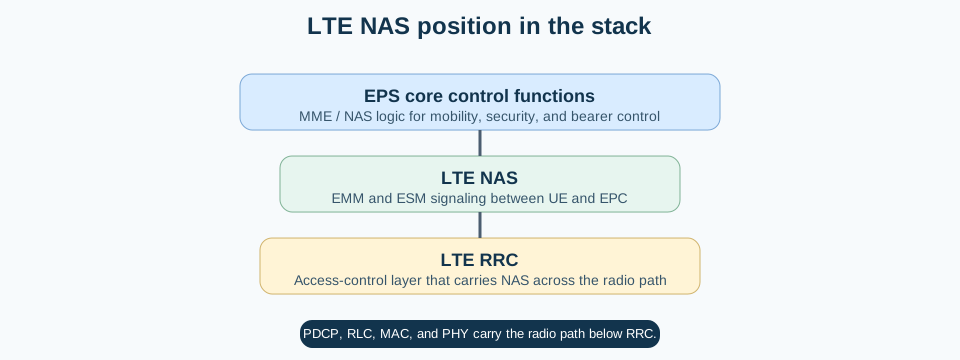
NAS sits above the LTE access stratum. The UE and EPC exchange NAS through the radio and access-control path, but NAS itself is not the radio-control layer. LTE RRC brings up the dedicated access path, and NAS then uses that path for EPS mobility and session-control signaling.
| Layer or function | Relation to NAS |
|---|---|
| EPS core control functions | Provide the mobility, authentication, bearer, and session logic that NAS signaling carries. |
| NAS | Controls UE reachability, mobility, service return, detach, and bearer/session behavior in EPS. |
| RRC | Carries NAS over the radio access path and controls the radio connection used by NAS signaling. |
| PDCP / RLC / MAC / PHY | Carry the radio data path below RRC after the access path is established. |
Main functions
| Function | Meaning | Why it matters |
|---|---|---|
| EPS mobility control | Tracks whether the UE is known, registered, reachable, and updated in the right tracking area. | Drives attach, TAU, detach, paging-related reachability, and service return behavior. |
| Session and bearer control | Controls PDN connectivity and EPS bearer context signaling. | Determines how the UE gets usable service and bearer state after registration. |
| Authentication and security context handling | Controls NAS-side authentication state and security context progression. | Many attach and service failures are really security-context problems before later access signaling continues. |
| Idle reachability and service return | Determines how the UE returns from idle when service or signaling is needed. | Useful for paging, service request, and return-to-service troubleshooting. |
| Interworking and fallback control | Coordinates behavior when service moves across LTE, EPS, and related fallback paths. | Matters for EPS fallback, mobility, and mixed-service environments. |
EMM and ESM
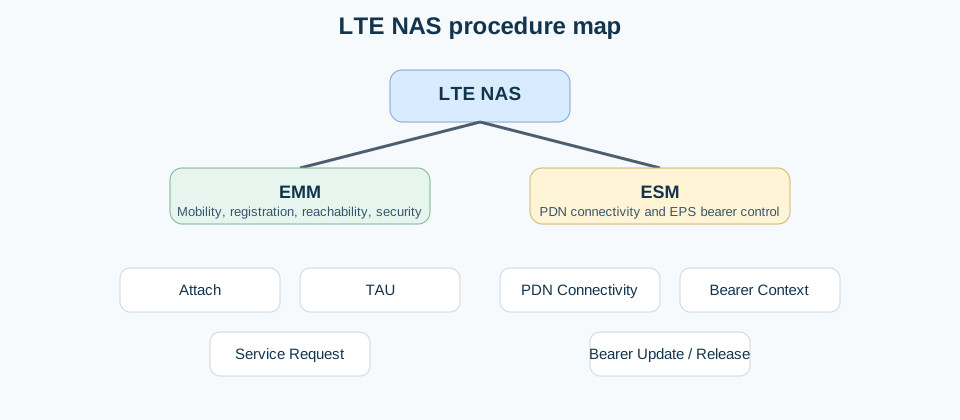
LTE NAS is usually read through two main branches: EPS Mobility Management and EPS Session Management.
| Branch | Main scope | Examples |
|---|---|---|
| EMM | Registration-style mobility control, reachability, authentication, security, and detach behavior. | Attach, TAU, service request, paging-related reachability, detach, authentication. |
| ESM | Session and bearer control once EPS service is available. | PDN connectivity, default bearer setup, dedicated bearer handling, bearer update or release. |
This split is important because a problem that looks like a general LTE NAS issue is often only one branch. Attach and TAU are mainly EMM-driven. Bearer activation and PDN connectivity are ESM-driven. Service-request problems often need both.
Main procedures
| Procedure | Main branch | Why it matters |
|---|---|---|
| Attach | EMM with ESM interaction | Establishes EPS registration and often the first usable bearer/session context. |
| Tracking Area Update | EMM | Keeps the UE reachable and mobility context correct as the UE moves or refreshes state. |
| Service Request | EMM with ESM interaction | Returns the UE to active service handling when idle-mode reachability is used. |
| Detach | EMM | Ends EPS registration and changes UE reachability state. |
| PDN connectivity and bearer control | ESM | Determines whether the UE gets the bearer/session state needed for service continuity. |
Messages and information elements
LTE NAS messages are best read through the active procedure branch and the result of the message exchange rather than as an isolated decode list. The most useful categories are:
- EMM registration and mobility messages such as attach, TAU, service request, and detach.
- Authentication and security-context messages that determine whether NAS can continue securely.
- ESM messages for PDN connectivity and EPS bearer context handling.
- Cause fields, timers, identities, and bearer/session fields that explain why the procedure moved the way it did.
Message library: LTE NAS Messages
Cross-layer interaction
| Layer or interface | Relation to NAS |
|---|---|
| RRC | Provides the radio control path that carries NAS signaling between the UE and the EPC. |
| S1AP | Transfers NAS between the radio access side and the EPC control plane. |
| Paging and broadcast configuration | Idle reachability depends on both NAS service need and the LTE paging and broadcast path that carries it. |
| Security handling | NAS authentication and security context progression affect whether later access and service signaling can continue. |
A good LTE NAS read usually crosses protocol boundaries. A failed service request might start as idle paging, pass through RRC, continue into NAS mobility handling, and only later show a bearer or service-side failure.
NAS in call flows
| Procedure area | Why NAS matters |
|---|---|
| Initial attach | NAS carries the registration and bearer-session side after the radio access path becomes available. |
| Tracking Area Update | NAS keeps mobility and reachability context current as the UE moves or refreshes state. |
| Paging return and service request | NAS determines what service or signaling must resume once the UE is reachable again. |
| Detach and release-side transitions | NAS changes whether the UE remains registered and reachable in EPS. |
| Bearer activation and service continuity | NAS carries the session and bearer-side control needed for usable service after mobility or access events. |
Release 18 scope
Release 18 LTE NAS is not a new protocol family, but the current reading scope still matters. A useful LTE NAS page today needs to cover the classic EPS mobility and session-management model while still being practical for mixed-service, fallback, paging-return, and bearer-continuity analysis in modern networks.
| Traditional LTE NAS focus | Release 18 reading scope |
|---|---|
| Attach and detach only | Attach, TAU, service request, detach, paging return, bearer control, and interworking behavior |
| Mobility only | Mobility plus security context handling and service continuity |
| Single-message decode | Procedure-based reading across NAS, RRC, paging, and core-facing transfer paths |
Troubleshooting
| Symptom | NAS area to inspect | Why |
|---|---|---|
| Attach does not complete | EMM registration flow, authentication, security progression, and first bearer/session handling | Attach failures often span mobility, security, and bearer control rather than only one message. |
| Tracking Area Update repeats | TAU message sequence, reachability context, and mobility update acceptance | Repeated TAU often points to unstable mobility or reachability context. |
| Paging reaches the UE but service still does not return | Service-request and NAS continuation after the radio return path | The radio wake-up can succeed while the NAS service branch still fails. |
| Bearer or PDN context looks wrong | ESM message flow, bearer/session fields, and acceptance result | Session and bearer-side problems are usually in the ESM branch, not in mobility registration alone. |
| Security or authentication loops appear | NAS authentication and security context handling | Many later failures are only downstream effects of a broken NAS security path. |
References
- 3GPP TS 24.301 Release 18 : main EPS mobility management and EPS session management NAS specification.
- 3GPP TS 23.401 Release 18 : EPS architecture and procedure context for NAS behavior.
- 3GPP TS 36.300 Release 18 : E-UTRAN and EPS access-side context for how LTE carries NAS signaling.
FAQ
What is LTE NAS?
LTE NAS is the Non-Access Stratum protocol family between the UE and the EPC control plane. It carries EPS mobility and session-control signaling above the LTE access stratum.
Which spec defines LTE NAS?
The main LTE NAS protocol specification is 3GPP TS 24.301. Architecture context comes from 3GPP TS 23.401 and 3GPP TS 36.300.
What is the difference between EMM and ESM?
EMM handles EPS mobility and registration-style control such as attach, TAU, service request, detach, authentication, and security. ESM handles bearer and PDN connectivity control.
Why is LTE NAS important for troubleshooting?
LTE NAS shows whether attach, TAU, service request, detach, bearer setup, and security-related control actually progressed correctly after the radio access path was available.