What does REGISTER do in IMS?
It creates or refreshes the UE contact binding so the IMS core can route later service signaling to the UE.
| Protocol | ims | Network | 5G and LTE |
|---|---|---|---|
| Spec | RFC 3261 / 3GPP TS 24.229 | Spec Section | SIP REGISTER method and IMS registration procedures |
| Direction | UE <-> IMS network | Message Type | SIP request method |
| Full message name | IMS SIP REGISTER |
|---|---|
| Protocol | IMS |
| Technology | 5G and LTE |
| Common deployment | VoNR and VoLTE |
| Direction | UE <-> IMS network |
| Interface | Gm (UE <-> P-CSCF) with onward IMS core routing |
| Signaling bearer / channel | IMS SIP signaling / SIP transaction and dialog control over the IMS access path |
| Typical trigger | UE powers on IMS service, refreshes registration before expiry, or re-registers after loss of IMS service continuity. |
| Main purpose | Lets the UE bind its public identity and contact information to the IMS core so later calls, messaging, and service signaling can reach it. |
| Main specification | RFC 3261 / 3GPP TS 24.229, SIP REGISTER method and IMS registration procedures |
| Release added | See specification history |
| Procedures where used | IMS Registration, VoLTE Registration, VoNR Registration |
REGISTER is the SIP request that creates, refreshes, or removes IMS service reachability for the UE.
Lets the UE bind its public identity and contact information to the IMS core so later calls, messaging, and service signaling can reach it.
REGISTER is the IMS request that makes the UE reachable for later voice, messaging, and service signaling.
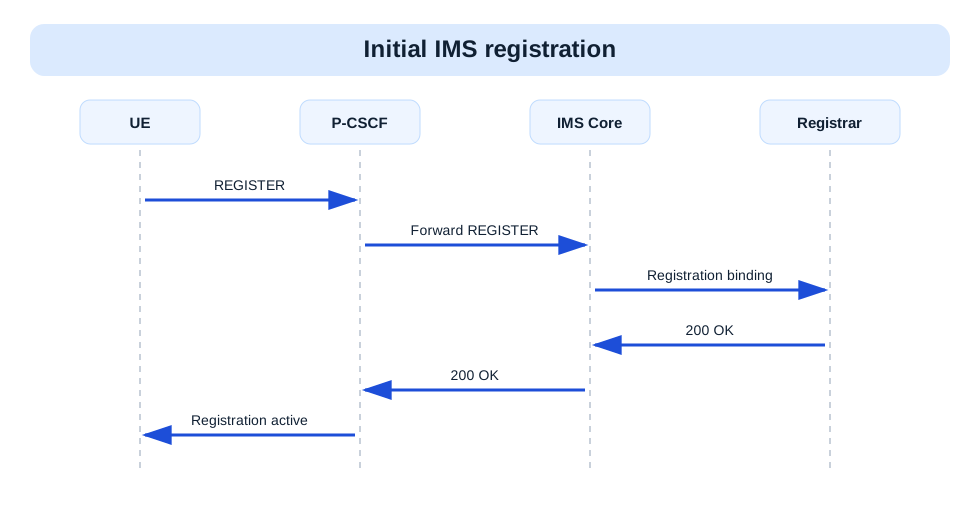
Call flow position: First SIP request that establishes service reachability in the IMS core.
Typical state: UE has IP connectivity and is trying to become reachable for IMS services.
Preconditions:
Next likely message: 401 Unauthorized or 200 OK
Call flow position: IMS-side registration step after 5G access and session setup are already usable.
Typical state: UE is preparing voice service reachability over IMS.
Preconditions:
Next likely message: Authentication challenge or successful registration acceptance
Previous message(s): PDN connectivity and IMS bearer are available
Next message(s): 401 Unauthorized, 200 OK
Security context: Usually tied to IMS AKA, SIP digest-style authentication, and the protected access path toward the P-CSCF.
REGISTER sip:ims.example.net SIP/2.0
Via:
From:
To:
Call-ID:
CSeq:
Contact:
Expires:                           OPTIONAL
Authorization:                     OPTIONAL
Supported:                         OPTIONAL
P-Access-Network-Info:             OPTIONAL
User-Agent:                        OPTIONAL
Content-Length:
This is SIP message syntax rather than ASN.1. Read it as a request line followed by IMS-relevant headers.
REGISTER sip:ims.example.net SIP/2.0
Via: SIP/2.0/UDP ue.example.net;branch=z9hG4bK-1
From: <sip:alice@example.net>;tag=reg1
To: <sip:alice@example.net>
Call-ID: reg-001@example.net
CSeq: 1 REGISTER
Contact: <sip:alice@192.0.2.10:5060>;expires=600
Expires: 600
P-Access-Network-Info: 3GPP-NR-FDD;utran-cell-id-3gpp=001010123456789
Content-Length: 0
| IE | Required | Description |
|---|---|---|
Request-URI | Yes | Identifies the registrar service target. |
To | Yes | Carries the public identity being registered. |
From | Yes | Identifies the originator of the registration transaction. |
Call-ID | Yes | Correlates all REGISTER transactions that belong to the same registration context. |
CSeq | Yes | Orders REGISTER attempts and refreshes. |
Contact | Yes | Provides the contact binding that should become reachable in IMS. |
Expires | Optional | Requests the binding lifetime or removal behavior. |
Authorization | Optional | Carries the authentication response after the network challenges the request. |
Request-URIIdentifies the registrar service target.
Presence: Required
In practice: In practice, compare this field with the original request and with any later release-dependent optional fields so you can see whether the network accepted the same service model the UE asked for.
ToCarries the public identity being registered.
Presence: Required
In practice: In practice, compare this field with the original request and with any later release-dependent optional fields so you can see whether the network accepted the same service model the UE asked for.
FromIdentifies the originator of the registration transaction.
Presence: Required
In practice: In practice, compare this field with the original request and with any later release-dependent optional fields so you can see whether the network accepted the same service model the UE asked for.
Call-IDCorrelates all REGISTER transactions that belong to the same registration context.
Presence: Required
In practice: In practice, compare this field with the original request and with any later release-dependent optional fields so you can see whether the network accepted the same service model the UE asked for.
CSeqOrders REGISTER attempts and refreshes.
Presence: Required
In practice: In practice, compare this field with the original request and with any later release-dependent optional fields so you can see whether the network accepted the same service model the UE asked for.
ContactProvides the contact binding that should become reachable in IMS.
Presence: Required
In practice: In practice, compare this field with the original request and with any later release-dependent optional fields so you can see whether the network accepted the same service model the UE asked for.
ExpiresRequests the binding lifetime or removal behavior.
Presence: Optional
In practice: In practice, compare this field with the original request and with any later release-dependent optional fields so you can see whether the network accepted the same service model the UE asked for.
AuthorizationCarries the authentication response after the network challenges the request.
Presence: Optional
In practice: In practice, compare this field with the original request and with any later release-dependent optional fields so you can see whether the network accepted the same service model the UE asked for.
Likely cause: The REGISTER may be missing the expected identity, contact binding, or authentication follow-up.
What to inspect: Check Call-ID, CSeq progression, Contact, Expires, and any later Authorization header.
Next step: Correlate the request with the first challenge or success response instead of reading REGISTER alone.
Likely cause: The UE may be refreshing too often, reusing stale authentication state, or failing to hold a stable binding.
What to inspect: Compare repeated REGISTER requests for changing CSeq, Contact, and expiration values.
Next step: Find the response that restarts the loop and read it together with the most recent REGISTER.
REGISTER creates service reachability. INVITE starts a SIP session.
It creates or refreshes the UE contact binding so the IMS core can route later service signaling to the UE.
Decode this message with the 3GPP Decoder, inspect the related message database, or open the matching call flow to see where this signaling step fits in the full procedure.