Telecom engineering reference for protocols, messages, call flows, troubleshooting, releases, and tools.
Menu
LTE RRCLTEeNodeB -> UE3GPP TS 36.331
LTE RRC Paging
Downlink LTE RRC message used to notify an idle UE that the network needs its attention for service, signaling, system information change, or warning-related behavior.
Message Fact Sheet
Protocol
lte-rrc
Network
lte
Spec
3GPP TS 36.331
Spec Section
5.3.2, 6.2.2
Direction
eNodeB -> UE
Message Type
Paging / Idle Reachability
Full message name
LTE RRC Paging
Protocol
LTE-RRC
Technology
LTE
Direction
eNodeB -> UE
Interface
Uu
Signaling bearer / channel
Broadcast paging transport / PCCH
Typical trigger
Triggered when the network needs to reach an idle UE for mobile-terminated service, NAS signaling continuation, system information change notification, ETWS, or CMAS-related warning behavior.
Main purpose
Alerts the UE during idle-mode monitoring so it can start the right next step such as fresh access, paging response handling, or system-information reacquisition.
Main specification
3GPP TS 36.331, 5.3.2, 6.2.2
Release added
Release 8
Procedures where used
LTE Paging Procedure, Idle-mode UE reachability, Paging response from idle, System information change notification
What is LTE RRC Paging in simple terms?
Downlink LTE RRC message used to notify an idle UE that the network needs its attention for service, signaling, system information change, or warning-related behavior.
Alerts the UE during idle-mode monitoring so it can start the right next step such as fresh access, paging response handling, or system-information reacquisition.
Why this message matters
Paging is the LTE RRC message that gets an idle UE’s attention when the network needs it to wake up.
Where this message appears in the call flow
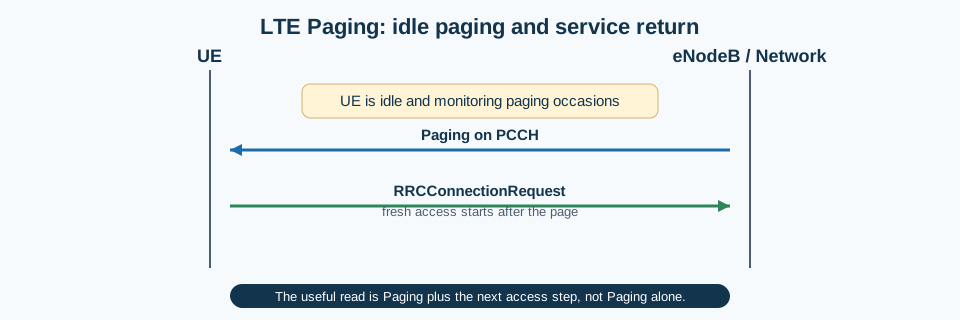
Idle paging and service return
In the normal service-return path, Paging gets the idle UE’s attention and the next step is fresh access using RRCConnectionRequest.
Call flow position: Broadcast paging step used while the UE is in LTE idle mode and the network needs it to return to active signaling.
Typical state: UE is camped, idle, and monitoring paging occasions according to broadcast configuration.
Preconditions:
The UE has valid paging-related broadcast information.
The UE is reachable in the serving area.
The network has data or signaling for the UE.
Next likely message: RRCConnectionRequest
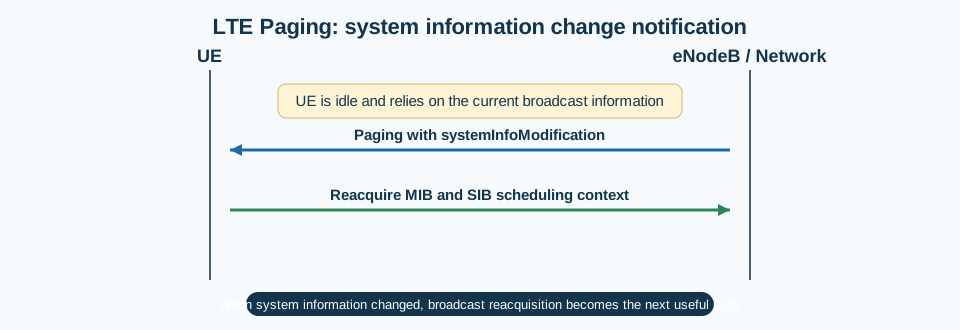
System information change notification
When Paging signals a system information change, the next useful reading path is broadcast reacquisition rather than immediate service return.
Call flow position: Paging-triggered notification path used when the UE needs to reacquire broadcast information.
Typical state: UE is idle and monitors paging occasions while relying on the current system information set.
Preconditions:
The cell has changed system information.
The UE is monitoring the relevant paging occasion.
Next likely message: Broadcast information reacquisition
Domain: Access-side radio control for LTE idle-mode UE reachability
Signaling bearer: Broadcast paging transport
Logical channel: PCCH
Transport / encapsulation: RRC paging message carried on PCCH and scheduled using P-RNTI
Security context: Paging is not carried on a dedicated SRB. It is broadcast in the relevant paging occasion and matched by UE identity and paging context.
Message Structure Overview
Paging is a compact RRC message used for idle-mode reachability.
The main reading path is to match the paging record to the UE, confirm the paging occasion, and then follow the next access or reacquisition step.
Paging issues are rarely solved by the PCCH decode alone. Broadcast configuration and the next UE action matter just as much.
The main trace questions are whether the correct UE identity appears in pagingRecordList, whether systemInfoModification is present, and what the UE does next.
Check whether the UE identity matches the target UE under investigation.
If the UE does not respond, confirm the page landed in the correct paging occasion and that the UE was actually monitoring it.
If systemInfoModification is present, the correct next path may be broadcast reacquisition rather than immediate service return.
Important Information Elements
IE
Required
Description
pagingRecordList
Yes
List of paging records used to identify the UE or UEs being paged.
ue-Identity
Yes
Identity value the UE uses to determine whether the page is meant for it.
systemInfoModification
Optional
Indicates that the UE should reacquire system information because the broadcast information changed.
etws-Indication / cmas-Indication
Optional
Warning-related indications used for public warning behavior.
nonCriticalExtension
Optional
Release-extension branch for later additions.
Detailed field explanation
pagingRecordList
List of paging records used to identify the UE or UEs being paged.
Presence: Required
In practice: In practice, compare this field with the original request and with any later release-dependent optional fields so you can see whether the network accepted the same service model the UE asked for.
ue-Identity
Identity value the UE uses to determine whether the page is meant for it.
Presence: Required
In practice: In practice, compare this field with the original request and with any later release-dependent optional fields so you can see whether the network accepted the same service model the UE asked for.
systemInfoModification
Indicates that the UE should reacquire system information because the broadcast information changed.
Presence: Optional
In practice: In practice, compare this field with the original request and with any later release-dependent optional fields so you can see whether the network accepted the same service model the UE asked for.
etws-Indication / cmas-Indication
Warning-related indications used for public warning behavior.
Presence: Optional
In practice: In practice, compare this field with the original request and with any later release-dependent optional fields so you can see whether the network accepted the same service model the UE asked for.
nonCriticalExtension
Release-extension branch for later additions.
Presence: Optional
In practice: In practice, compare this field with the original request and with any later release-dependent optional fields so you can see whether the network accepted the same service model the UE asked for.
What to check in logs and traces
Confirm the UE is in LTE idle mode when paging is sent.
Check SIB1-derived paging configuration and paging cycle assumptions.
Verify that the paging record contains the expected UE identity.
Correlate the page with the next UE action such as RRCConnectionRequest or system information reacquisition.
If the UE misses the page, compare radio conditions, paging occasion timing, and identity matching.
Common Issues and Troubleshooting
The network sends paging but the UE does not return to service.
Likely cause: The UE may have missed the paging occasion, the paging identity may not match, or the following access attempt may fail.
What to inspect: Check pagingRecordList, paging timing, broadcast paging configuration, and the next access messages.
Next step: Move from paging into the access path instead of stopping at the PCCH decode.
Paging appears but the UE reacquires broadcast information instead of returning to service.
Likely cause: systemInfoModification may be present, so the UE first needs to refresh system information.
What to inspect: Check whether the page is really a service page or a broadcast-change notification.
Next step: Continue into the system-information reading path.
Paging works in one cell but not another.
Likely cause: The difference may be in paging configuration, timing, radio conditions, or area reachability.
What to inspect: Compare SIB1 paging parameters, coverage, and UE tracking-area context across cells.
Next step: Validate whether the issue is cell-specific, UE-specific, or core-trigger related.
LTE / 5G / Variant Comparison
Paging versus dedicated LTE RRC messages
Paging is a PCCH message for idle reachability. It is not a dedicated SRB1 message like RRCConnectionSetup or RRCConnectionReconfiguration.
Paging versus system information change notification
Both use the paging path, but systemInfoModification changes the expected next UE action from service return toward broadcast reacquisition.
FAQ
What is Paging in LTE?
It is the downlink LTE RRC message used to notify an idle UE that the network needs its attention.
On which channel is LTE Paging sent?
Paging is carried on PCCH and scheduled using P-RNTI.
What usually comes after Paging in LTE?
In the normal service-return path, the UE starts fresh access and sends RRCConnectionRequest. In other cases it may reacquire system information first.
What should I inspect first in LTE Paging?
Start with pagingRecordList, UE identity matching, paging occasion timing, and the next UE action.
Decode this message with the 3GPP Decoder, inspect the related message database, or open the matching call flow to see where this signaling step fits in the full procedure.