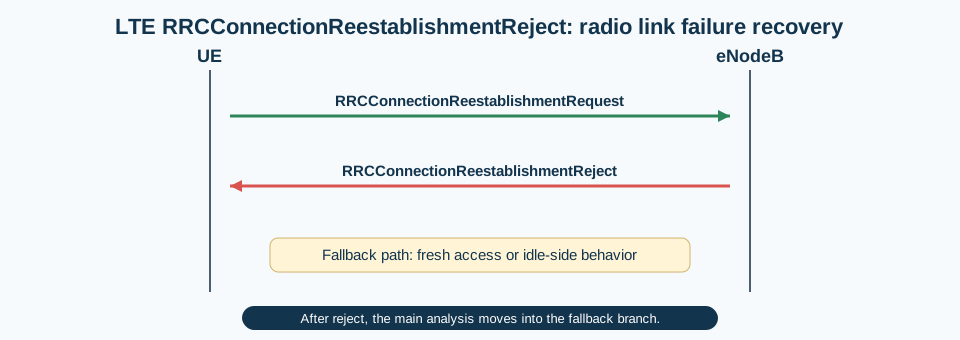
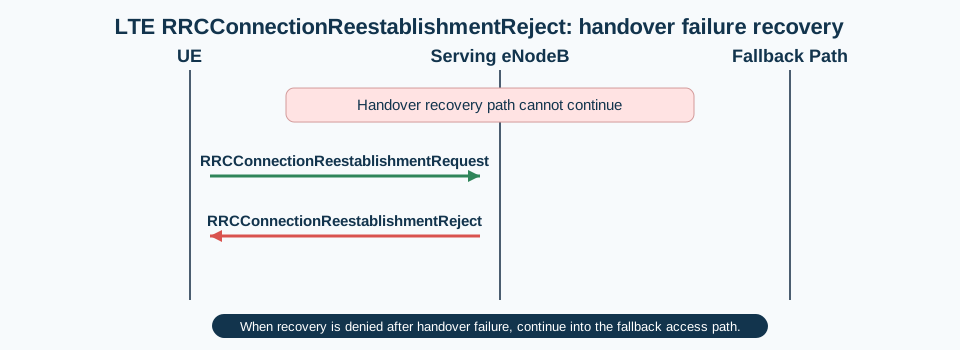
The main significance is procedural, not payload-heavy.
After this message, the useful next read is the fallback path rather than the reject structure itself.
If the UE later starts fresh access, that is usually expected behavior after the reject.
Important Information Elements
IE
Required
Description
criticalExtensions
Yes
Top-level wrapper for the reject message.
nonCriticalExtension
Optional
Release-extension branch for later additions.
Detailed field explanation
criticalExtensions
Top-level wrapper for the reject message.
Presence: Required
In practice: In practice, compare this field with the original request and with any later release-dependent optional fields so you can see whether the network accepted the same service model the UE asked for.
nonCriticalExtension
Release-extension branch for later additions.
Presence: Optional
In practice: In practice, compare this field with the original request and with any later release-dependent optional fields so you can see whether the network accepted the same service model the UE asked for.
What to check in logs and traces
Confirm the message follows RRCConnectionReestablishmentRequest.
Check what fallback behavior follows next.
Correlate the reject with the earlier failure cause and candidate-cell assumptions.
If a fresh access path starts next, treat that as the main continuation.
Do not stop at the reject; follow the next branch.
Common Issues and Troubleshooting
Recovery is attempted but the network rejects it.
Likely cause: The earlier connected context may no longer be recoverable, the identity may not match, or the recovery path may not be allowed.
What to inspect: Check the earlier failure path, UE identity assumptions, and the cell where recovery was attempted.
Next step: Follow the fallback path into fresh setup or idle behavior.
The reject appears after handover failure.
Likely cause: The failed mobility path may no longer be recoverable through re-establishment.
What to inspect: Read the reject together with the earlier mobility failure and what the UE does next.
Next step: Move from recovery analysis into fallback access analysis.
The trace ends at the reject.
Likely cause: The most useful part of the story may be missing after the reject.
What to inspect: Check whether the trace captured the later fresh access or idle fallback behavior.
Next step: Extend the trace window beyond the reject.
LTE / 5G / Variant Comparison
Compared with RRCConnectionReestablishment
RRCConnectionReestablishment accepts recovery. RRCConnectionReestablishmentReject ends the recovery attempt.
Compared with RRCConnectionRequest
After reject, the UE often has to move into a fresh access path that starts with RRCConnectionRequest.
FAQ
What is RRCConnectionReestablishmentReject in LTE?
It is the downlink LTE RRC message the network sends when the re-establishment attempt is not accepted.
What usually comes after RRCConnectionReestablishmentReject?
The UE usually moves into a fresh access path or another fallback behavior.
What should I inspect first in RRCConnectionReestablishmentReject?
Start with the earlier failure context and then follow the fallback path that comes after the reject.
Does the reject carry a detailed cause?
No. The message is structurally small, so the useful clues come from the wider procedure context.
Decode this message with the 3GPP Decoder, inspect the related message database, or open the matching call flow to see where this signaling step fits in the full procedure.