What is LTE RRC Connection Reject in simple terms?
Downlink LTE RRC message sent by the eNodeB when a fresh RRC connection establishment attempt is not accepted.
Ends the current LTE connection-establishment attempt and tells the UE that a dedicated connected context is not being created in this access attempt.
Why this message matters
RRCConnectionReject is the LTE network telling the UE that the current connection-establishment attempt is not accepted.
Where this message appears in the call flow
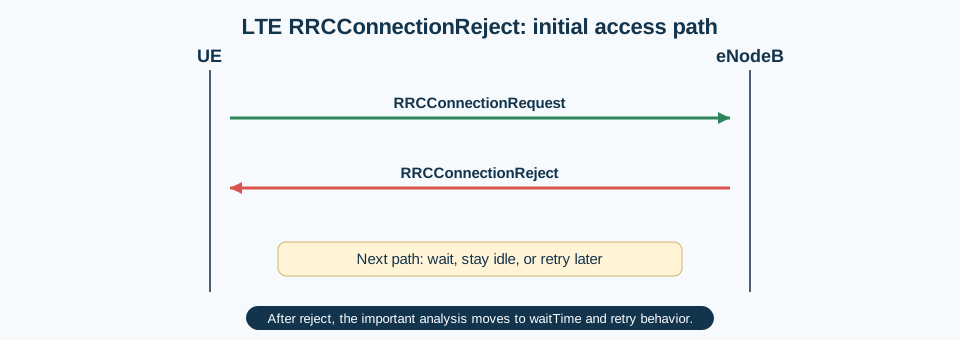
LTE initial access
In the reject path, RRCConnectionReject ends the current setup attempt and the next useful read is the retry or idle behavior.
Call flow position: Network reject step used when the fresh connection-establishment attempt is not accepted.
Typical state: UE is on the early CCCH setup path and has not entered stable connected-mode signaling.
Preconditions:
RRCConnectionRequest was sent.
The network chose not to proceed with setup.
Next likely message: Idle-side wait or a later fresh access retry
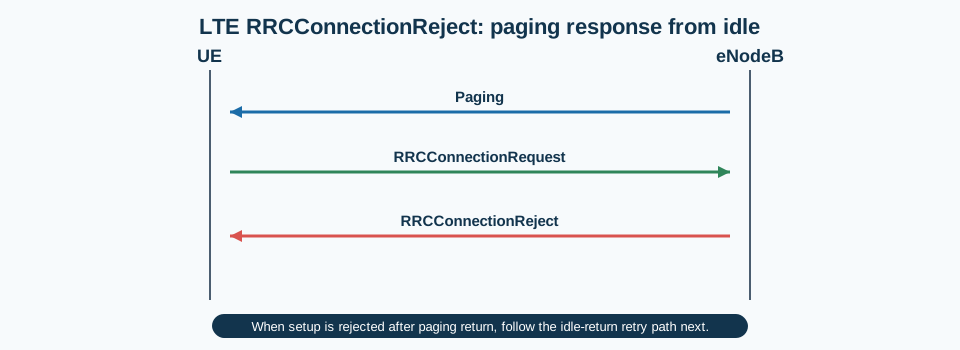
Paging response from idle
When the UE returns from idle after paging but setup is not accepted, the reject marks the failure boundary in the paging-return path.
Call flow position: Reject step used when the UE returned from idle due to paging or service need but the network still does not create a new connected context.
Typical state: UE is attempting fresh access after idle return.
Preconditions:
The UE started a new access attempt from idle.
The network does not continue with setup.
Next likely message: Later retry or continued idle-side behavior
If waitTime is present, it is one of the first fields to inspect.
Read waitTime together with the later retry gap because that is usually what explains the visible UE behavior after reject.
The practical meaning of the reject is mostly in the next UE behavior rather than the message payload itself.
Do not confuse a rejected LTE setup path with later dedicated signaling failure, because dedicated signaling never started.
Important Information Elements
IE
Required
Description
waitTime
Optional
Tells the UE how long to wait before retrying a fresh connection-establishment attempt and is the main practical timing field in the reject message.
nonCriticalExtension
Optional
Release-extension branch for later additions.
Detailed field explanation
waitTime
Tells the UE how long to wait before retrying a fresh connection-establishment attempt and is the main practical timing field in the reject message.
Presence: Optional
In practice: In practice, compare this field with the original request and with any later release-dependent optional fields so you can see whether the network accepted the same service model the UE asked for.
nonCriticalExtension
Release-extension branch for later additions.
Presence: Optional
In practice: In practice, compare this field with the original request and with any later release-dependent optional fields so you can see whether the network accepted the same service model the UE asked for.
What to check in logs and traces
Confirm the message follows RRCConnectionRequest.
Check whether waitTime is present.
Correlate the reject with why the access attempt happened in the first place.
Follow the next UE action: idle wait, retry, or later paging return.
Keep the analysis in the setup branch rather than jumping prematurely into later connected-mode issues.
Common Issues and Troubleshooting
The UE keeps attempting setup but receives RRCConnectionReject.
Likely cause: The network is not accepting fresh access at that point, and waitTime or wider access-control conditions may be shaping the retry pattern.
What to inspect: Check waitTime, T302-style retry delay, repeated request causes, and whether the rejection is cell-specific or broader.
Next step: Compare repeated rejects and retry spacing rather than looking at a single message in isolation.
Paging returns the UE to access, but setup is rejected.
Likely cause: The paging trigger may be real, but the fresh connection-establishment attempt is still not accepted.
What to inspect: Read the paging path together with the reject, waitTime, and the next retry behavior.
Next step: Treat this as an idle-return failure path, not a paging decode problem alone.
The reject is present but later connected-mode assumptions are still being made.
Likely cause: The analysis may be incorrectly assuming setup succeeded.
What to inspect: Reset the reading path to the reject outcome and confirm that no dedicated connected path was created.
Next step: Continue from retry, idle, or fallback behavior instead.
LTE / 5G / Variant Comparison
Compared with RRCConnectionSetup
RRCConnectionSetup accepts the request and creates the dedicated path. RRCConnectionReject denies the current setup attempt.
Compared with RRCConnectionRelease
RRCConnectionReject happens before connected mode exists. RRCConnectionRelease ends an already established connected context.
FAQ
What is RRCConnectionReject in LTE?
It is the downlink LTE RRC message the network sends when a fresh connection-establishment attempt is not accepted.
What should I inspect first in RRCConnectionReject?
Start with waitTime, then follow the next UE behavior such as idle wait or retry.
What comes after RRCConnectionReject?
The UE usually waits, stays idle, or retries fresh access later.
How is it different from RRCConnectionRelease?
RRCConnectionReject denies setup before connected mode exists. RRCConnectionRelease ends a connected context that already exists.
Decode this message with the 3GPP Decoder, inspect the related message database, or open the matching call flow to see where this signaling step fits in the full procedure.