Telecom engineering reference for protocols, messages, call flows, troubleshooting, releases, and tools.
Menu
LTE RRCLTEeNodeB -> UE3GPP TS 36.331
LTE RRC Connection Release
Downlink LTE RRC message used to release the connected RRC context and move the UE back toward idle-mode behavior or redirection handling.
Message Fact Sheet
Protocol
lte-rrc
Network
lte
Spec
3GPP TS 36.331
Spec Section
5.3.8, 6.2.2
Direction
eNodeB -> UE
Message Type
Connection Release
Full message name
LTE RRC Connection Release
Protocol
LTE-RRC
Technology
LTE
Direction
eNodeB -> UE
Interface
Uu
Signaling bearer / channel
SRB1 / DL-DCCH
Typical trigger
The network decides to release the active LTE RRC connection because the dedicated context is no longer needed or because the UE should be redirected.
Main purpose
Ends the current LTE connected-mode context while optionally providing release redirection or idle-side information that affects what the UE does next.
Main specification
3GPP TS 36.331, 5.3.8, 6.2.2
Release added
Release 8
Procedures where used
RRC Connection Release, Connected-to-idle transition, CS fallback and redirection
What is LTE RRC Connection Release in simple terms?
Downlink LTE RRC message used to release the connected RRC context and move the UE back toward idle-mode behavior or redirection handling.
Ends the current LTE connected-mode context while optionally providing release redirection or idle-side information that affects what the UE does next.
Why this message matters
RRCConnectionRelease is the LTE network telling the UE that the active connected RRC context is ending, sometimes with instructions about where to go next.
Where this message appears in the call flow
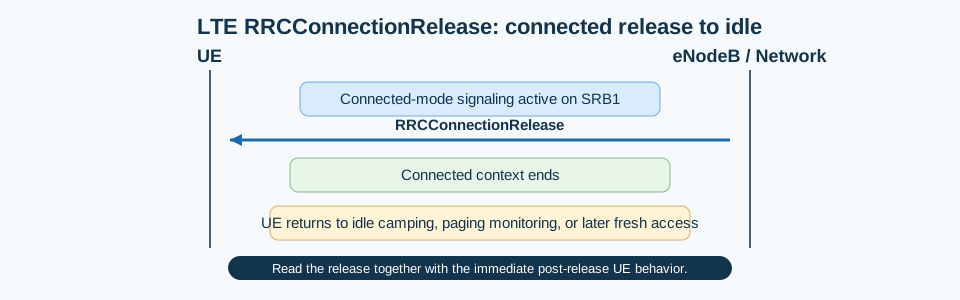
Connected release to idle
In the normal release path, RRCConnectionRelease is the last dedicated LTE RRC step before the UE returns to idle-side behavior.
Call flow position: Network command that ends the active LTE connected context and returns the UE toward idle behavior.
Typical state: UE is in RRC_CONNECTED and the dedicated signaling path is being closed.
Preconditions:
The UE already has an active connected LTE RRC context.
The network no longer needs to keep the UE in connected mode.
Next likely message: Idle-mode camping, paging monitoring, or later fresh access
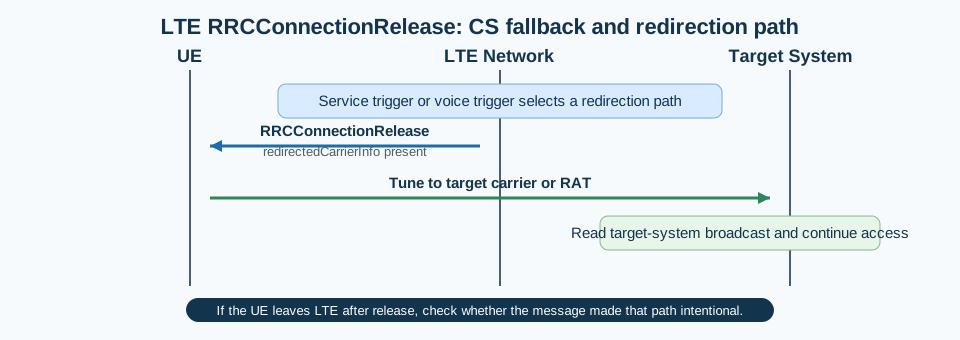
CS fallback and redirection path
In redirection-related cases such as CS fallback, the release carries the context that moves the UE away from the current LTE path.
Call flow position: Release message used to redirect the UE away from LTE toward another RAT or carrier.
Typical state: UE is in connected-mode signaling long enough to receive the release and the redirection context.
Preconditions:
The network has decided to move the UE to another system or carrier.
Any preceding paging, service, or voice trigger has already selected the release path.
Next likely message: Target-system acquisition and later access signaling outside the current LTE connected path
Call flow position
Previous message(s): Connected-mode LTE RRC signaling, RRCConnectionReconfiguration in redirection-related paths
Next message(s): Idle-mode cell camping and paging monitoring, Fresh access signaling if service returns later, Inter-RAT redirection behavior in redirected cases
Message direction and transport
Sender and receiver: eNodeB -> UE
Interface: Uu
Domain: Access-side radio control
Signaling bearer: SRB1
Logical channel: DL-DCCH
Transport / encapsulation: RRC over DCCH on SRB1 in connected mode
Security context: Normally sent after LTE AS security activation as protected dedicated signaling before the UE leaves the connected context.
Message Structure Overview
RRCConnectionRelease can be a plain release to idle or a release carrying redirection-related information.
The main practical reading point is not only that the connection ends, but what the UE is expected to do immediately after the release.
redirectedCarrierInfo and idle-side context often explain why later behavior leaves the LTE connected path.
Check whether redirectedCarrierInfo is present because it changes the next expected UE behavior completely.
If the release is plain, the next useful reading path moves toward idle camping and later paging or fresh setup.
If idleModeMobilityControlInfo is present, read the release together with the expected post-release idle behavior.
Important Information Elements
IE
Required
Description
rrc-TransactionIdentifier
Yes
Transaction identifier used to correlate the release procedure.
redirectedCarrierInfo
Optional
Redirection information telling the UE which other carrier or RAT to move to after release.
idleModeMobilityControlInfo
Optional
Idle-side mobility information that affects how the UE behaves after the release.
nonCriticalExtension
Optional
Release-extension branch used for later additions.
Detailed field explanation
rrc-TransactionIdentifier
Transaction identifier used to correlate the release procedure.
Presence: Required
In practice: In practice, compare this field with the original request and with any later release-dependent optional fields so you can see whether the network accepted the same service model the UE asked for.
redirectedCarrierInfo
Redirection information telling the UE which other carrier or RAT to move to after release.
Presence: Optional
In practice: In practice, compare this field with the original request and with any later release-dependent optional fields so you can see whether the network accepted the same service model the UE asked for.
idleModeMobilityControlInfo
Idle-side mobility information that affects how the UE behaves after the release.
Presence: Optional
In practice: In practice, compare this field with the original request and with any later release-dependent optional fields so you can see whether the network accepted the same service model the UE asked for.
nonCriticalExtension
Release-extension branch used for later additions.
Presence: Optional
In practice: In practice, compare this field with the original request and with any later release-dependent optional fields so you can see whether the network accepted the same service model the UE asked for.
What to check in logs and traces
Confirm the message appears as the final dedicated downlink control step before the UE leaves connected mode.
Check whether redirectedCarrierInfo is present.
Check whether idleModeMobilityControlInfo is present.
Correlate the release with what the UE does next: idle camping, fresh access, or inter-RAT move.
If the wider issue is service interruption, confirm whether the release itself is expected behavior.
Common Issues and Troubleshooting
The UE leaves LTE connected mode earlier than expected.
Likely cause: The network may have intentionally released the connection, or the wider procedure may have fallen back into a release path.
What to inspect: Check whether the release is plain or includes redirectedCarrierInfo or idle-side mobility context.
Next step: Follow the immediate post-release behavior instead of stopping at the message decode.
Voice or service continuation moves out of LTE after release.
Likely cause: The release may be part of a redirection or CS fallback path rather than an unexpected drop.
What to inspect: Check redirectedCarrierInfo and correlate with the service trigger that happened just before the release.
Next step: Continue into the target-system acquisition path.
The UE returns to idle but does not behave as expected afterward.
Likely cause: Post-release idle behavior may depend on the release context and later idle-mode system information.
What to inspect: Read the release together with idle-side mobility context and the next camping or paging path.
Next step: Move into idle-side broadcast and paging analysis.
LTE / 5G / Variant Comparison
Compared with RRCConnectionReconfiguration
RRCConnectionReconfiguration changes the connected LTE context. RRCConnectionRelease ends it.
Compared with NR RRC Release
LTE and NR both use release messages to end the connected context, but the LTE release path is centered on idle return and redirection handling rather than NR inactive behavior.
FAQ
What is RRCConnectionRelease in LTE?
It is the downlink LTE RRC message the network sends to end the active connected RRC context.
Does RRCConnectionRelease always mean a failure?
No. It can be a normal connected-to-idle transition or a planned redirection path.
What should I inspect first in RRCConnectionRelease?
Start with redirectedCarrierInfo, idle-side mobility context, and the UE action immediately after the release.
Why is RRCConnectionRelease important?
It defines the boundary between connected LTE signaling and the next idle, paging, or redirection behavior.
Decode this message with the 3GPP Decoder, inspect the related message database, or open the matching call flow to see where this signaling step fits in the full procedure.