Telecom engineering reference for protocols, messages, call flows, troubleshooting, releases, and tools.
Menu
LTE RRCLTEeNodeB -> UE3GPP TS 36.331
LTE RRC Connection Resume-r13
Downlink LTE RRC message sent by the eNodeB to resume a suspended LTE connection context without starting a full fresh connection setup.
Message Fact Sheet
Protocol
lte-rrc
Network
lte
Spec
3GPP TS 36.331
Spec Section
5.3.12, 6.2.2, Annex B
Direction
eNodeB -> UE
Message Type
Suspend / Resume Control
Full message name
LTE RRC Connection Resume-r13
Protocol
LTE-RRC
Technology
LTE
Direction
eNodeB -> UE
Interface
Uu
Signaling bearer / channel
SRB0 / DL-CCCH
Typical trigger
The network accepts a resume attempt and continues the LTE suspend and resume procedure instead of forcing a full fresh setup.
Main purpose
Restores the suspended LTE RRC context so the UE can continue on the resumed dedicated signaling path with the stored context and updated resume-related configuration.
Main specification
3GPP TS 36.331, 5.3.12, 6.2.2, Annex B
Release added
Release 13
Procedures where used
LTE Suspend and Resume, Resume Return from Suspended Context
What is LTE RRC Connection Resume-r13 in simple terms?
Downlink LTE RRC message sent by the eNodeB to resume a suspended LTE connection context without starting a full fresh connection setup.
Restores the suspended LTE RRC context so the UE can continue on the resumed dedicated signaling path with the stored context and updated resume-related configuration.
Why this message matters
RRCConnectionResume-r13 is the LTE network accepting the resume path and restoring a suspended context.
Where this message appears in the call flow
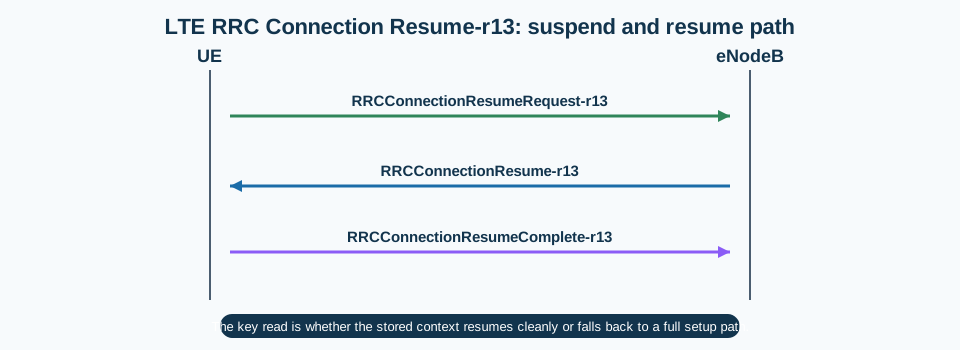
LTE suspend and resume
In the suspend and resume path, RRCConnectionResume-r13 is the network acceptance step before the UE confirms the resumed context.
Call flow position: Network acceptance message in the LTE resume branch after the UE requested continuation of a suspended context.
Typical state: UE is resuming a stored LTE context rather than creating a full new connection.
Preconditions:
A suspend and resume capable context exists.
The UE sent a valid resume request.
The network accepts the resume path.
Next likely message: RRCConnectionResumeComplete-r13
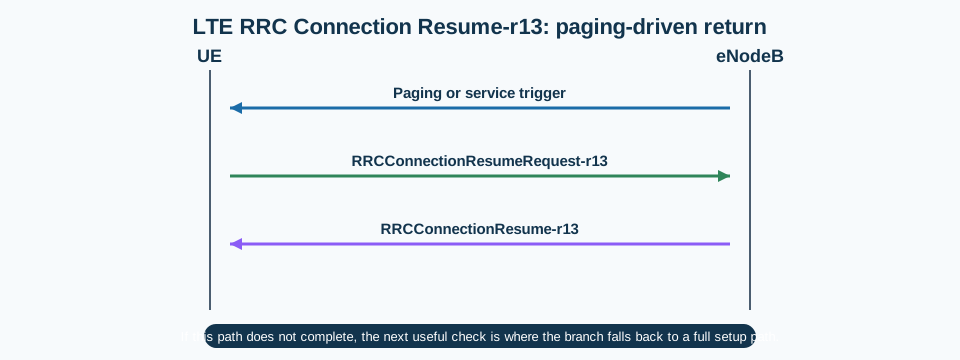
Paging-driven resume return
When paging return uses the resume branch, RRCConnectionResume-r13 shows that the stored context was resumed instead of a full fresh setup.
Call flow position: Resume-accept message used when paging or service return leads into the resume branch instead of a full fresh setup.
Typical state: UE is returning from a suspended context after a paging or service trigger.
Preconditions:
The suspended context is still valid.
The network chooses resume rather than a new full setup.
Next likely message: RRCConnectionResumeComplete-r13
Domain: Access-side radio control suspend and resume handling
Signaling bearer: SRB0
Logical channel: DL-CCCH
Transport / encapsulation: RRC over CCCH during the LTE suspend and resume branch before the resumed dedicated context fully continues
Security context: Used in the suspend and resume path where an earlier context exists but normal connected-mode signaling is not simply continuing from SRB1 without resume handling.
Message Structure Overview
RRCConnectionResume-r13 is the network acceptance step in the LTE suspend and resume branch.
Its practical meaning is that the network resumed the stored context instead of forcing a full fresh setup.
The next useful check is whether the UE confirms the resumed path with RRCConnectionResumeComplete-r13.
Resume-related context fields that connect the accept message to the suspended state being resumed.
nonCriticalExtension
Optional
Release-extension branch for later additions.
Detailed field explanation
rrc-TransactionIdentifier
Transaction identifier used to correlate the resume exchange.
Presence: Required
In practice: In practice, compare this field with the original request and with any later release-dependent optional fields so you can see whether the network accepted the same service model the UE asked for.
radioResourceConfigDedicated
Dedicated radio configuration used for the resumed context.
Presence: Required
In practice: In practice, compare this field with the original request and with any later release-dependent optional fields so you can see whether the network accepted the same service model the UE asked for.
Resume-related context fields that connect the accept message to the suspended state being resumed.
Presence: Optional
In practice: In practice, compare this field with the original request and with any later release-dependent optional fields so you can see whether the network accepted the same service model the UE asked for.
nonCriticalExtension
Release-extension branch for later additions.
Presence: Optional
In practice: In practice, compare this field with the original request and with any later release-dependent optional fields so you can see whether the network accepted the same service model the UE asked for.
What to check in logs and traces
Confirm the message follows the resume request path and not a fresh RRCConnectionRequest path.
Check the resumed dedicated configuration.
Verify whether the UE completes the branch with RRCConnectionResumeComplete-r13.
Correlate the message with the earlier suspend or paging return context.
If later signaling still fails, move forward into the resumed path instead of treating this message as the whole issue.
Common Issues and Troubleshooting
The UE tries to resume but does not continue after the network response.
Likely cause: The resumed configuration may not complete cleanly or the resume context may not match what the UE can continue with.
What to inspect: Check the resume-accept message, the resumed dedicated configuration, and whether the UE sends the completion message.
Next step: Use the missing completion as the first strong clue that the resume branch did not finish.
Paging return should have resumed a stored context but a full fresh setup still happens later.
Likely cause: The resume path may have failed or the stored context may not have been usable.
What to inspect: Check whether RRCConnectionResume-r13 appeared, whether it was followed by completion, and where the path switched to fresh setup.
Next step: Treat this as a failed-or-abandoned resume branch.
Resume appears accepted but later resumed behavior is unstable.
Likely cause: The stored context may have been resumed formally but may still lead to unstable later signaling.
What to inspect: Read the acceptance message together with the later resumed signaling and the earlier suspend context.
Next step: Continue into the post-resume connected path.
LTE / 5G / Variant Comparison
Compared with RRCConnectionSetup
RRCConnectionSetup creates a fresh connected path. RRCConnectionResume-r13 restores a suspended one.
Compared with RRCConnectionReestablishment
RRCConnectionReestablishment recovers a failed connected context. RRCConnectionResume-r13 resumes a stored suspended context.
FAQ
What is RRCConnectionResume-r13 in LTE?
It is the downlink LTE RRC message the network sends to accept the resume of a suspended LTE context.
What comes after RRCConnectionResume-r13?
The UE normally responds with RRCConnectionResumeComplete-r13.
How is it different from RRCConnectionSetup?
RRCConnectionSetup creates a new connection. RRCConnectionResume-r13 restores a suspended one.
What should I inspect first in RRCConnectionResume-r13?
Start with whether the branch is really a resume path, then inspect the resumed dedicated configuration and the following completion step.
Decode this message with the 3GPP Decoder, inspect the related message database, or open the matching call flow to see where this signaling step fits in the full procedure.