Telecom engineering reference for protocols, messages, call flows, troubleshooting, releases, and tools.
Menu
LTE RRCLTEUE -> eNodeB3GPP TS 36.331
LTE RRC Connection Resume Request-r13
Uplink LTE RRC message sent by the UE to request continuation of a suspended LTE context without starting a full fresh connection setup.
Message Fact Sheet
Protocol
lte-rrc
Network
lte
Spec
3GPP TS 36.331
Spec Section
5.3.12, 6.2.2, Annex B
Direction
UE -> eNodeB
Message Type
Suspend / Resume Control
Full message name
LTE RRC Connection Resume Request-r13
Protocol
LTE-RRC
Technology
LTE
Direction
UE -> eNodeB
Interface
Uu
Signaling bearer / channel
SRB0 / UL-CCCH
Typical trigger
The UE has a valid suspended context and attempts to continue service through the LTE resume path instead of a full new setup.
Main purpose
Starts the LTE suspend and resume branch so the UE can request restoration of a stored context instead of building a new connection from scratch.
Main specification
3GPP TS 36.331, 5.3.12, 6.2.2, Annex B
Release added
Release 13
Procedures where used
LTE Suspend and Resume, Resume Return from Suspended Context
What is LTE RRC Connection Resume Request-r13 in simple terms?
Uplink LTE RRC message sent by the UE to request continuation of a suspended LTE context without starting a full fresh connection setup.
Starts the LTE suspend and resume branch so the UE can request restoration of a stored context instead of building a new connection from scratch.
Why this message matters
RRCConnectionResumeRequest-r13 is the LTE UE asking the network to restore a suspended context.
Where this message appears in the call flow
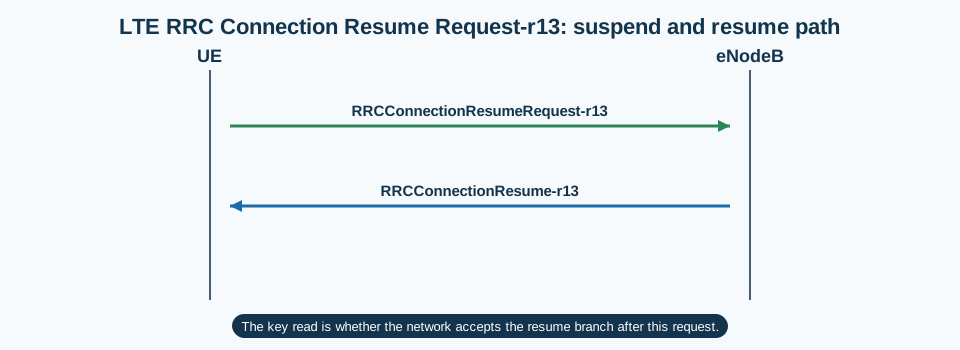
LTE suspend and resume
In the suspend and resume path, RRCConnectionResumeRequest-r13 is the UE request that starts the resume branch.
Call flow position: First UE message in the LTE resume branch when the UE asks the network to continue a suspended context.
Typical state: UE is not building a full new connected context from scratch and is instead attempting to resume stored state.
Preconditions:
A suspend and resume capable context exists.
The UE has a reason to return to active signaling.
The UE chooses the resume branch instead of a fresh connection request.
Next likely message: RRCConnectionResume-r13
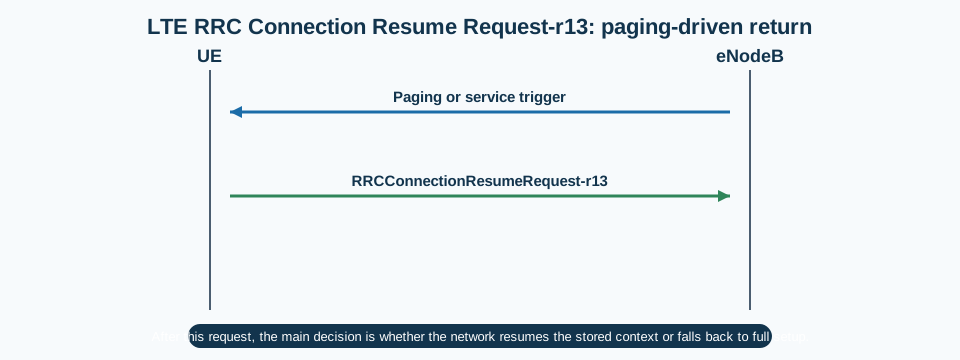
Paging-driven resume return
When paging return uses the resume branch, the UE sends RRCConnectionResumeRequest-r13 before the network decides whether to resume the stored context.
Call flow position: Resume request used when paging or service return activates the LTE resume path.
Typical state: UE is returning from suspended context after a paging or service trigger.
Preconditions:
The stored context is still usable.
The network can potentially resume the context.
Next likely message: RRCConnectionResume-r13 or fallback to fresh setup
Call flow position
Previous message(s): Paging or service trigger that led into the resume branch, Earlier RRCConnectionRelease carrying suspend-related context
Resume-side context that helps interpret why the UE entered the resume branch.
spare
Optional
Reserved bits with limited practical value.
Detailed field explanation
resumeIdentity-r13
Resume identity information used to correlate the UE request with the stored suspended context.
Presence: Required
In practice: In practice, compare this field with the original request and with any later release-dependent optional fields so you can see whether the network accepted the same service model the UE asked for.
shortResumeMAC-I-r13
Short integrity-related value used in the resume procedure.
Presence: Required
In practice: In practice, compare this field with the original request and with any later release-dependent optional fields so you can see whether the network accepted the same service model the UE asked for.
Resume-side context that helps interpret why the UE entered the resume branch.
Presence: Optional
In practice: In practice, compare this field with the original request and with any later release-dependent optional fields so you can see whether the network accepted the same service model the UE asked for.
spare
Reserved bits with limited practical value.
Presence: Optional
In practice: In practice, compare this field with the original request and with any later release-dependent optional fields so you can see whether the network accepted the same service model the UE asked for.
What to check in logs and traces
Confirm the message belongs to the resume branch and not the fresh setup branch.
Check the resume identity and short resume MAC fields.
Correlate the request with the earlier suspend context and the later network response.
Verify whether the next message is RRCConnectionResume-r13 or a fallback path.
If resume does not continue, identify exactly where the branch switched to fresh setup.
Common Issues and Troubleshooting
The UE should have resumed a stored context but starts full setup later.
Likely cause: The resume request may not have been accepted, or the stored context may no longer have been valid.
What to inspect: Check whether RRCConnectionResumeRequest-r13 was sent, whether the network answered with RRCConnectionResume-r13, and where the branch changed.
Next step: Treat this as a failed-or-abandoned resume branch rather than a normal setup-only problem.
Paging return triggers activity, but the resume path does not complete.
Likely cause: The UE may have attempted resume, but the network may not have continued with the stored context.
What to inspect: Read paging, resume request, and the next network response together.
Next step: Keep following the branch into fallback setup if needed.
Resume attempts repeat.
Likely cause: The stored context may be unstable, stale, or repeatedly failing to continue.
What to inspect: Compare repeated resume requests with their following network responses and the stored-context assumptions.
Next step: Determine whether resume is repeatedly retried or quickly abandoned for fresh setup.
LTE / 5G / Variant Comparison
Compared with RRCConnectionRequest
RRCConnectionRequest starts a fresh LTE connection. RRCConnectionResumeRequest-r13 asks to continue a stored suspended context.
Compared with RRCConnectionReestablishmentRequest
RRCConnectionReestablishmentRequest recovers a failed connected context. RRCConnectionResumeRequest-r13 resumes a suspended one.
FAQ
What is RRCConnectionResumeRequest-r13 in LTE?
It is the uplink LTE RRC message the UE sends to request continuation of a suspended LTE context.
What comes after RRCConnectionResumeRequest-r13?
The network may respond with RRCConnectionResume-r13, or the branch may fall back to fresh setup.
How is it different from RRCConnectionRequest?
RRCConnectionRequest starts a new connection. RRCConnectionResumeRequest-r13 tries to continue a stored suspended one.
What should I inspect first in RRCConnectionResumeRequest-r13?
Start with whether the branch is really a resume path, then inspect the resume identity fields and the next network response.
Decode this message with the 3GPP Decoder, inspect the related message database, or open the matching call flow to see where this signaling step fits in the full procedure.