Telecom engineering reference for protocols, messages, call flows, troubleshooting, releases, and tools.
Menu
LTE RRCLTEeNodeB -> UE3GPP TS 36.331
LTE RRC UE Capability Enquiry
Downlink LTE RRC message used by the eNodeB to request UE capability information before applying capability-dependent radio configuration.
Message Fact Sheet
Protocol
lte-rrc
Network
lte
Spec
3GPP TS 36.331
Spec Section
5.6.1, 6.2.2, Annex B
Direction
eNodeB -> UE
Message Type
Capability Exchange
Full message name
LTE RRC UE Capability Enquiry
Protocol
LTE-RRC
Technology
LTE
Direction
eNodeB -> UE
Interface
Uu
Signaling bearer / channel
SRB1 / DL-DCCH
Typical trigger
The network needs UE capability details before applying feature-dependent radio configuration such as mobility, measurements, carrier support, or advanced connected-mode behavior.
Main purpose
Requests the UE capability containers the network needs so later LTE configuration decisions match what the UE actually supports.
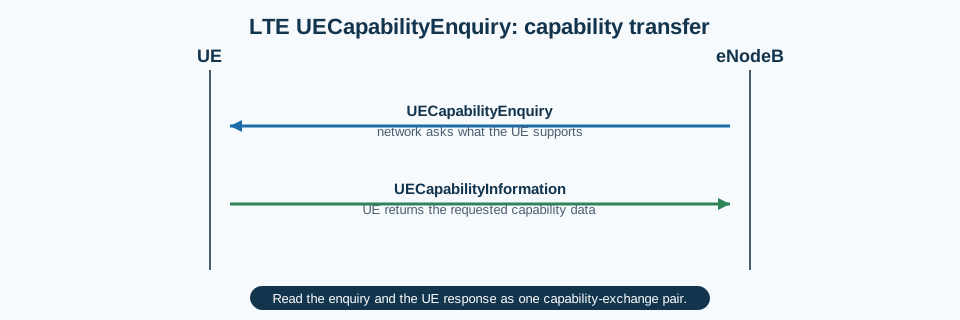
The main next step is normally UECapabilityInformation on UL-DCCH.
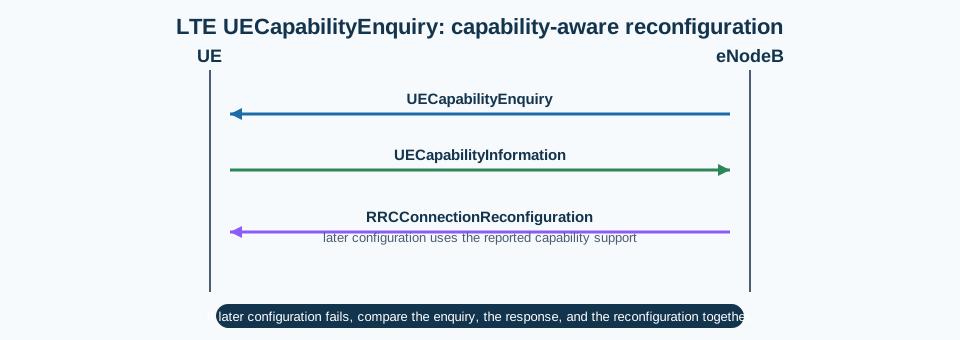
If later configuration fails, check whether the network requested the right capability scope and whether the UE returned a matching response.
This message is mainly valuable as part of the larger capability exchange, not as an isolated decode.
Important Information Elements
IE
Required
Description
rrc-TransactionIdentifier
Yes
Transaction identifier used to correlate the enquiry with the UE response.
ue-CapabilityRequest
Yes
Capability request content telling the UE what capability information the network expects next.
lateNonCriticalExtension
Optional
Extension container for later release evolution.
nonCriticalExtension
Optional
Forward-compatible extension branch for later additions.
Detailed field explanation
rrc-TransactionIdentifier
Transaction identifier used to correlate the enquiry with the UE response.
Presence: Required
In practice: In practice, compare this field with the original request and with any later release-dependent optional fields so you can see whether the network accepted the same service model the UE asked for.
ue-CapabilityRequest
Capability request content telling the UE what capability information the network expects next.
Presence: Required
In practice: In practice, compare this field with the original request and with any later release-dependent optional fields so you can see whether the network accepted the same service model the UE asked for.
lateNonCriticalExtension
Extension container for later release evolution.
Presence: Optional
In practice: In practice, compare this field with the original request and with any later release-dependent optional fields so you can see whether the network accepted the same service model the UE asked for.
nonCriticalExtension
Forward-compatible extension branch for later additions.
Presence: Optional
In practice: In practice, compare this field with the original request and with any later release-dependent optional fields so you can see whether the network accepted the same service model the UE asked for.
What to check in logs and traces
Confirm the message is sent on SRB1 and DL-DCCH after connected-mode security is active.
Check what capability information the network is asking for.
Correlate the transaction identifier with the following UECapabilityInformation.
Check whether later reconfiguration assumes support the UE did not actually report.
If the exchange repeats, verify whether the wider procedure changed.
Common Issues and Troubleshooting
UECapabilityEnquiry is sent but no capability response follows.
Likely cause: The UE may fail to process the request, the response may be missing from the trace, or the procedure may be interrupted.
What to inspect: Check transaction pairing, UL-DCCH activity, and whether the capability exchange completed.
Next step: Move forward to see whether the exchange stalled or the trace is incomplete.
Later LTE reconfiguration fails after capability exchange.
Likely cause: The network may have built configuration from incorrect, incomplete, or misread UE capability information.
What to inspect: Compare UECapabilityEnquiry, the UE response, and the following RRCConnectionReconfiguration.
Next step: Validate that the later feature configuration matches the reported UE support.
Capability exchange repeats unexpectedly.
Likely cause: The network may be re-requesting capabilities because context was lost or the procedure restarted.
What to inspect: Check whether the connection path changed, restarted, or entered a new capability-dependent branch.
Next step: Correlate repeated enquiries with the broader connected-mode procedure instead of treating them as isolated duplicates.
LTE / 5G / Variant Comparison
Compared with UECapabilityInformation
UECapabilityEnquiry is the network request. UECapabilityInformation is the UE response carrying the reported capability data.
Compared with RRCConnectionReconfiguration
UECapabilityEnquiry asks what the UE supports. RRCConnectionReconfiguration later applies capability-dependent configuration.
FAQ
What is UECapabilityEnquiry in LTE?
It is the downlink LTE RRC message the eNodeB sends to request UE capability information.
What comes after UECapabilityEnquiry?
The UE normally responds with UECapabilityInformation.
Does UECapabilityEnquiry contain the UE capability itself?
No. It only requests the capability information. The UE reports the actual capability in UECapabilityInformation.
Why is UECapabilityEnquiry important?
It helps the network avoid applying feature-dependent LTE configuration that the UE does not support.
Decode this message with the 3GPP Decoder, inspect the related message database, or open the matching call flow to see where this signaling step fits in the full procedure.