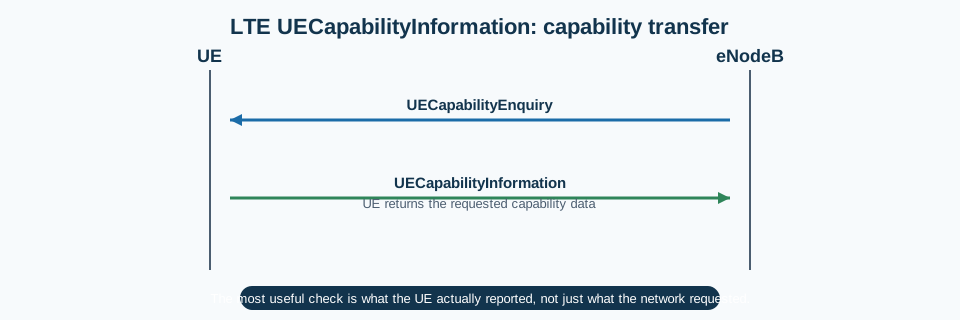
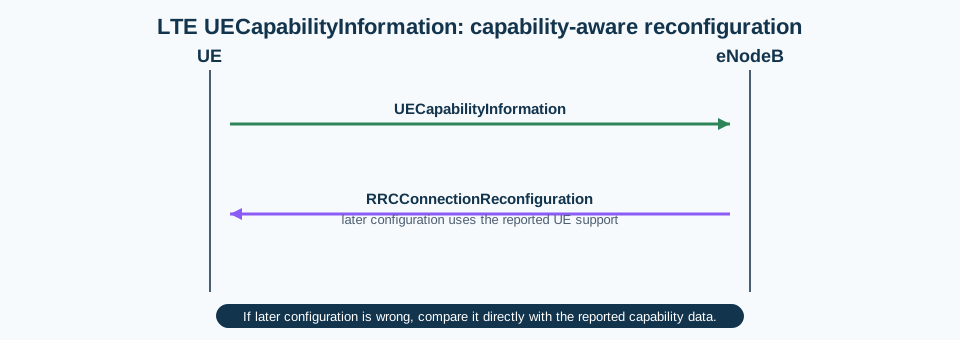
Most of the practical value is inside the returned capability container list. The useful reading path is what the UE reported and what the network did with it next.
The returned capability container list is the main thing to inspect.
In practical traces, the capability container can be large and heavily nested, so parser confidence matters.
If later configuration fails, compare the network decision against what the UE actually reported here.
Important Information Elements
IE
Required
Description
rrc-TransactionIdentifier
Yes
Transaction identifier used to correlate the UE response with the preceding UECapabilityEnquiry.
ue-CapabilityRAT-ContainerList
Yes
List of capability containers returned by the UE for the requested RATs.
lateNonCriticalExtension
Optional
Extension container for later release evolution.
nonCriticalExtension
Optional
Forward-compatible extension branch for later additions.
Detailed field explanation
rrc-TransactionIdentifier
Transaction identifier used to correlate the UE response with the preceding UECapabilityEnquiry.
Presence: Required
In practice: In practice, compare this field with the original request and with any later release-dependent optional fields so you can see whether the network accepted the same service model the UE asked for.
ue-CapabilityRAT-ContainerList
List of capability containers returned by the UE for the requested RATs.
Presence: Required
In practice: In practice, compare this field with the original request and with any later release-dependent optional fields so you can see whether the network accepted the same service model the UE asked for.
lateNonCriticalExtension
Extension container for later release evolution.
Presence: Optional
In practice: In practice, compare this field with the original request and with any later release-dependent optional fields so you can see whether the network accepted the same service model the UE asked for.
nonCriticalExtension
Forward-compatible extension branch for later additions.
Presence: Optional
In practice: In practice, compare this field with the original request and with any later release-dependent optional fields so you can see whether the network accepted the same service model the UE asked for.
What to check in logs and traces
Confirm the message follows UECapabilityEnquiry and uses SRB1 and UL-DCCH.
Verify the transaction identifier matches the preceding enquiry.
Inspect which capability containers are present.
Check whether the reported capability content is complete for the current scenario.
Correlate the message with the following RRCConnectionReconfiguration or later network action.
Common Issues and Troubleshooting
UECapabilityInformation is present but later feature configuration fails.
Likely cause: The network may have misread or misused the reported capability data, or the response may be incomplete for the intended feature.
What to inspect: Compare the returned capability information with the later RRCConnectionReconfiguration content.
Next step: Validate that the configured feature is actually declared as supported by the UE.
Capability reporting looks incomplete or missing expected containers.
Likely cause: The enquiry may not have requested the full set, the decoder may be incomplete, or the UE may not report the expected capability information.
What to inspect: Check UECapabilityEnquiry first, then compare the requested and returned capability scope.
Next step: Confirm whether the missing information is truly absent or simply not decoded by the current toolchain.
Capability exchange repeats.
Likely cause: The network may be revalidating capability context after procedure restart, context loss, or implementation-specific behavior.
What to inspect: Check whether the repeated exchange belongs to a new connected-mode context.
Next step: Correlate repeated capability transfer with the broader connected-mode procedure.
LTE / 5G / Variant Comparison
Compared with UECapabilityEnquiry
UECapabilityEnquiry asks for capability data. UECapabilityInformation carries the actual UE-reported capability information.
Compared with RRCConnectionReconfiguration
UECapabilityInformation reports what the UE supports. RRCConnectionReconfiguration later applies capability-dependent LTE configuration.
FAQ
What is UECapabilityInformation in LTE?
It is the uplink LTE RRC message the UE sends to report capability information back to the eNodeB.
What comes before UECapabilityInformation?
UECapabilityEnquiry normally comes immediately before it.
Why is UECapabilityInformation important?
It gives the network the capability data it needs to apply LTE configuration that the UE can actually support.
Does UECapabilityInformation affect later RRCConnectionReconfiguration?
Yes. The reported support often directly affects what the network configures next.
Decode this message with the 3GPP Decoder, inspect the related message database, or open the matching call flow to see where this signaling step fits in the full procedure.