Telecom engineering reference for protocols, messages, call flows, troubleshooting, releases, and tools.
Menu
LTE RRCLTEUE -> eNodeB3GPP TS 36.331
LTE RRC UL Information Transfer
Uplink LTE RRC message used by the UE to carry NAS payloads toward the network over the LTE access stratum.
Message Fact Sheet
Protocol
lte-rrc
Network
lte
Spec
3GPP TS 36.331
Spec Section
5.3.11, 6.2.2
Direction
UE -> eNodeB
Message Type
Dedicated Information Transfer
Full message name
LTE RRC UL Information Transfer
Protocol
LTE-RRC
Technology
LTE
Direction
UE -> eNodeB
Interface
Uu
Signaling bearer / channel
SRB1 / UL-DCCH
Typical trigger
The UE has uplink EPS NAS content that must be delivered to the network through the current LTE RRC connection.
Main purpose
Transfers UE-originated EPS NAS signaling transparently across LTE RRC so the network can receive attach requests, TAU requests, service requests, detach requests, or other NAS content through the current LTE RRC connection.
Main specification
3GPP TS 36.331, 5.3.11, 6.2.2
Release added
Release 8
Procedures where used
Initial access and attach continuation, Tracking area update continuation, Service request continuation, Connected-mode NAS signaling
What is LTE RRC UL Information Transfer in simple terms?
Uplink LTE RRC message used by the UE to carry NAS payloads toward the network over the LTE access stratum.
Transfers UE-originated EPS NAS signaling transparently across LTE RRC so the network can receive attach requests, TAU requests, service requests, detach requests, or other NAS content through the current LTE RRC connection.
Why this message matters
UL Information Transfer is the LTE RRC message that carries uplink NAS signaling from the UE to the network.
Where this message appears in the call flow
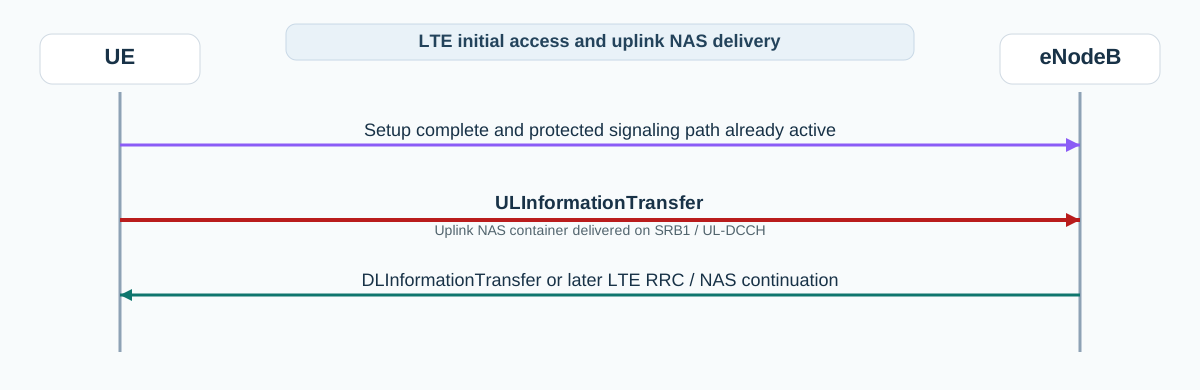
LTE initial access
In the initial access continuation path, UL Information Transfer carries UE-originated NAS content after the dedicated RRC signaling path is active.
Call flow position: Uplink NAS delivery step used after the dedicated RRC signaling path is active.
Typical state: UE is in connected mode and sends EPS NAS content through LTE RRC toward the network.
Preconditions:
The dedicated SRB1 path is active.
The UE has NAS content to send.
Next likely message: DLInformationTransfer or later LTE RRC / NAS continuation
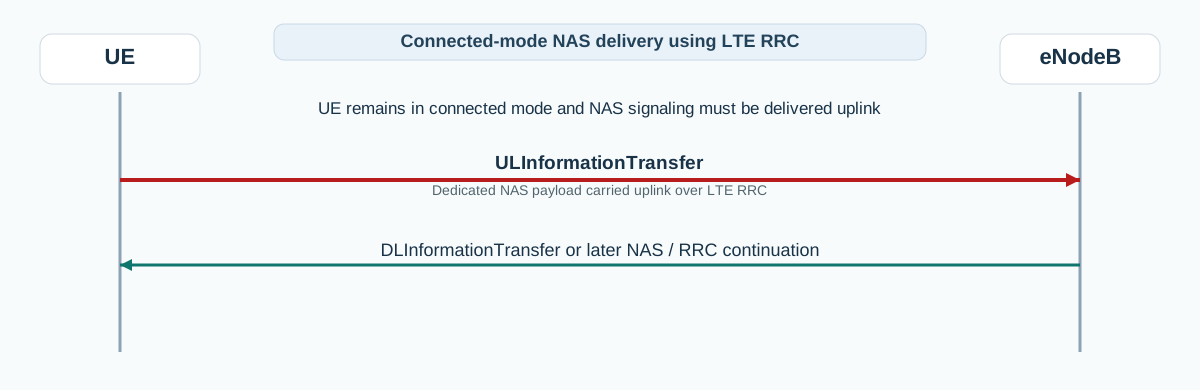
Connected-mode NAS delivery
In connected mode, UL Information Transfer is the uplink LTE RRC wrapper used to deliver NAS signaling from the UE toward the network.
Call flow position: Transparent uplink NAS transport step used while the UE remains in connected mode.
Typical state: LTE RRC carries a NAS container without changing the basic role of NAS as the higher-layer control payload.
Preconditions:
SRB1 is active.
The UE remains in connected mode.
An EPS NAS procedure needs uplink signaling.
Next likely message: DLInformationTransfer or later NAS/RRC continuation
Call flow position
Previous message(s):DLInformationTransfer, Earlier NAS or RRC procedure context in connected mode
Domain: Access-side radio control carrying core-network NAS signaling
Signaling bearer: SRB1
Logical channel: UL-DCCH
Transport / encapsulation: RRC over DCCH on SRB1 carrying a dedicated NAS message container
Security context: This message appears after the dedicated signaling path is active and is used to carry NAS content through protected LTE RRC signaling.
Message Structure Overview
ULInformationTransfer is mainly a transport wrapper for an uplink NAS payload.
The useful read starts with the carried NAS content, not with the outer RRC message name alone.
This message is best read together with the related NAS procedure and the later downlink reply path.
Start by confirming that the payload is dedicatedInfoNAS.
The next useful step is decoding the carried NAS payload and placing it in the active EPS procedure.
Do not stop at the outer RRC decode when the real meaning sits inside the NAS container.
Important Information Elements
IE
Required
Description
rrc-TransactionIdentifier
Yes
Transaction identifier for the LTE RRC message exchange.
dedicatedInfoType
Yes
Wrapper that identifies the payload type being carried by ULInformationTransfer.
dedicatedInfoNAS
Yes
NAS message container delivered transparently from the UE toward the network.
lateNonCriticalExtension / nonCriticalExtension
Optional
Release-extension branch for later additions.
Detailed field explanation
rrc-TransactionIdentifier
Transaction identifier for the LTE RRC message exchange.
Presence: Required
In practice: In practice, compare this field with the original request and with any later release-dependent optional fields so you can see whether the network accepted the same service model the UE asked for.
dedicatedInfoType
Wrapper that identifies the payload type being carried by ULInformationTransfer.
Presence: Required
In practice: In practice, compare this field with the original request and with any later release-dependent optional fields so you can see whether the network accepted the same service model the UE asked for.
dedicatedInfoNAS
NAS message container delivered transparently from the UE toward the network.
Presence: Required
In practice: In practice, compare this field with the original request and with any later release-dependent optional fields so you can see whether the network accepted the same service model the UE asked for.
lateNonCriticalExtension / nonCriticalExtension
Release-extension branch for later additions.
Presence: Optional
In practice: In practice, compare this field with the original request and with any later release-dependent optional fields so you can see whether the network accepted the same service model the UE asked for.
What to check in logs and traces
Confirm the message appears on SRB1 / UL-DCCH.
Check that the payload is a NAS container.
Decode the carried NAS message and identify the active EPS procedure.
Correlate the message with the earlier RRC connection and paging or service context if relevant.
Follow the next downlink NAS or RRC continuation instead of reading the message in isolation.
Common Issues and Troubleshooting
ULInformationTransfer is present but the procedure meaning is unclear.
Likely cause: The outer RRC wrapper was read, but the carried NAS payload was not decoded or correlated with the EPS procedure.
What to inspect: Decode the NAS container and map it to attach, TAU, service request, detach, or other EPS signaling.
Next step: Move from the RRC wrapper into the NAS message reference path.
The UE sends ULInformationTransfer but no expected downlink continuation follows.
Likely cause: The problem may be in the carried NAS procedure, not in the transport wrapper itself.
What to inspect: Check the carried NAS message, the security state, and the expected downlink reply such as DLInformationTransfer.
Next step: Read the message inside the wider NAS request-response sequence.
The message appears after paging and the path looks radio-related.
Likely cause: ULInformationTransfer may simply be the LTE RRC transport path for the uplink NAS continuation after service return.
What to inspect: Check the NAS container first before assuming the problem is in radio configuration.
Next step: Treat the message as a bridge between LTE RRC and EPS NAS rather than a standalone radio action.
LTE / 5G / Variant Comparison
Compared with DLInformationTransfer
UL Information Transfer carries NAS payloads from the UE to the network. DLInformationTransfer carries NAS payloads from the network to the UE.
Compared with RRCConnectionSetupComplete
RRCConnectionSetupComplete ends the early setup branch and can include an initial NAS container. UL Information Transfer is the general connected-mode uplink NAS transport wrapper.
FAQ
What is UL Information Transfer in LTE?
It is the uplink LTE RRC message used to carry NAS payloads from the UE to the network.
What does UL Information Transfer carry?
It typically carries a dedicated NAS container, so the real procedure meaning comes from the NAS message inside it.
What should I inspect first in UL Information Transfer?
Start by confirming the NAS container and decoding the carried NAS payload.
Why is UL Information Transfer important in troubleshooting?
It marks the point where UE-originated EPS NAS signaling is delivered through LTE RRC, so problems often sit in the carried NAS procedure rather than in the outer wrapper.
Decode this message with the 3GPP Decoder, inspect the related message database, or open the matching call flow to see where this signaling step fits in the full procedure.