Open Release Tracking Page
3GPP Release 20
3GPP Release 20 is the current open release, combining continued 5G-Advanced enhancement work with early 6G study activity. This page explains the roadmap, timelines, main technical themes, and the areas engineers should track as the release evolves.
Because Release 20 is still open, this page should be read as a live roadmap reference rather than a frozen implementation baseline.
Quick facts
| Release | Rel-20 |
|---|---|
| Status | Open |
| Start date | 2024-03-14 |
| End date | SA#116, 2027-06-18 |
| Position in roadmap | Active 5G-Advanced release plus early 6G study phase |
| Editorial framing | Live release tracking page |
What is Release 20?
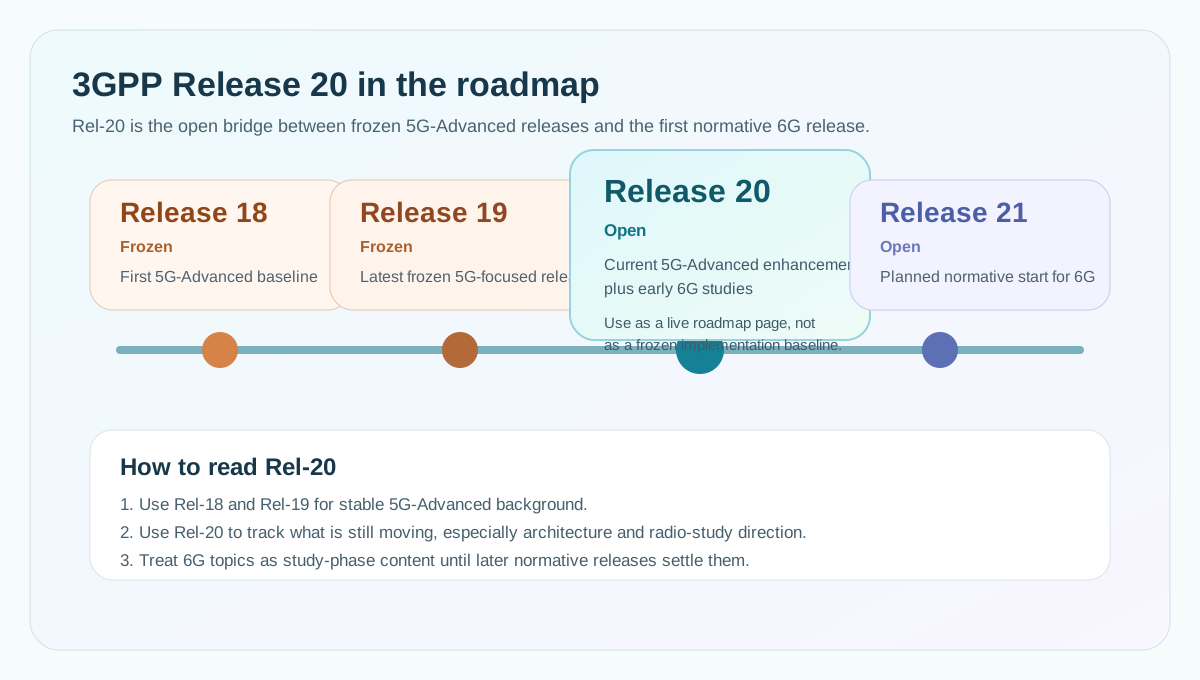
Release 20 sits in the roadmap as the current active release after Release 19. That already makes it different from Release 18 and Release 19, which can be read as frozen reference points. Rel-20 is still moving, so the right question is not only what it contains, but also which parts are already mature and which parts are still being shaped.
The main reason Release 20 matters is that it combines two different standards stories on one page. It continues 5G-Advanced enhancement work, but 3GPP also states that Release 20 is the release for 6G studies, while Release 21 is intended for the normative start of 6G work.
For engineers, that means Rel-20 should be used as a tracking page for direction of travel. It is where you watch ongoing 5G evolution, early 6G framing, and the milestones that indicate when an area is moving from study language toward more stable implementation guidance.
Release 20 timeline and milestones
This is one of the most important sections on the page because Release 20 is still open. The milestone dates tell you which parts of the release should be treated as more settled and which parts still deserve caution.
Stage 1 freeze
June 2025
Service requirements baseline for Rel-20 5G-Advanced work.
Stage 2 at 80%
June 2026
Architecture work reaches the planned partial-completion checkpoint.
Stage 2 final freeze
September 2026
System architecture scope is expected to settle by Q4 2026.
Stage 3 target
March 2027
Protocol details are scheduled to freeze after the architecture stage.
ASN.1 / OpenAPI freeze
June 2027
Final encoding and interface-definition freeze at the end of the release.
Key Features in Release 20
Continued 5G-Advanced enhancement
Release 20 continues the 5G-Advanced path with an 18-month roadmap focused on enhancing current 5G capabilities rather than replacing them.
Early 6G studies
Unlike Release 18 or 19, Release 20 also carries study work for 6G, making it a bridge between ongoing 5G evolution and future-generation planning.
Service and architecture evolution
Stage 1 and Stage 2 work continue to reshape service requirements and system architecture while the release remains open.
Satellite and NTN progression
3GPP highlights Satellite Access Phase 4 as a notable Release 20 study area, keeping NTN and broader access evolution visible.
Energy efficiency evolution
Energy Efficiency as Service Criteria Phase 2 shows that operational and efficiency topics remain central in Rel-20.
Railway and vertical-industry support
FRMCS Phase 6 highlights how Release 20 continues to serve vertical and mission-specific communication needs while standards evolve.
RAN prioritization between 5G-A and 6G
3GPP explicitly notes that RAN working-group capacity must be shared carefully between commercial 5G-Advanced work and successful 6G studies.
Live standards roadmap tracking
Because Rel-20 is still open, this page should be read as a tracking reference for direction, milestones, and study maturity rather than a frozen baseline.
Release 20 by technical domain
5G-Advanced evolution in Rel-20
3GPP describes Release 20 5G-Advanced work as an 18-month roadmap focused on enhancing the current capabilities of 5G. That means Rel-20 is not a reset. It is a continuation and refinement step for the 5G-Advanced path established in Release 18 and extended in Release 19.
For readers of this site, this is the stable half of the Release 20 story. It is where you look for ongoing commercial enhancement and refinement rather than future-generation repositioning.
Early 6G studies
Release 20 is also where 3GPP places early 6G studies. The official Release 20 page says technical studies on the radio interface and 6G core network architecture are underway, and that Release 21 will be the formal start of normative 6G work.
That distinction matters. These are studies, not yet the final stable specifications engineers would treat in the same way as a frozen release baseline. The right use of this material is to understand direction and architecture thinking, not to over-read it as finished protocol behavior.
Core network and service evolution
Release 20 remains important on the system side because the active Stage 1 and Stage 2 schedule keeps service requirements and architecture work open for refinement. This is where service criteria, broader system evolution, and architecture implications continue to develop.
Engineers reading Rel-20 for core implications should therefore treat it as an architecture-watch page first, then follow the stable pieces into AMF, SBA, NAS, and NGAP reading as milestones settle.
RAN priorities and workload balance
One of the most distinctive official messages on the Release 20 page is not a feature name but a prioritizing principle: RAN working-group capacity has to be shared carefully between 5G-Advanced and 6G studies, and duplicate scope should be avoided.
That makes Release 20 important as a roadmap-management release as well as a technical one. It explains why some radio topics should be read as immediate 5G enhancement work while others should be treated as future study direction.
NTN, satellite, and expanded access scenarios
3GPP explicitly highlights Satellite Access Phase 4 as one of the notable Release 20 studies advancing in TSG SA. That keeps NTN and broader access evolution clearly in scope for Rel-20 rather than treating them as closed topics after earlier releases.
For practitioners, this means satellite and continuity-related reading should remain on the watch list as the release progresses and the architecture side settles.
Energy efficiency and industry-specific evolution
Release 20 also highlights Energy Efficiency as Service Criteria Phase 2 and FRMCS Phase 6. These show that Rel-20 is not only about generic roadmap language. It also carries concrete work relevant to operational efficiency and vertical-industry communications.
This is the part of the page that is especially useful for operators and domain specialists who need to monitor whether the release is moving in directions that affect deployment strategy and service prioritization.
Deployment and roadmap relevance
This section is editorial synthesis rather than a direct 3GPP phrase: because Release 20 is open, planners, vendors, and engineers should separate what already has a clear freeze path from what is still better treated as roadmap intelligence.
In practice, that means using Rel-20 to monitor milestone progress, watch which technical areas are becoming more concrete, and avoid treating every study-era statement as settled implementation guidance.
Major Release 20 focus areas
5G-Advanced capability enhancement
6G radio study
6G core architecture study
Satellite Access Phase 4
FRMCS Phase 6
Energy Efficiency as Service Criteria Phase 2
RAN scope management between 5G-A and 6G
Stage-based release progression
Protocol and signaling impact
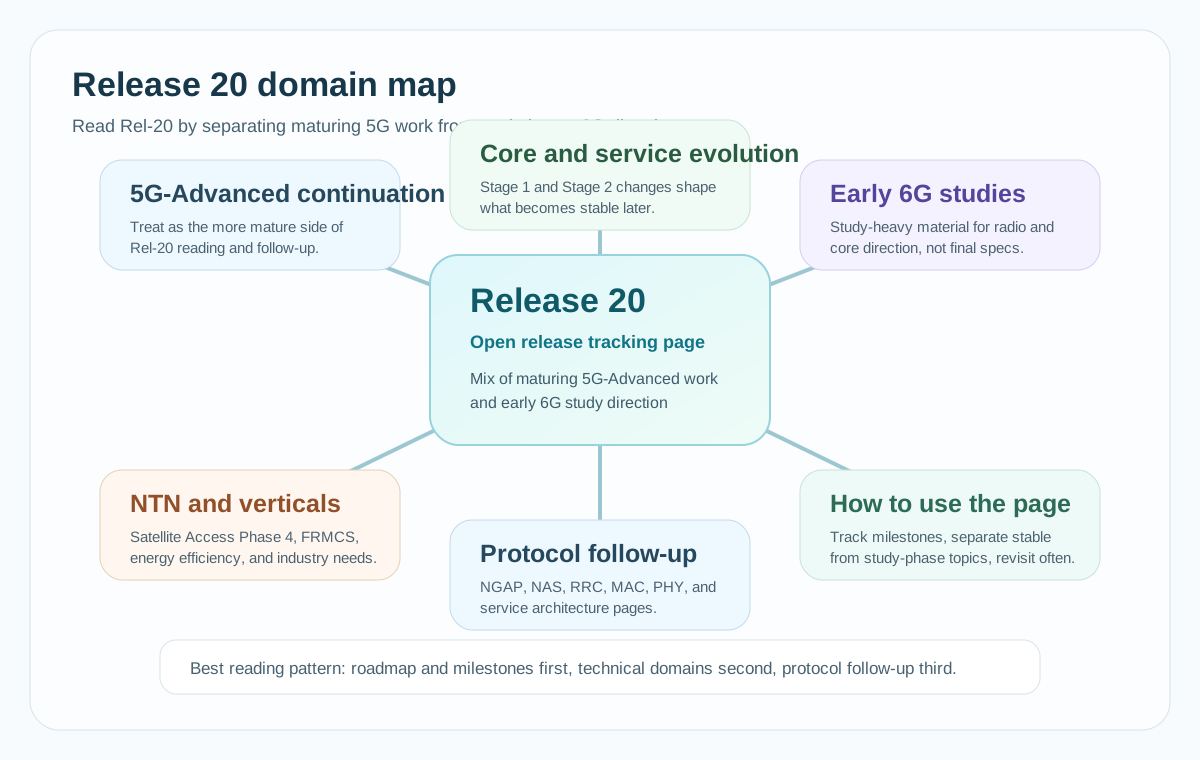
This section is intentionally navigational rather than exhaustive. Because Release 20 is open, the goal here is to show where impact is most likely and whether the area should be read as relatively stable, actively evolving, or still study-heavy.
NGAP
EvolvingTrack NGAP when Rel-20 service and core evolution starts affecting signaling expectations, access procedures, or feature support tied to 5G-Advanced growth.
NAS
EvolvingUse NAS pages to watch how open release work may shape registration, mobility, service continuity, identity handling, and session procedures as architecture evolves.
RRC
Study-heavyRRC is one of the most important layers to monitor in Rel-20 because 5G-Advanced radio work continues while 6G radio studies influence future reading direction.
SDAP
Mostly stable, context evolvingSDAP is still useful as a follow-up layer when Rel-20 service and QoS evolution changes how engineers should think about user-plane treatment and flow mapping.
PDCP
Mostly stable, context evolvingPDCP remains a practical follow-up area when open Rel-20 work changes expectations around duplication, delivery, recovery, or advanced user-plane behavior.
RLC
Mostly stable, context evolvingRLC should be treated as a follow-up protocol when broader radio work in Rel-20 changes how you interpret buffering, reassembly, or reliability behavior.
MAC
EvolvingUse MAC pages when Release 20 themes touch scheduling, resource coordination, efficiency, control signaling, or radio behavior below RRC.
PHY
Study-heavyPHY is central to Rel-20 tracking because it sits close to both continued 5G-Advanced radio enhancement and the early 6G radio-study direction.
Service architecture
EvolvingCore-network and service-architecture pages become more important in Rel-20 because Stage 1 and Stage 2 work are still shaping what becomes stable later.
Management APIs
EvolvingManagement and interface-level reading matters because an open release changes how automation, service criteria, interoperability, and operational support should be tracked.
How Release 20 differs from Release 19
| Area | Release 19 | Release 20 direction |
|---|---|---|
| Status | Frozen | Open |
| 5G-Advanced maturity | Latest frozen 5G-focused wave | Continued 5G-Advanced enhancement in progress |
| 6G involvement | Not the main framing | Includes early 6G studies |
| Roadmap role | Stable study anchor | Live roadmap and tracking release |
| Freeze state | Completed at release level | Still progressing through milestone stages |
| Engineering usage | Read as a stable baseline | Read as a mix of maturing 5G work and study-phase future direction |
What should you study in Release 20?
For beginners
- Start with Release 18 first to understand the first 5G-Advanced baseline.
- Then read Release 19 to get the latest frozen 5G-focused release context.
- Use Release 20 mainly to understand where standards are heading next.
For intermediate engineers
- Track continued 5G-Advanced themes rather than trying to read all 6G studies at once.
- Monitor the Stage 2 and Stage 3 milestones so you know when a topic becomes more stable.
- Watch NTN, energy-efficiency, and service-architecture directions as they mature.
For advanced engineers
- Map active studies into likely architecture and protocol touchpoints without overstating certainty.
- Separate stable 5G-Advanced continuation from early 6G study language.
- Revisit the page as milestones progress rather than treating one snapshot as the final state.
Related specs and official references
Release 20 FAQs
What is 3GPP Release 20?
Release 20 is the current open release that combines ongoing 5G-Advanced enhancement with early 6G studies.
Is Release 20 complete?
No. As checked on April 23, 2026, the 3GPP portal listed Release 20 as Open.
Is Release 20 part of 5G-Advanced or 6G?
It is both a continuation of 5G-Advanced work and the release used for 6G studies. 3GPP says Release 20 is for studies, while Release 21 is intended for normative 6G work.
What is the difference between Release 20 and Release 19?
Release 19 is the latest frozen release fully focused on 5G evolution, while Release 20 is open and mixes ongoing 5G-Advanced enhancement with early 6G study work.
When will Release 20 be frozen?
The official Release 20 page shows Stage 3 targeted for March 2027 followed by ASN.1 and OpenAPI freeze in June 2027, and the portal lists the release end at SA#116 on June 18, 2027.
Should engineers treat Release 20 as stable yet?
Not as a final baseline. Release 20 is best treated as a live roadmap and tracking page, with some areas more mature than others and 6G topics still clearly in study phase.