5G RRC Failure Causes - Setup, Resume, Reconfiguration, and Release Analysis
5G RRC failure causes sit in the middle of the access and control chain. The UE may reach cell selection and even complete random access, but still fail during RRC setup, resume, security progression, or reconfiguration. In practice, that means engineers need to separate genuine RRC logic problems from earlier PHY instability and later NAS or core-side issues.
For beginners, this page explains where RRC fits in the registration and connected-mode path. For experienced engineers, it is a cause-led checklist for diagnosing missing messages, rejects, abnormal releases, configuration mismatches, and security-related failures without chasing the wrong layer first.
| Primary focus | RRC setup, resume, security, and reconfiguration failure analysis in 5G NR |
|---|---|
| Most useful checks | PDCCH delivery, access stability, RRC message sequence, security progression, release cause, config mismatch |
| Typical symptoms | No setup completion, repeated reject, abnormal release, reestablishment loop, or failed resume |
| Best paired references | RRC message library, initial access, PDCCH, registration failure, decoder |
What RRC failure means in simple terms
In simple terms, an RRC failure means the UE and network could not complete or maintain the control relationship needed to progress the radio connection. Sometimes the UE cannot move beyond setup. In other cases it enters RRC signaling but fails during security, configuration, resume, or later mobility-related handling.
- RRC failure is often visible as setup loops, reject, release, or missing next-step messages.
- The visible symptom may still be caused by earlier access instability or later NAS dependencies.
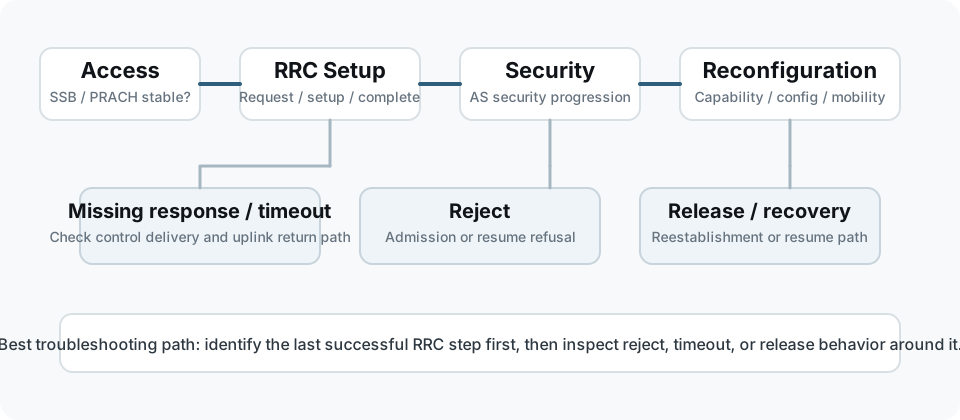
- The fastest diagnosis comes from identifying the last successful RRC message and the first missing one.
- Control-channel reliability matters as much as the message content itself.
Fast triage before deep trace analysis
| Question | Why it matters |
|---|---|
| Did random access complete cleanly? | If access is unstable, the apparent RRC failure may actually start before setup begins. |
| What is the last successful RRC message? | This is the fastest way to isolate setup, security, resume, or reconfiguration failure. |
| Is there an explicit reject or just timeout / release? | Reject often points to deliberate network logic, while timeout often points to delivery or sequencing failure. |
| Did security mode start and complete? | Many apparent setup problems are actually security-progression failures one step later. |
| Is the issue UE-specific, area-specific, or general? | This helps separate capability or configuration mismatch from broad radio or gNB behavior. |
Main RRC failure domains
Access instability before clean setup
If initial access is unstable, the UE may appear to fail in RRC when the real problem is weak entry into the cell. Poor SSB visibility, failed PRACH attempts, or control-delivery instability often show up as missing or repeated setup behavior.
Setup-path failure
A clean RRCSetupRequest should normally be followed by setup progression, completion, and later security/configuration. If the network responds with RRCReject, or setup never completes, focus on admission logic, access stability, and missing follow-up signaling.
Security progression failure
If SecurityModeCommand is present but the UE does not answer cleanly, the apparent RRC problem may actually be an AS security mismatch, integrity issue, or sequence break.
Reconfiguration and capability mismatch
Some failures only appear when the network moves into reconfiguration, capability handling, measurement setup, or bearer-related radio configuration. These cases often look stable early, then fail once the network applies a configuration the UE cannot sustain or interpret.
Resume and reestablishment failure
Resume and reestablishment failures usually point to context mismatch, expired assumptions, mobility timing, or earlier radio instability that forced recovery and then prevented it from completing.
Access -> RRCSetupRequest -> RRC Setup -> Security -> Reconfiguration / Resume -> Stable RRC or Reject / ReleaseHow RRC failure usually appears in practice
| Observed symptom | Most likely interpretation |
|---|---|
| RRCSetupRequest repeats many times | Access instability, weak control delivery, or admission rejection is likely. |
| Setup appears but completion never follows | Check control delivery, UE response, configuration mismatch, or unstable uplink after setup. |
| SecurityModeCommand sent, no clean response | Security progression or integrity-context mismatch is likely. |
| Reconfiguration sent, then release or radio link failure | Later radio configuration may be too aggressive or inconsistent with UE capability or current conditions. |
| Resume / reestablishment loops | Context, mobility, timer, or persistent radio-quality issues are likely. |
What to check in logs, traces, and KPIs
- The exact last successful RRC message and the first missing or abnormal follow-up message
- PDCCH and downlink control delivery around setup, security, and reconfiguration
- Whether the UE could transmit the expected uplink response after setup or security command
- RRC reject, release, or reestablishment triggers and any explicit reason information
- Capability exchange and whether the later configuration matches UE support
- Whether the problem is tied to one cell, one UE type, one area, or only certain mobility conditions
- NAS dependency if RRC looked healthy but registration still failed afterward
Common failure patterns and what they usually mean
Missing network response after RRCSetupRequest
Check access success, admission logic, and whether control-channel delivery was reliable enough for the network response to be received cleanly.
RRCReject instead of setup progression
This often indicates temporary rejection, admission control, resume-specific refusal, or network logic that declines the request rather than progressing the connection.
Setup succeeds but SecurityModeComplete never arrives
This usually points to AS security mismatch, uplink delivery failure, sequence break, or implementation-level interoperability issues.
Reconfiguration triggers immediate instability
Check whether the configuration introduces measurement, bandwidth, beam, or scheduling assumptions the UE cannot sustain in current radio conditions.
Repeated resume or reestablishment attempts
These cases often point to stale context, mobility timing mismatch, or a radio environment that never lets the UE stabilize long enough to maintain or recover the connection.
Engineer workflow
- Identify the last successful RRC message in the failing attempt.
- Check whether access and control delivery were stable before blaming RRC logic alone.
- Separate setup-path failure from security-path failure and later reconfiguration failure.
- Correlate with UE type, area, mobility condition, and whether the failure is repeatable.
- Use the decoder and related message pages to inspect fields only after the sequence break is clearly located.
Beginner takeaway
The simplest way to understand 5G RRC failure is to ask: which RRC step was the last one that worked? Once you know whether the break happened during setup, security, reconfiguration, or recovery, the troubleshooting path becomes much clearer.
Advanced engineer notes
- Many “RRC failures” are really cross-layer issues where PHY instability prevents reliable signaling progression.
- Do not treat reject, release, and timeout as equivalent; they usually imply very different network behavior.
- Security-mode failure should be analyzed separately from plain setup failure because the sequence assumptions differ.
- Capability or configuration mismatches often appear only after early setup looks healthy, so the failure point matters more than the initial symptom.
- Area-specific or UE-specific failures often expose configuration scope issues faster than message-by-message inspection alone.
FAQ
What are common 5G RRC failure causes?
Common causes include unstable access, weak control delivery, RRC reject conditions, security progression failure, capability mismatch, reconfiguration problems, and recovery-path instability.
How do I troubleshoot 5G RRC setup failure?
Start with access stability, then check the exact last successful message, whether the network answered, and whether the UE could send the expected completion or security response.
Why does RRC setup fail even when the UE sees the cell?
Seeing the cell is only the start. The UE still needs stable control-channel delivery, successful access, correct admission behavior, and successful signaling progression afterward.
What is the difference between RRCReject and RRCRelease?
RRCReject refuses a request or resume attempt before connection progression completes. RRCRelease ends an already established or partially established radio control context.
Can RRC failure be caused by security issues?
Yes. Once security progression starts, integrity or context mismatch can stop the procedure even if setup looked healthy one step earlier.
Which messages are most useful to inspect for RRC failures?
Start with RRCSetupRequest, RRC Setup, RRCReject, SecurityModeCommand, SecurityModeComplete, and RRC Reconfiguration.
Use the decoder and message library together
Use the 3GPP Decoder when you need to inspect the exact signaling content around setup, security, reject, or reconfiguration. Then move into the 5G NR RRC message library to compare the failing message with the expected procedure path.