5G Registration Failure Troubleshooting
5G registration failure means the UE cannot complete the path from radio access into successful NAS registration and stable network service. In practice, that failure can start much earlier than the NAS layer: weak SSB, failed random access, unstable RRC setup, security mismatch, or a later Registration Reject can all produce the same user-visible symptom.
For beginners, the main troubleshooting question is simple: where in the chain does the registration process stop? For experienced engineers, the goal is to separate PHY access problems, RRC problems, NAS problems, and AMF / policy problems quickly enough that trace analysis becomes targeted instead of broad and repetitive.
| Primary symptom | UE cannot complete 5G registration and reach stable service |
|---|---|
| Most useful checks | SSB, access, RRC setup, NAS Registration Request, reject causes, security context |
| Failure domains | PHY access, RRC progression, NAS signaling, AMF or core-side validation |
| Best paired references | Initial registration call flow, initial access, NAS messages, decoder |
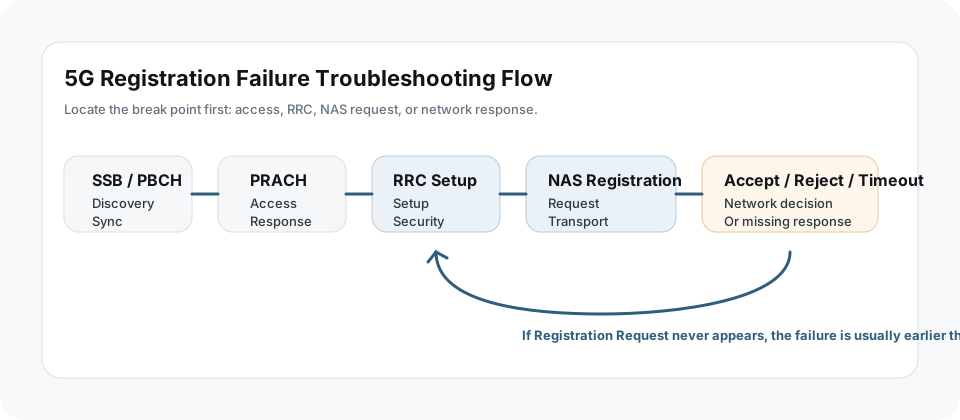
What a registration failure means in simple terms
In simple terms, the UE finds a 5G cell but does not manage to become a properly registered device on the network. Sometimes the UE never reaches NAS signaling at all. In other cases it sends Registration Request but gets rejected, ignored, or timed out later in the procedure.
- Registration failure is not always a NAS-only issue.
- The failure may begin in discovery, access, RRC setup, security, or AMF-side validation.
- The fastest troubleshooting method is to find the exact point where the sequence stops.
- Call flow context matters more than reading one reject or one KPI in isolation.
Fast triage before deep analysis
| Question | Why it matters |
|---|---|
| Does the UE detect the serving cell cleanly? | If SSB visibility is unstable, the problem may start before registration signaling even begins. |
| Does random access complete? | If PRACH or access response fails, the UE never reaches reliable RRC progression. |
| Does RRC setup complete successfully? | If setup fails, NAS Registration Request will never be sent or will be incomplete. |
| Is Registration Request visible? | This separates access-side failure from NAS or core-side failure. |
| Is there a Registration Reject or just timeout / release? | An explicit reject points to network-side reasoning, while silent timeout often points to sequencing or transport issues. |
Where the registration failure usually occurs
Before access completes
If the UE cannot maintain SSB visibility, decode PBCH, or complete random access, the registration process never really starts.
During RRC setup or early security
If RRC Setup, RRCSetupComplete, or the following security/configuration steps fail, the UE may appear to camp on the cell but still never progress into stable NAS registration. Compare the failing trace with the 5G RRC connection setup and 5G security mode command procedures to see exactly where the sequence breaks.
During NAS registration
If Registration Request is sent but a valid accept path does not follow, focus on NAS content, identity, security context, subscription state, and AMF-side behavior. The 5G initial registration, authentication, and identity request call flows are the best next references here.
After explicit reject or release
If the network returns a reject, the failure is usually clearer and can be mapped to cause-driven pages. If the procedure is silently released or times out, check sequencing, missing responses, transport, and access stability. If the failure appears during update rather than first attach to the network, compare it with mobility registration update or periodic registration update.
SSB -> PRACH / access -> RRC Setup -> Registration Request -> Registration Accept or RejectHow registration failure usually appears in practice
| Observed symptom | Most likely interpretation |
|---|---|
| No NAS messages at all | The failure is usually on the PHY or RRC side before Registration Request can be sent. |
| Registration Request sent, then timeout | Likely missing response, transport issue, sequencing issue, or unstable earlier setup path. |
| Registration Reject with cause | Usually a NAS or AMF-side validation problem rather than pure access failure. |
| Repeated access and release loop | Weak radio entry, unstable control delivery, or repeated early-procedure failure is likely. |
| Works in one area, fails in another | Coverage, beam, mobility, or area-specific policy configuration may be involved. |
What to check in logs, traces, and KPIs
- SSB visibility, PBCH decode, and whether the UE has a stable serving cell before access
- PRACH attempts, access response, and whether random access succeeds consistently
- RRC Setup, SetupComplete, and security-mode progression
- Registration Request contents and whether the message is actually delivered
- Registration Accept, Registration Reject, release, or timeout behavior after the request
- AMF or NAS-side cause values if the network explicitly rejects the request
- whether the issue is location-specific, UE-specific, SIM/subscription-specific, or general
Common failure patterns and what they usually mean
UE keeps retrying access but never reaches Registration Request
This is usually an access-side or early RRC problem, not a pure NAS problem. Start with SSB, PRACH, and setup stability, then compare the trace with the 5G RRC connection setup flow.
Registration Request is present but no Accept follows
Check whether the network responded at all, whether security or identity handling failed, and whether the UE was released or timed out. The authentication and identity request procedures are especially useful here.
Explicit Registration Reject
Move quickly into cause-based analysis. At this point the issue is usually more policy, identity, service, or subscription related than purely radio related. Compare the trace with the initial registration procedure so you can see exactly which step diverges before the reject.
Works intermittently depending on signal conditions
Registration failure that changes with location or coverage often starts with unstable access or control signaling rather than AMF-side logic. If the issue shows up after movement or tracking changes, compare it with mobility registration update.
Engineer workflow for 5G registration failure
- Confirm whether the UE can stably detect and synchronize to the serving cell.
- Check whether random access completes successfully.
- Confirm whether RRC setup reaches a usable connected state.
- Check whether Registration Request is sent and delivered.
- Look for Registration Accept, Reject, timeout, or release to find the exact break point.
- If reject is present, move into cause-based NAS troubleshooting.
- If no reject is present, correlate access, control, and transport-side evidence before blaming the core.
Beginner takeaway
The most important step in troubleshooting 5G registration failure is to find where the sequence stops. Once you know whether the failure is in access, RRC, NAS, or network-side validation, the rest of the analysis becomes much easier.
Advanced engineer notes
- Registration failure without any NAS messaging is almost always a sign to look earlier in the chain.
- Access instability can create symptoms that look like NAS timeout even when the real problem is radio-side.
- Explicit reject causes usually save time because they narrow the domain immediately to network-side reasoning.
- If the issue is intermittent and location-dependent, coverage or beam behavior is often part of the root cause even when NAS rejects are also visible.
FAQ
How do I troubleshoot 5G registration failure?
Find the break point first: cell detection, random access, RRC setup, Registration Request, or network response.
Why does 5G registration fail before NAS messages appear?
Because the UE may still be failing in discovery, access, PBCH decode, PRACH, or RRC setup before NAS can progress.
What does Registration Reject usually mean?
It usually means the failure has reached NAS and the network has an explicit reason to deny or block registration.
What should I check first?
Check whether the UE actually reaches Registration Request. That single check separates radio / RRC issues from NAS / core issues.
Use the decoder and call flow with this workflow
Use the 3GPP Decoder when you need to inspect NAS and RRC payloads quickly, and keep the 5G Initial Registration call flow open while reading traces so you always know which step is missing or failing. If the break point shifts into identity, authentication, or security progression, jump directly to the identity request, authentication, or security mode call flows instead of staying at a generic level.