5G RAN (NG-RAN) Architecture Explained
The 5G Radio Access Network is called the NG-RAN. It connects the UE to the 5G Core, terminates the NR radio side, carries control signaling toward the core, and forwards user traffic into the data path.
In practice, NG-RAN is where radio behavior becomes visible to engineers. RRC setup, measurements, handovers, paging, QoS enforcement, and the first step of many 5G procedures all pass through the RAN before they become core-network issues.
Quick facts
| What it is | The NG-RAN is the 5G radio access network that connects the UE to the 5G Core. |
|---|---|
| Main node | The main NG-RAN node is the gNB, with optional ng-eNB support in deployments that connect LTE access to the 5GC. |
| Important interfaces | NR-Uu toward the UE, N2 toward the AMF, N3 toward the UPF, Xn between RAN nodes, and F1 or E1 inside split gNB deployments. |
| Control and user plane | RRC and NAS transport sit on the control side, while user traffic runs from UE to gNB to UPF on the user side. |
| Why engineers care | Most registration, bearer setup, measurement, mobility, paging, and handover issues cross the NG-RAN first. |
| Specification baseline | 3GPP TS 38.401, TS 38.300, TS 23.501, and TS 23.502. |
Why this matters
If you are reading traces, testing mobility, debugging access failures, or preparing for interviews, the NG-RAN is one of the first architecture blocks you need to place correctly. It sits between the radio side and the core side, so problems here often show up as a mix of RRC, NGAP, and user-plane symptoms rather than a clean single-domain failure.
A useful way to think about it is simple: the UE talks radio protocols to the gNB, the gNB talks access-core protocols to the 5GC, and the gNB decides how radio resources, measurements, and mobility should behave.
Where it fits in the network
| Layer | Role in the end-to-end path |
|---|---|
| UE | Uses NR-Uu to access the network and exchanges RRC plus NAS-carrying signaling through the gNB. |
| NG-RAN | Provides radio access, resource control, mobility handling, paging, QoS enforcement, and transport toward the core. |
| 5GC | Uses the AMF for control handling and the UPF for user-plane forwarding after the gNB hands traffic into the core. |
| IMS or DN | Sits beyond the UPF and carries voice services, operator applications, Internet access, or enterprise traffic. |
In standalone deployments, the NG-RAN connects directly to the 5GC. In non-standalone deployments, LTE anchor behavior and EPC involvement still shape part of the access path, even when NR is present on the radio side.
5G NG-RAN architecture diagram
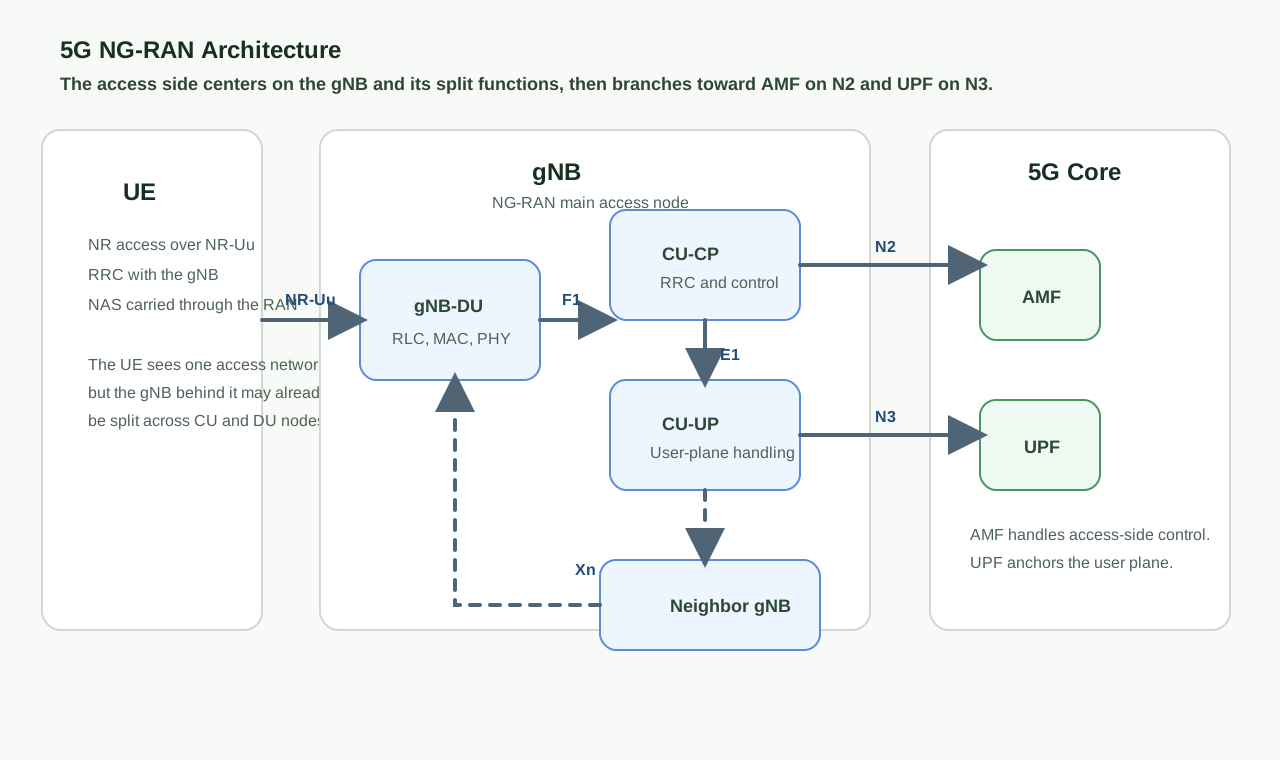
Main nodes and functions
| Node or function | What it does |
|---|---|
| gNB | The main 5G access node. It handles RRC, radio resource management, mobility control, paging, NAS transport, and user-plane forwarding. |
| ng-eNB | An LTE evolved node that can connect to the 5GC in mixed deployments. It is part of the broader NG-RAN picture, but the gNB remains the main 5G node. |
| gNB-CU-CP | The control-oriented central unit side, commonly associated with RRC and related control functions. |
| gNB-CU-UP | The user-plane central unit side, used when the split deployment separates user forwarding from control handling. |
| gNB-DU | The distributed unit that stays closer to time-sensitive lower-layer radio processing. |
The gNB is conceptually similar to the LTE eNodeB because it anchors the access side, but 5G adds more deployment flexibility and a cleaner split between control and user functions inside the node.
gNB functional split: CU and DU
One of the biggest architectural changes in 5G RAN is that the gNB does not have to be deployed as one fixed box. Operators can split the node into central and distributed parts so they can centralize some processing while keeping lower-layer work closer to the radio site.
| Component | Typical role |
|---|---|
| gNB-CU | Handles higher-layer functions such as RRC and higher user-plane processing. In many deployments this is further split into CU-CP and CU-UP. |
| gNB-DU | Handles lower-layer work such as RLC, MAC, PHY, and timing-sensitive radio-side processing. |
| F1-C and F1-U | Carry control and user coordination between the CU and DU. |
| E1 | Links CU-CP and CU-UP when the central unit itself is split across control and user functions. |
This split is important for cloud RAN, vRAN, scaling, and transport planning. It also affects troubleshooting, because a fault may sit in the DU, the CU, the fronthaul or midhaul transport, or the CU-CP and CU-UP relationship rather than in the radio interface alone.
Interfaces used
| Interface | Connects | Purpose |
|---|---|---|
| NR-Uu | UE and gNB | Radio interface carrying RRC plus the access-side user plane. |
| N2 | gNB and AMF | Control-plane signaling path using NGAP. |
| N3 | gNB and UPF | User-plane path carrying GTP-U traffic into the core. |
| Xn | gNB and gNB | Mobility coordination, context transfer, and inter-node cooperation. |
| F1 | gNB-CU and gNB-DU | Split-node control and user coordination inside the gNB architecture. |
| E1 | CU-CP and CU-UP | Internal split interface for central-unit control and user separation. |
Engineers sometimes describe the gNB to core connection as the NG interface. On this site, that path is usually read as N2 for control and N3 for user plane, because those are the interfaces you will usually trace in procedures and captures.
Protocols used
| Area | Main protocols | Why they matter |
|---|---|---|
| Radio control | RRC | Sets up access, configures measurements, controls mobility, and carries many of the radio decisions the UE must apply. |
| User-plane adaptation | SDAP, PDCP | Maps QoS flows, protects packets, and prepares traffic for lower layers and user-plane forwarding. |
| Lower layers | RLC, MAC, PHY | Handle segmentation, scheduling, HARQ behavior, and the physical radio transmission itself. |
| Core-facing control | NGAP over SCTP/IP | Carries access-core signaling on N2 between the gNB and the AMF. |
| Core-facing user plane | GTP-U over UDP/IP | Carries user traffic on N3 between the gNB and the UPF. |
The QoS model is also important here. In 5G, QoS flows are mapped through the access side and ultimately enforced through radio-bearer handling, scheduling, and user-plane treatment rather than through the older LTE-style mental model alone.
Used in procedures
- 5G RRC Connection Setup shows the first radio-side establishment path between UE and gNB.
- 5G Initial Registration shows how the RAN bridges RRC and NAS toward the AMF.
- 5G PDU Session Establishment shows how the gNB adds the user plane into the end-to-end path.
- 5G Measurement Reporting shows how radio observations drive mobility and optimization decisions.
- 5G Xn Handover, 5G N2 Handover, and 5G Inter-gNB Handover show how the NG-RAN handles connected mobility.
Common troubleshooting notes
| Symptom | NG-RAN checks |
|---|---|
| Access fails early | Check cell availability, SIB and setup behavior, RRC setup progression, and whether the first NAS container reaches N2. |
| Registration stalls after RRC | Check the handoff from RRC Setup Complete to Initial UE Message. |
| User plane missing | Check whether N3 setup, radio-bearer activation, and QoS mapping all align after the control plane looks healthy. |
| Handover problems | Check measurements, Xn or N2 mobility path, context transfer timing, and whether the target side applies the new radio configuration correctly. |
| Split-node instability | Check F1 or E1 transport, DU reachability, CU-DU synchronization, and whether the issue is local to one split component. |
FAQ
What is NG-RAN?
NG-RAN is the 5G radio access network that connects the UE to the 5G Core through NR-based access nodes.
What is a gNB?
The gNB is the main 5G base-station node responsible for radio access, mobility handling, paging, NAS transport, and user-plane forwarding toward the 5GC.
What is the CU-DU split?
The CU-DU split separates higher-layer and lower-layer functions so the deployment can be more flexible and easier to scale.
What is the difference between N2 and N3?
N2 is the control-plane path between gNB and AMF, while N3 is the user-plane path between gNB and UPF.
Is Xn only for handover?
No. Xn is heavily used for mobility, but it also supports coordination, context transfer, and broader inter-node cooperation.
Key takeaways
- The NG-RAN is the 5G radio access network built around the gNB and related access nodes.
- The gNB sits between the UE and the 5GC, so both control-plane and user-plane paths cross the RAN.
- The CU-DU split is one of the biggest structural differences between 5G RAN and LTE RAN.
- N2, N3, Xn, F1, E1, and NR-Uu are the key interfaces to keep straight when reading procedures and traces.
- Most registration, session, measurement, paging, and handover procedures become easier to read once the NG-RAN role is clear.