5G Inter-gNB Handover Procedure Call Flow
5G Inter-gNB Handover is the connected-mode mobility procedure that moves an active UE from one gNB domain to another.
It is broader than a local cell change because radio, context, and traffic continuity all cross the gNB boundary.
Introduction
This page explains the end-to-end inter-node move: measurement trigger, target preparation, handover command, target access, and post-move continuity.
The strongest troubleshooting split is between preparation failure, radio execution failure, and post-completion continuity failure.
What Is Inter-gNB Handover in Simple Terms?
- What starts the procedure: The network decides another gNB should become the new serving node.
- What the UE and network want to achieve: Move the UE across the gNB boundary while preserving service.
- What success looks like: The UE accesses the target gNB and service continues cleanly there.
- What failure means: Preparation, target access, or path-switch continuity fails across the node boundary.
Why this procedure matters
Inter-gNB mobility is one of the places where radio issues, coordination issues, and transport continuity issues all look similar in alarms unless the engineer separates them carefully.
Quick Fact Sheet
| Procedure name | 5G Inter-gNB Handover |
|---|---|
| Domain | 5G NR mobility between different gNBs |
| Main trigger | Connected UE must move from one gNB domain to another |
| Start state | UE is actively served by a source gNB |
| End state | UE continues service under a different target gNB |
| Main nodes | UE, source gNB, target gNB, AMF, UPF |
| Main protocols | RRC, Xn or N2 coordination, NGAP, user-plane path switch |
| Main success outcome | UE moves to the target gNB and service continues with preserved context |
| Main failure outcome | Preparation, target access, or path switch fails across the gNB boundary |
| Most important messages | Measurement Report, Handover Request, RRC Reconfiguration, RRC Reconfiguration Complete |
| Main specs | TS 23.502, TS 38.300, TS 38.331 |
Preconditions
- The UE is already connected on the source gNB.
- A different gNB is available as a valid target.
- Neighbor and target preparation data are configured correctly.
- The user-plane path can follow the UE once the move completes.
Nodes and Interfaces
Nodes involved
| Node | Role in this procedure |
|---|---|
| UE | Reports measurements, executes the move, and completes service under the target gNB. |
| Source gNB | Owns the UE before handover and starts the inter-node mobility preparation. |
| Target gNB | Allocates resources and becomes the new serving node after execution. |
| AMF | Coordinates mobility when core assistance is required or the path is N2-based. |
| UPF | Supports user-plane continuity as traffic follows the new gNB. |
Interfaces used
| Interface | Path | Role |
|---|---|---|
| NR-Uu | UE <-> gNBs | Carries measurements, handover command execution, and target access. |
| Xn | Source gNB <-> target gNB | Preferred direct coordination path when available between gNBs. |
| N2 | gNB <-> AMF | Used for core-assisted inter-gNB mobility when Xn is not used or sufficient. |
| N3 | gNB <-> UPF | Carries or updates the user-plane anchor after the move. |
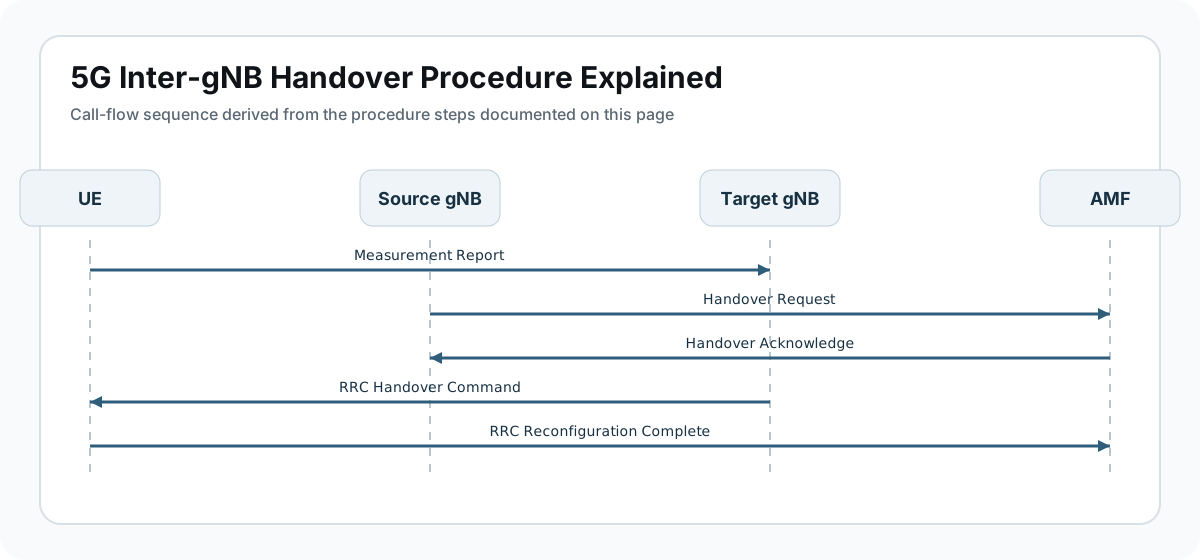
End-to-End Call Flow
UE                Source gNB              Target gNB              AMF / UPF
|                     |                        |                    |
|-- Measurement Report ----------------------->|                    |
|                     |-- Handover Request --->|------------------->|
|                     |<-- Handover Ack -------|<-------------------|
|<-- RRC Reconfiguration ----------------------|                    |
|==== move to target gNB =========================================>|
|-- RRC Reconfiguration Complete -------------------------------->|
|==== traffic continues via target gNB ==========================>|
Major Phases
| Phase | What happens |
|---|---|
| 1. Measurement trigger | The source gNB learns that another gNB offers a better serving opportunity. |
| 2. Inter-node preparation | The source and target coordinate resources across the gNB boundary. |
| 3. UE execution | The source sends the mobility command and the UE accesses the target gNB. |
| 4. Completion and path switch | The target confirms the UE and the user-plane path follows the move. |
| 5. Stable target-side service | The UE continues on the new gNB without falling into recovery. |
Step-by-Step Breakdown
The source gNB sees another gNB as the better target
Sender -> receiver: UE -> source gNB
Message(s): Measurement Report
Purpose: Trigger mobility across the gNB boundary based on real neighbor measurements.
State or context change: The move becomes an inter-node mobility case rather than a local cell change.
Note: Always classify whether the target is within the same gNB or a different gNB before reading the trace further.
The source and target prepare across the node boundary
Sender -> receiver: Source gNB -> target gNB or via AMF
Message(s): Handover Request and acknowledgment
Purpose: Prepare target radio and context resources before the UE is moved.
State or context change: The inter-gNB path becomes executable.
Note: Inter-node mobility has more failure surface than local cell change because context leaves the source gNB domain.
The UE receives the mobility command
Sender -> receiver: Source gNB -> UE
Message(s): RRC Reconfiguration
Purpose: Tell the UE which target gNB and target cell to move toward.
State or context change: The UE leaves the source-side radio context and begins target access.
Note: The source-side decision may be good while the target-side RF execution still fails.
The UE accesses the target gNB
Sender -> receiver: UE -> target gNB
Message(s): Target-cell synchronization and access sequence
Purpose: Establish the radio connection under the new gNB domain.
State or context change: The target gNB becomes the active radio serving node.
Note: Target access failure is one of the most common practical reasons a clean preparation still ends badly.
Completion and continuity are validated
Sender -> receiver: UE -> target gNB -> AMF / UPF
Message(s): RRC Reconfiguration Complete
Purpose: Confirm completion and shift the service continuity fully to the target side.
State or context change: The inter-gNB mobility branch closes with stable target-side service.
Note: Validate both completion signaling and post-move traffic before calling the handover healthy.
Important Messages in This Flow
| Message | Protocol | Direction | Purpose in this procedure | What to inspect briefly |
|---|---|---|---|---|
| Measurement Report | RRC | UE -> source gNB | Starts the inter-gNB mobility reasoning. | Check target ranking and timing. |
| Handover Request | XnAP / NGAP | Source side -> target side | Prepares inter-node resources. | Confirms the move really crossed the gNB boundary. |
| RRC Reconfiguration | RRC | Source gNB -> UE | Carries the move toward the target gNB. | Use it to inspect target identity and mobility control info. |
| RRC Reconfiguration Complete | RRC | UE -> target side | Confirms the UE completed the move. | Main radio success checkpoint. |
Important Parameters to Inspect
| Parameter | What it is | Where it appears | Why it matters | Common issues |
|---|---|---|---|---|
| Target gNB identity | The node chosen to receive the UE. | Preparation and command stage | Proves the move is really inter-gNB. | Misclassification here causes bad debugging assumptions. |
| Preparation success | Whether the target gNB was ready. | Handover Request / Ack | Key for separating coordination failure from RF failure. | A missing or weak prep stage often hides upstream causes. |
| Target access timing | Time from command to successful access under the target gNB. | Execution correlation | Shows whether the UE moved efficiently. | Long gaps or no completion point to execution trouble. |
| Path-switch state | How the user-plane path followed the move. | Post-completion continuity | Separates radio completion from full service success. | Traffic continuity matters after RRC success. |
| Fallback or recovery signals | Whether the UE fell into reestablishment or another recovery branch. | Post-failure phase | Shows the handover did not complete cleanly. | Important for root-cause classification. |
Success Criteria
- The target gNB is correctly selected and prepared.
- The UE executes the move and completes target access cleanly.
- Completion signaling reaches the network successfully.
- Traffic continuity remains stable under the target gNB.
Common Failures and Troubleshooting
| Symptom | Likely cause | Where to inspect | Relevant message(s) | Relevant interface(s) | Likely next step |
|---|---|---|---|---|---|
| Target gNB preparation fails | The source selects a target but the inter-node preparation does not complete correctly. | Handover Request, Ack, and target resource readiness. | Preparation stage | Xn or N2 | Often hidden behind later generic handover failure alarms. |
| UE cannot access the target gNB | The command is delivered but target-side radio execution fails. | RRC command, target access steps, and absence of completion. | RRC Reconfiguration | NR-Uu | Classic execution failure branch. |
| Radio completion succeeds but traffic continuity fails | The user-plane path did not follow the inter-gNB move correctly. | Completion plus post-move traffic checks. | RRC Reconfiguration Complete | N3 | This is a post-handover continuity failure, not a clean success. |
| UE falls into recovery after attempted move | The inter-gNB handover broke badly enough to trigger downstream recovery procedures. | Missing completion and later recovery signaling. | RRC Reconfiguration, recovery messages | NR-Uu | Treat recovery as a symptom, not the original cause. |
What to Check in Logs and Traces
- Verify the move is truly inter-gNB by checking the target identity first.
- Inspect Handover Request / Ack to prove target preparation really happened.
- Correlate RRC Reconfiguration and target access timing closely.
- Use RRC Reconfiguration Complete as the radio success point, then keep going.
- Validate post-move traffic continuity before declaring success.
Related Pages
Related sub-procedures
Related message reference pages
Related troubleshooting pages
FAQ
What is 5G Inter-gNB Handover?
It is the connected-mode mobility procedure where the UE moves from one gNB to a different gNB.
How is it different from Intra-gNB Handover?
Inter-gNB crosses the gNB boundary, so preparation and continuity handling are broader and riskier.
What proves success?
The UE completes the move to the target gNB and traffic continuity remains healthy afterward.
What should I inspect first?
Start with the target gNB choice, preparation signaling, command timing, and post-move traffic continuity.
Is Xn always used?
Not always. The move may use Xn directly or rely more on N2/core assistance depending on network conditions.