5G Connected Mode Handover Procedure Call Flow
5G Connected Mode Handover is the umbrella network-controlled mobility procedure used when an actively connected UE must move to a better serving cell.
It covers the common structure shared by Xn Handover, N2 Handover, and related connected-mode execution paths.
Introduction
This page focuses on the big connected-mode mobility story: measurement trigger, target selection, resource preparation, UE execution, and post-move continuity.
When troubleshooting, it is useful to treat this as the parent procedure first, then drill into the specific Xn or N2 branch once the path is clear.
What Is Connected Mode Handover in Simple Terms?
- What starts the procedure: Measurement and policy logic show the connected UE should move to another cell.
- What the UE and network want to achieve: Preserve service while moving the UE to a better target cell.
- What success looks like: The UE completes the move and service continues with minimal interruption.
- What failure means: Preparation, execution, or path continuity breaks and the UE falls into degraded service or recovery.
Why this procedure matters
Connected-mode mobility problems are some of the most visible live-network failures because they affect ongoing service, not just idle reachability.
Quick Fact Sheet
| Procedure name | 5G Connected Mode Handover |
|---|---|
| Domain | 5G NR connected-state mobility umbrella procedure |
| Main trigger | Network decides an actively connected UE should move to a better serving cell |
| Start state | UE is in connected mode with ongoing service on a source cell |
| End state | UE continues service on a target cell with radio and user-plane continuity preserved |
| Main nodes | UE, source gNB, target gNB, AMF, UPF |
| Main protocols | RRC, NGAP, Xn or N2 mobility coordination, user-plane path continuity |
| Main success outcome | The UE moves cleanly to the target side and service continues with minimal interruption |
| Main failure outcome | Handover command, target access, or path continuity fails and the UE falls into recovery |
| Most important messages | Measurement Report, Handover Request, RRC Reconfiguration, RRC Reconfiguration Complete |
| Main specs | TS 23.502, TS 38.300, TS 38.331 |
Preconditions
- The UE is in connected mode with ongoing signaling or data service.
- Neighbor measurement reporting is configured and functioning.
- A valid target can be selected and prepared through the chosen mobility path.
- The user-plane path can follow the UE after the move.
Nodes and Interfaces
Nodes involved
| Node | Role in this procedure |
|---|---|
| UE | Measures neighbors, executes the handover command, and confirms successful completion on the target side. |
| Source gNB | Decides the move based on measurements and prepares the mobility branch. |
| Target gNB | Allocates target resources and receives the UE after execution. |
| AMF | Supports mobility coordination, especially for N2-assisted cases. |
| UPF | Sees continuity or path updates as user-plane traffic follows the moved radio leg. |
Interfaces used
| Interface | Path | Role |
|---|---|---|
| NR-Uu | UE <-> source and target gNB | Carries measurements, handover command delivery, and target access. |
| Xn | Source gNB <-> target gNB | Supports gNB-to-gNB mobility preparation for Xn-based handover cases. |
| N2 | gNB <-> AMF | Supports core-assisted connected-mode mobility when Xn is not the chosen path. |
| N3 | gNB <-> UPF | Maintains or switches user-plane continuity across the move. |
End-to-End Call Flow
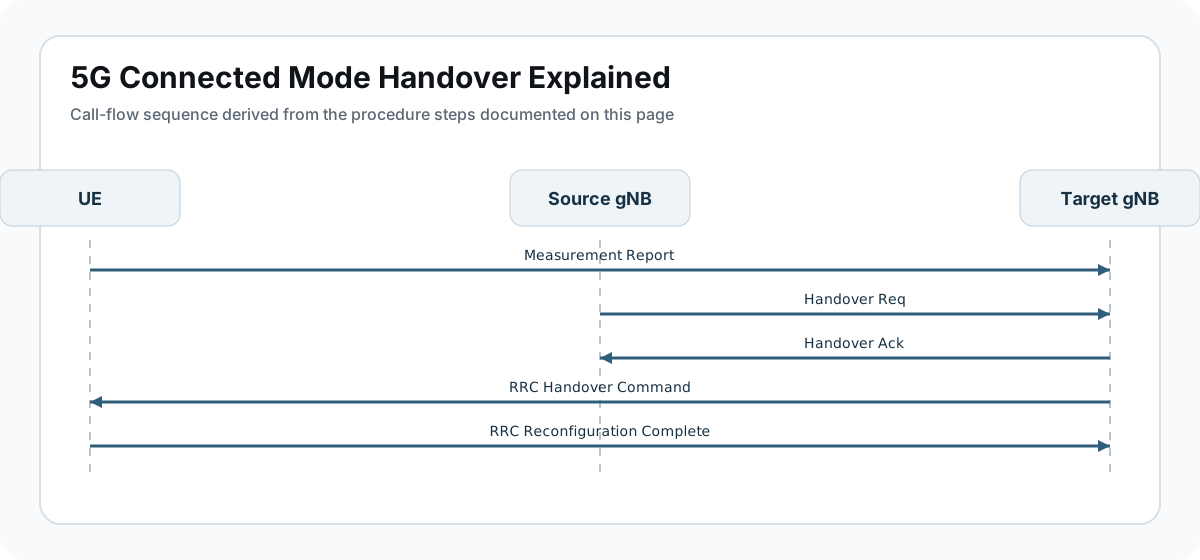
UE                Source gNB              Target Side              AMF / UPF
|                     |                        |                    |
|-- Measurement Report ----------------------->|                    |
|                     |-- target prep -------->|------------------->|
|<-- RRC Reconfiguration / HO command --------|                    |
|==== move to target cell ========================================>|
|-- RRC Reconfiguration Complete -------------------------------->|
|==== traffic continues on target path ==========================>|
Major Phases
| Phase | What happens |
|---|---|
| 1. Measurement trigger | The UE reports neighbor quality that suggests the source cell is no longer best. |
| 2. Mobility decision | The network selects the target and chooses the appropriate handover path. |
| 3. Target preparation | The target side prepares radio and context resources before execution. |
| 4. Handover execution | The UE receives the command, leaves the source side, and accesses the target side. |
| 5. Completion and continuity | The UE confirms the move and traffic continues on the new serving path. |
Step-by-Step Breakdown
The UE reports measurement conditions
Sender -> receiver: UE -> source gNB
Message(s): Measurement Report
Purpose: Provide the network with evidence that a connected-mode move is needed.
State or context change: The mobility branch begins from measurement-driven optimization or protection.
Note: The measurement trigger explains why the move happened now and which target was preferred.
The source side chooses the handover path
Sender -> receiver: Source gNB with optional AMF involvement
Message(s): Handover decision and target selection
Purpose: Choose whether the move should proceed as Xn, N2, or another connected-mode branch.
State or context change: The umbrella connected-mode handover becomes a specific execution path.
Note: This is the key difference between the umbrella procedure and the narrower Xn or N2 sub-procedures.
The target side prepares resources
Sender -> receiver: Source gNB -> target gNB or AMF -> target side
Message(s): Handover Request and target preparation
Purpose: Allocate radio and context resources before the UE is told to move.
State or context change: The target side becomes ready to receive the UE.
Note: Target preparation problems often appear later as radio failure even though the root cause was earlier resource allocation.
The UE executes the handover command
Sender -> receiver: Source gNB -> UE -> target gNB
Message(s): RRC Reconfiguration
Purpose: Move the UE from the source cell to the chosen target side.
State or context change: The UE leaves the old radio anchor and attempts target access.
Note: Execution quality depends on both command correctness and target-cell RF conditions.
The UE confirms completion and service continues
Sender -> receiver: UE -> target side
Message(s): RRC Reconfiguration Complete
Purpose: Confirm successful completion and let the network clean up the source side.
State or context change: The connected-mode mobility branch ends in stable target-side service.
Note: Completion is the main radio success checkpoint, but traffic continuity still must be validated afterward.
Important Messages in This Flow
| Message | Protocol | Direction | Purpose in this procedure | What to inspect briefly |
|---|---|---|---|---|
| Measurement Report | RRC | UE -> source gNB | Triggers the connected-mode mobility decision. | Inspect event type, target candidate, and timing. |
| Handover Request | NGAP / XnAP | Source side -> target side | Prepares the target resources. | Use it to prove the target was actually ready before command delivery. |
| RRC Reconfiguration | RRC | Source gNB -> UE | Carries the handover command. | Check target identity, mobility info, and execution timing. |
| RRC Reconfiguration Complete | RRC | UE -> target side | Confirms the UE completed the move. | Primary execution success sign. |
Important Parameters to Inspect
| Parameter | What it is | Where it appears | Why it matters | Common issues |
|---|---|---|---|---|
| Measurement trigger | Why the source decided to move the UE. | Measurement Report | Provides the cause of the mobility branch. | Wrong trigger tuning leads to early or late handover. |
| Target selection | Which cell or gNB was chosen. | Decision and preparation stage | Separates the umbrella handover story from the concrete target path. | Bad target choice creates downstream failure. |
| Preparation success | Whether the target actually allocated needed resources. | Handover preparation stage | Explains many later access failures. | A command sent to an unready target is a classic problem. |
| Execution timing | Delay from command to completion. | Command and completion correlation | Shows whether the move was efficient and healthy. | Long gaps often reveal RF or target-access trouble. |
| Post-handover traffic continuity | How service behaved after the move. | N3 and application validation | Proves the handover mattered positively at service level. | A clean RRC completion can still hide degraded traffic. |
Success Criteria
- The source selects the right connected-mode mobility path and target.
- Target resources are prepared before execution starts.
- The UE completes the move and confirms it cleanly.
- Traffic continuity remains stable after the handover.
Common Failures and Troubleshooting
| Symptom | Likely cause | Where to inspect | Relevant message(s) | Relevant interface(s) | Likely next step |
|---|---|---|---|---|---|
| Measurement trigger is wrong or unstable | The move starts from poor tuning rather than real need. | Repeated measurement events and neighbor ranking. | Measurement Report | NR-Uu | This creates ping-pong or late protection failure. |
| Target preparation fails silently | The source sends the UE toward a target that was not properly ready. | Preparation signaling and resource availability. | Handover Request | Xn or N2 | Often misread later as pure RF failure. |
| UE cannot complete target access | The handover command was received, but execution failed on the target side. | RRC command, target-cell access, and absence of completion. | RRC Reconfiguration | NR-Uu | This is the main radio execution failure branch. |
| Handover completes but service degrades | Radio execution worked but traffic continuity or target quality is weak. | Completion, traffic continuity, and target RF quality. | RRC Reconfiguration Complete | N3, NR-Uu | Treat this as post-handover service degradation, not a clean success. |
What to Check in Logs and Traces
- Start with the Measurement Report that triggered the move.
- Confirm whether the path was really Xn, N2, or another branch.
- Inspect target preparation success before blaming target RF alone.
- Correlate RRC Reconfiguration and RRC Reconfiguration Complete timing carefully.
- Validate the result with post-handover traffic continuity, not only completion signaling.
Related Pages
Related sub-procedures
Related message reference pages
Related troubleshooting pages
FAQ
What is 5G Connected Mode Handover?
It is the umbrella mobility procedure used when an actively connected UE moves between serving cells under network control.
How is it different from Xn or N2 Handover?
Connected Mode Handover is the broader family, while Xn and N2 are specific execution paths inside it.
What proves success?
A clean execution to the target side followed by completion and stable traffic continuity.
What should I inspect first?
Start with the measurement trigger, target selection, handover command, and post-move traffic continuity.
When should I drill into Xn or N2 details?
As soon as the source selects the concrete mobility path, because the failure branches differ.