5G Inter-RAT Handover Procedure Call Flow
5G Inter-RAT Handover is the mobility procedure used when service must move off NR onto another radio technology such as LTE.
The key engineering challenge is not just the radio move itself, but preserving usable service across the RAT boundary.
Introduction
This page explains the generic inter-RAT handover story: why the move starts, how the target RAT is prepared, how the UE leaves NR, and how service continuity is validated afterward.
When analyzing real traces, always separate the reason for leaving NR from the later target-RAT execution result.
What Is Inter-RAT Handover in Simple Terms?
- What starts the procedure: Coverage, quality, policy, or service rules say another RAT should serve the UE.
- What the UE and network want to achieve: Move the UE cleanly to the target RAT while preserving service continuity.
- What success looks like: The UE accesses the target RAT and service remains usable.
- What failure means: Interworking prep, target access, or bearer continuity breaks during the RAT change.
Why this procedure matters
Inter-RAT mobility is where access, core interworking, and bearer continuity all intersect. That makes it one of the easiest places to misdiagnose the wrong layer.
Quick Fact Sheet
| Procedure name | 5G Inter-RAT Handover |
|---|---|
| Domain | Mobility between 5G NR and LTE or other RATs |
| Main trigger | The network decides service should continue on a different radio technology |
| Start state | UE is active on 5G NR and another RAT becomes the better or required serving choice |
| End state | UE continues service on the target RAT with preserved context as far as possible |
| Main nodes | UE, source gNB, target eNB or other RAT node, AMF, MME/EPC where relevant |
| Main protocols | RRC measurement and command handling, interworking mobility coordination, bearer continuity |
| Main success outcome | UE moves off NR onto the target RAT and service remains available |
| Main failure outcome | Interworking coordination, target access, or bearer continuity fails during the RAT change |
| Most important messages | Measurement Report, Handover Required, RRC Reconfiguration, target-RAT access and completion |
| Main specs | TS 23.502, TS 38.300, TS 36.300, TS 38.331, TS 36.331 |
Preconditions
- The UE is active on NR and another RAT is available as a valid destination.
- Inter-RAT measurements and target-RAT configuration are present.
- Core interworking or bearer continuity support is available for the move.
- The target RAT can accept the UE after it leaves NR.
Nodes and Interfaces
Nodes involved
| Node | Role in this procedure |
|---|---|
| UE | Measures inter-RAT targets, executes the move, and re-enters service on the new RAT. |
| Source gNB | Decides when NR is no longer the best or allowed serving technology. |
| Target eNB or RAT node | Accepts the UE on the new technology and anchors the radio side after the move. |
| AMF | Coordinates the NR-side mobility and interworking decision. |
| MME / EPC or other target-core anchor | Support the target-RAT mobility and bearer continuity where needed. |
Interfaces used
| Interface | Path | Role |
|---|---|---|
| NR-Uu | UE <-> source gNB | Carries measurement reporting and the last NR-side mobility command. |
| LTE-Uu or target RAT air interface | UE <-> target access node | Carries target-RAT access after leaving NR. |
| N2 | Source gNB <-> AMF | Supports the NR-side mobility decision and coordination. |
| Interworking mobility interfaces | NR side <-> LTE/EPC or other RAT side | Transfer context and bearer handling across RAT boundaries. |
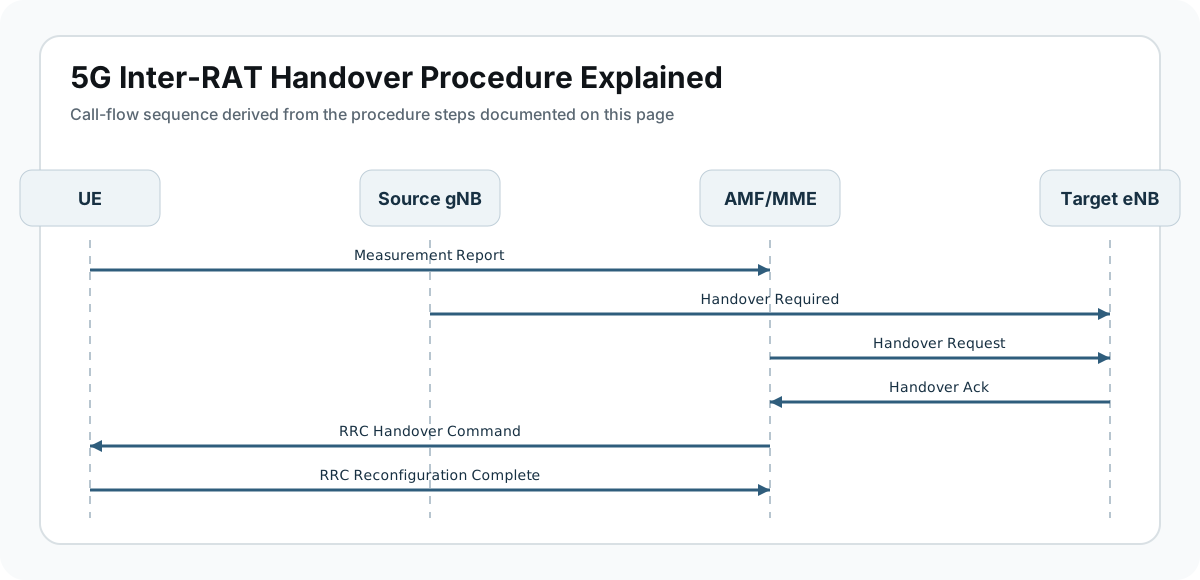
End-to-End Call Flow
UE                Source gNB            Core / Target RAT            Target Node
|                     |                        |                    |
|-- Measurement Report ----------------------->|                    |
|                     |-- inter-RAT prep ----->|------------------->|
|<-- RRC Reconfiguration ----------------------|                    |
|==== leave NR and access target RAT =============================>|
|==== service continues on target RAT if bearer continuity holds =>|
Major Phases
| Phase | What happens |
|---|---|
| 1. Inter-RAT target becomes preferable | Measurements, coverage, policy, or service rules say NR should no longer carry the UE. |
| 2. Interworking preparation | The network prepares the target RAT and coordinates context continuity. |
| 3. NR-side command | The source sends the UE the information needed to leave NR toward the target RAT. |
| 4. Target-RAT access | The UE synchronizes to the target technology and re-establishes the radio side there. |
| 5. Service continuity validation | Bearer and application continuity are checked on the new RAT. |
Step-by-Step Breakdown
The source gNB sees a target RAT as the right next serving choice
Sender -> receiver: UE -> source gNB
Message(s): Measurement Report
Purpose: Show that another RAT should now take over service.
State or context change: The mobility branch becomes inter-RAT rather than pure NR mobility.
Note: This may be driven by coverage, policy, service needs, or fallback logic such as voice continuity.
The network prepares the target RAT path
Sender -> receiver: Source side -> target RAT side
Message(s): Handover Required and target preparation
Purpose: Coordinate context and bearer continuity across technology boundaries.
State or context change: The target RAT becomes a viable destination before the UE leaves NR.
Note: Inter-RAT problems often start in interworking preparation rather than on the air interface itself.
The UE receives the NR-side move command
Sender -> receiver: Source gNB -> UE
Message(s): RRC Reconfiguration
Purpose: Tell the UE which target RAT and target cell it should move to.
State or context change: The UE is instructed to leave NR and enter the target technology.
Note: At this point the engineer should already know whether the move was a generic inter-RAT handover or part of a more specific flow like EPS fallback.
The UE accesses the target RAT
Sender -> receiver: UE -> target RAT node
Message(s): Target-RAT synchronization and access
Purpose: Re-establish radio continuity on the destination technology.
State or context change: The UE leaves NR and becomes active on the target RAT.
Note: Target-RAT access failure is often the most visible symptom even when the root cause was earlier preparation logic.
Service continuity is validated on the new RAT
Sender -> receiver: UE <-> target core and user plane
Message(s): Bearer continuity and first live packets
Purpose: Prove the move preserved usable service beyond the radio transition itself.
State or context change: The inter-RAT mobility branch closes in stable service on the target RAT.
Note: A clean radio move without working bearer continuity is still not a true success.
Important Messages in This Flow
| Message | Protocol | Direction | Purpose in this procedure | What to inspect briefly |
|---|---|---|---|---|
| Measurement Report | RRC | UE -> source gNB | Shows why the inter-RAT branch started. | Use it to understand whether the trigger was coverage, quality, or another policy-driven reason. |
| Handover Required | NGAP / interworking control | Source side -> core / target side | Starts interworking preparation toward the target RAT. | Helpful for finding the first real transition point. |
| RRC Reconfiguration | RRC | Source gNB -> UE | Carries the command to leave NR toward the target RAT. | Check target RAT details carefully. |
| First target-RAT service packets | User plane | UE <-> target path | Validate bearer continuity on the new technology. | This is the real success measure. |
Important Parameters to Inspect
| Parameter | What it is | Where it appears | Why it matters | Common issues |
|---|---|---|---|---|
| Target RAT and cell | Which technology and cell the UE was told to enter. | Preparation and command stage | Defines the entire rest of the mobility branch. | Wrong target means instant downstream confusion. |
| Inter-RAT measurement quality | Why the target RAT was chosen. | Measurement Report | Explains whether the move was justified by radio conditions. | Important when the move feels unnecessary. |
| Bearer/context transfer state | How user sessions were preserved across RAT change. | Preparation and post-move stage | Separates radio success from service success. | A major root cause area for inter-RAT trouble. |
| Target access timing | How quickly the UE entered the new RAT. | Execution stage | Shows whether the move was clean or strained. | Long gaps degrade user experience. |
| Post-move service quality | How well traffic behaved on the new RAT. | After access | Determines whether the inter-RAT move was actually worthwhile. | A completed move can still be a poor service outcome. |
Success Criteria
- The target RAT is selected for a valid and traceable reason.
- Interworking preparation completes before the UE leaves NR.
- The UE accesses the target RAT successfully.
- Bearer and application continuity remain usable after the move.
Common Failures and Troubleshooting
| Symptom | Likely cause | Where to inspect | Relevant message(s) | Relevant interface(s) | Likely next step |
|---|---|---|---|---|---|
| Interworking preparation is weak or incomplete | The target RAT path is not truly ready before the UE leaves NR. | Handover Required and target-preparation state. | Preparation stage | N2 and interworking interfaces | Often causes later failure that looks like RF trouble. |
| UE cannot access the target RAT | The command is delivered but the target technology cannot be entered successfully. | RRC command and target-RAT access behavior. | RRC Reconfiguration | Air interface | Main execution failure branch. |
| Move succeeds but sessions break | Radio continuity worked but bearer continuity did not. | Post-move traffic, bearer handling, and first application packets. | Post-move service stage | User plane | This is not a clean handover success. |
| The wrong inter-RAT branch is diagnosed | A specific use case such as EPS fallback or redirection is misread as generic handover. | Trigger reason and service context. | Measurement and decision stage | Cross-layer correlation | Always classify the exact inter-RAT use case before deep debugging. |
What to Check in Logs and Traces
- Write down why NR was left before reading the rest of the trace.
- Inspect target-RAT preparation state before blaming the target RF alone.
- Use RRC Reconfiguration to confirm the exact target RAT and target cell.
- Validate the result with first service packets on the target RAT.
- When voice is involved, check whether the branch was really EPS Fallback rather than generic inter-RAT mobility.
Related Pages
Related sub-procedures
- EPS Fallback Procedure
- LTE to 5G Inter-RAT Handover / Redirection
- Inter-gNB Handover
- Session Recovery after Mobility / Path Switch
Related message reference pages
Related troubleshooting pages
FAQ
What is 5G Inter-RAT Handover?
It is the mobility procedure where service moves between NR and another radio technology such as LTE.
Is it always NR to LTE?
No. That is the most common case here, but inter-RAT mobility can cover other technology transitions too.
What proves success?
The UE enters the target RAT and service continues with usable bearer continuity.
What should I inspect first?
Start with the trigger reason, target RAT, preparation state, and first service packets after the move.
How is it related to EPS Fallback?
EPS Fallback is a more specific inter-RAT mobility use case focused on voice continuity toward LTE.