5G PDU Session Modification Procedure Explained
Introduction
The PDU Session Modification procedure in 5G networks is used to update an existing PDU session after it has already been established.
This procedure allows the network or UE to modify session parameters such as:
- QoS flows
- user plane routing
- session policies
- network slice parameters
Unlike PDU Session Establishment, this procedure does not create a new session, but instead modifies the configuration of an existing one.
The procedure is defined by the 3rd Generation Partnership Project in:
- 3GPP TS 23.502 - 5G System Procedures
- 3GPP TS 24.501 - NAS Protocol
When PDU Session Modification Happens
PDU Session Modification may be triggered by either the UE or the network.
Typical triggers include:
- new QoS flow request
- policy changes from the core network
- application bandwidth changes
- network slicing adjustments
- mobility-related session updates
Network Functions Involved
Several core network components participate in this procedure.
UE (User Equipment)
The UE may request session modification when applications require new QoS resources.
gNB
The gNB handles radio configuration updates and forwards control-plane signaling.
AMF (Access and Mobility Management Function)
The AMF forwards signaling messages between the UE and session management entities.
SMF (Session Management Function)
The SMF controls session parameters including:
- QoS flow creation
- policy enforcement
- routing updates
UPF (User Plane Function)
The UPF updates forwarding rules and traffic handling based on the new session configuration.
Interfaces Used
| Interface | Description |
|---|---|
| NR-Uu | Radio interface between UE and gNB |
| N1 | NAS signaling between UE and AMF |
| N2 | Control plane between gNB and AMF |
| N11 | Control signaling between AMF and SMF |
| N4 | SMF control interface toward UPF |
| N3 | User plane tunnel between gNB and UPF |
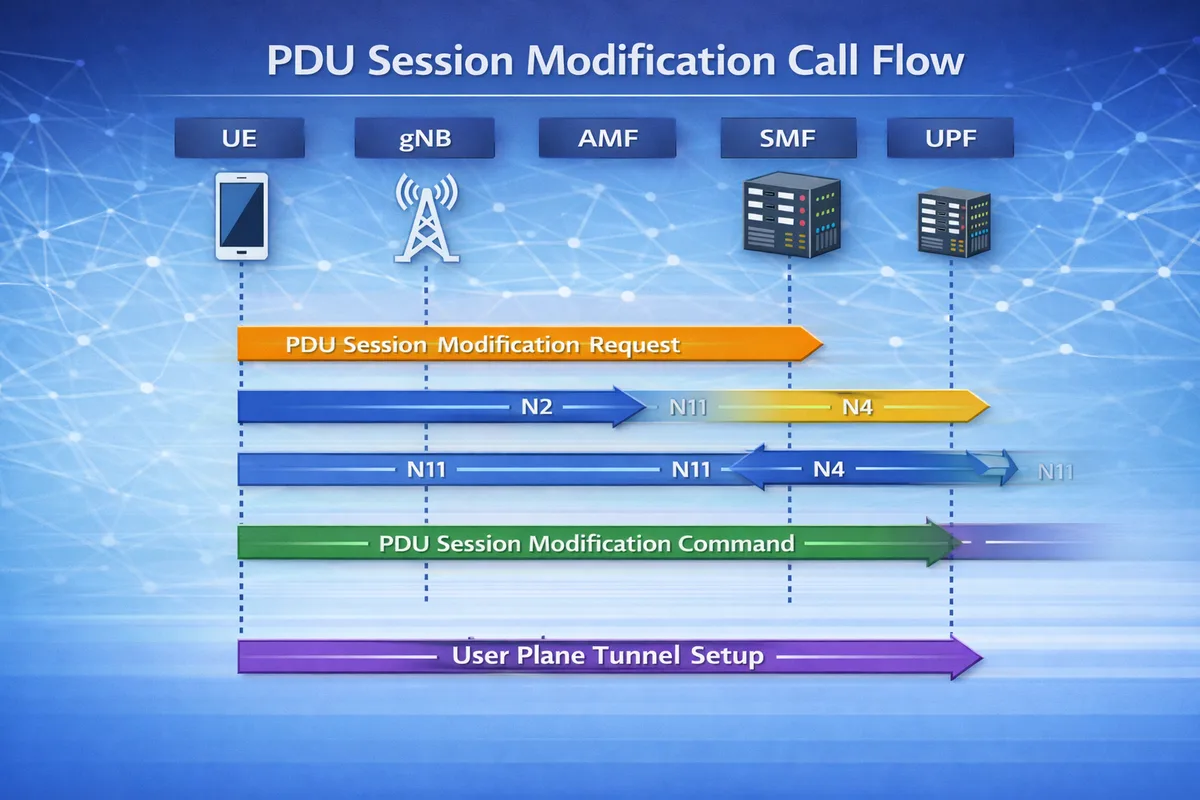
PDU Session Modification Call Flow
Below is the simplified signaling sequence.
UE           gNB           AMF            SMF            UPF
 |            |             |              |              |
 |--PDU Session Modification Request----->|
 |            |----N2--------------------->|
 |            |             |----N11----->|
 |            |             |              |----N4----->|
 |            |             |              |<---N4-----|
 |            |             |<---N11------|
 |<--PDU Session Modification Command----|
 |--PDU Session Modification Complete--->|
This procedure updates the existing PDU session configuration.
Step-by-Step Explanation
Step 1: PDU Session Modification Request
The UE sends a PDU Session Modification Request message.
This may request:
- new QoS flow
- removal of QoS flow
- modification of session parameters
Important parameters to check
Engineers should verify:
- PDU Session ID
- requested QoS flow parameters
- DNN (Data Network Name)
- slice information (S-NSSAI)
Step 2: Session Management Processing
The AMF forwards the request to the SMF.
The SMF:
- validates the request
- checks policy rules
- determines if the modification is allowed
Important parameters to check
Check:
- SMF session context
- policy control rules
- QoS authorization
Step 3: UPF Update
The SMF updates the UPF using the N4 interface.
This may include:
- creating new forwarding rules
- updating QoS flows
- modifying packet filtering rules
Important parameters to check
Verify:
- forwarding rules
- QoS Flow Identifier (QFI)
- packet detection rules (PDR)
Step 4: PDU Session Modification Command
The network sends a PDU Session Modification Command to the UE.
This message instructs the UE to update session parameters.
The message may contain:
- new QoS flow identifiers
- updated session policies
- traffic rules
Important parameters to check
Look for:
- QFI values
- QoS rule updates
- traffic filter parameters
Step 5: Modification Complete
The UE sends PDU Session Modification Complete.
After this step:
- the new session parameters become active
- the updated QoS flows are applied
Common PDU Session Modification Scenarios
| Scenario | Description |
|---|---|
| QoS upgrade | Application requires higher bandwidth |
| QoS downgrade | Network congestion control |
| Policy update | Policy control changes |
| Mobility update | Session path change |
Troubleshooting PDU Session Modification
Modification Request Rejected
Possible causes:
- invalid QoS request
- policy restrictions
- subscription limitations
QoS Flow Not Activated
Possible reasons:
- SMF configuration error
- UPF rule mismatch
- incorrect QFI mapping
Data Path Not Updated
Possible causes:
- N4 signaling failure
- UPF forwarding rule error
- radio bearer mismatch
Key NAS Messages
| Message | Purpose |
|---|---|
| PDU Session Modification Request | UE requests session change |
| PDU Session Modification Command | Network instructs UE |
| PDU Session Modification Complete | UE confirms update |
Relevant 3GPP Specifications
This procedure is defined in:
- 3GPP TS 23.502 - 5G System Procedures
- 3GPP TS 24.501 - NAS Protocol
- 3GPP TS 38.300 - NR Architecture
Published by the 3rd Generation Partnership Project.
Summary
The PDU Session Modification procedure allows the 5G Core Network to update session parameters dynamically during an active data session.
This enables:
- dynamic QoS adjustments
- policy enforcement
- optimized data routing
The procedure is essential for adaptive network performance and application-aware traffic management in 5G networks.