5G RRC Suspend Procedure Explained
Introduction
In 5G networks, the RRC Suspend procedure allows the network to temporarily suspend an active RRC connection while preserving the UE context.
This procedure transitions the User Equipment (UE) from RRC Connected state to RRC Inactive state.
Unlike RRC Release, where the context is removed, RRC Suspend keeps the UE context stored in the gNB, allowing the connection to be resumed quickly using the RRC Resume procedure.
This mechanism improves network efficiency and reduces signaling overhead.
The procedure is defined by the 3rd Generation Partnership Project in:
- 3GPP TS 38.331 - NR RRC Protocol
- 3GPP TS 38.300 - NR Architecture
Why RRC Suspend Is Needed
Modern mobile applications often generate intermittent traffic patterns.
Instead of releasing the connection completely, the network can suspend it and restore it quickly later.
Benefits include:
| Benefit | Description |
|---|---|
| Faster reconnection | UE can quickly resume connection |
| Reduced signaling overhead | Avoids full connection setup |
| Lower latency | Faster service resumption |
| Efficient resource usage | Radio resources released but context preserved |
Network Elements Involved
UE (User Equipment)
Receives the suspend command and transitions to RRC Inactive state.
gNB (Next Generation NodeB)
Initiates the suspend procedure and stores the UE context.
Interfaces Used
| Interface | Description |
|---|---|
| NR-Uu | Radio interface between UE and gNB |
RRC Suspend Call Flow
Below is the simplified signaling sequence.
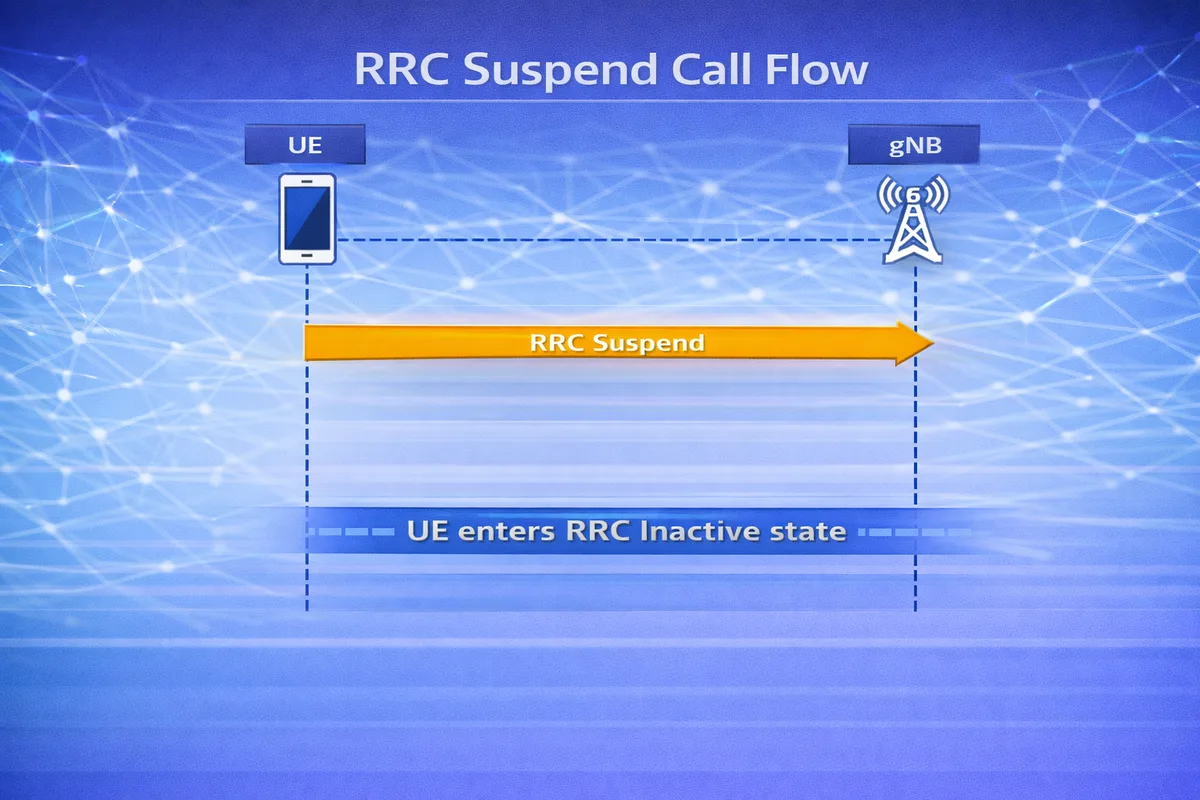
UE                     gNB
 |                      |
 |<----RRC Suspend------|
 |                      |
 |==== UE enters RRC Inactive state ====|
After this procedure, the UE context remains stored in the gNB.
Step-by-Step Explanation
Step 1: Suspend Decision
The gNB decides to suspend the connection when the UE becomes inactive.
Typical triggers include:
- inactivity timer expiry
- bursty traffic patterns
- network optimization
Important parameters to check
Engineers should verify:
- inactivity timer values
- UE traffic pattern
- resource usage
Step 2: RRC Suspend Message
The gNB sends an RRC Suspend message to the UE.
This message contains:
- Suspend configuration
- resume identity
- context storage information
Important parameters to check
Check:
- resume identity
- suspend cause
- UE context parameters
Step 3: UE Enters RRC Inactive State
After receiving the suspend message, the UE transitions to RRC Inactive state.
In this state:
- the UE monitors paging
- radio resources are released
- UE context remains stored in the gNB
Important parameters to check
Verify:
- UE state transition
- paging configuration
- resume identity validity
RRC State Transitions in 5G
| Current State | Procedure | Next State |
|---|---|---|
| RRC Connected | RRC Suspend | RRC Inactive |
| RRC Inactive | RRC Resume | RRC Connected |
| RRC Connected | RRC Release | RRC Idle |
RRC Suspend vs RRC Release
| Feature | RRC Suspend | RRC Release |
|---|---|---|
| UE context stored | Yes | No |
| Next state | RRC Inactive | RRC Idle |
| Resume speed | Fast | Requires full setup |
| Signaling overhead | Low | Higher |
Troubleshooting RRC Suspend
Suspend Failure
Possible causes:
- UE capability limitations
- incorrect configuration parameters
- signaling errors
Resume Failure After Suspend
Possible reasons:
- lost UE context in gNB
- resume identity mismatch
- synchronization issues
Frequent Suspend / Resume Cycles
Possible causes:
- bursty traffic patterns
- incorrect inactivity timer configuration
- mobility conditions
Key Messages in RRC Suspend
| Message | Purpose |
|---|---|
| RRC Suspend | gNB instructs UE to suspend connection |
Relevant 3GPP Specifications
The RRC Suspend procedure is defined by the 3rd Generation Partnership Project in:
- 3GPP TS 38.331 - NR RRC Protocol
- 3GPP TS 38.300 - NR Architecture
Summary
The RRC Suspend procedure allows the 5G network to temporarily suspend the radio connection while preserving UE context.
The process includes:
- gNB deciding to suspend the connection
- gNB sending RRC Suspend message
- UE transitioning to RRC Inactive state
This mechanism enables faster reconnection and improved resource efficiency in 5G networks.