VoNR Call Flow and Procedures | Voice Over NR Complete Tutorial
Introduction to VoNR
Voice over New Radio (VoNR) is the native voice service for 5G Standalone (SA) networks.
VoNR enables voice calls to be carried directly over 5G NR radio and the 5G Core network, without relying on legacy LTE fallback mechanisms.
Unlike VoLTE, where voice services operate over LTE radio access, VoNR allows pure 5G voice communication, delivering:
- lower call setup latency
- improved voice quality
- better spectrum efficiency
- simplified network architecture
VoNR uses the IP Multimedia Subsystem (IMS) for session control and SIP signaling.
The VoNR architecture is standardized by the 3rd Generation Partnership Project in specifications such as:
- 3GPP TS 23.501
- 3GPP TS 23.502
- 3GPP TS 24.229
VoNR Architecture
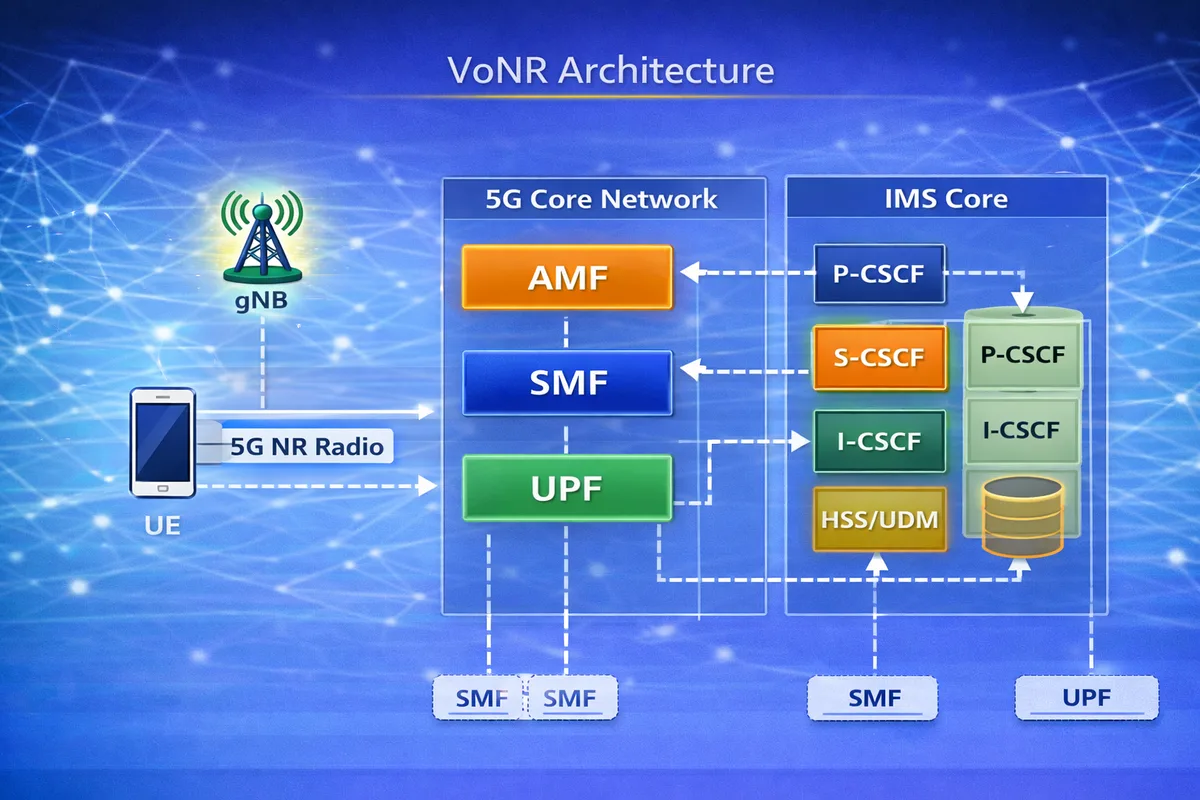
VoNR integrates 5G NR radio access with the IMS core network to provide voice services.
| Network Element | Function |
|---|---|
| UE | User Equipment initiating or receiving calls |
| gNB | 5G base station providing NR radio connectivity |
| AMF | Access and Mobility Management Function |
| SMF | Session Management Function |
| UPF | User Plane Function |
| IMS Core | SIP call control |
| P-CSCF | IMS entry point for the UE |
| S-CSCF | Central session controller |
How VoNR Works
- UE connects to the 5G NR network
- UE establishes an IMS PDU session
- UE registers with IMS using SIP
- Voice calls are handled using SIP signaling
The voice media is carried using RTP over the 5G user plane.
VoNR Deployment
Operators deploy VoNR when they roll out 5G Standalone networks.
There are typically three deployment stages:
| Stage | Description |
|---|---|
| LTE Voice (VoLTE) | Voice services provided over LTE |
| EPS Fallback | Voice temporarily falls back to LTE |
| VoNR | Voice handled directly over 5G NR |
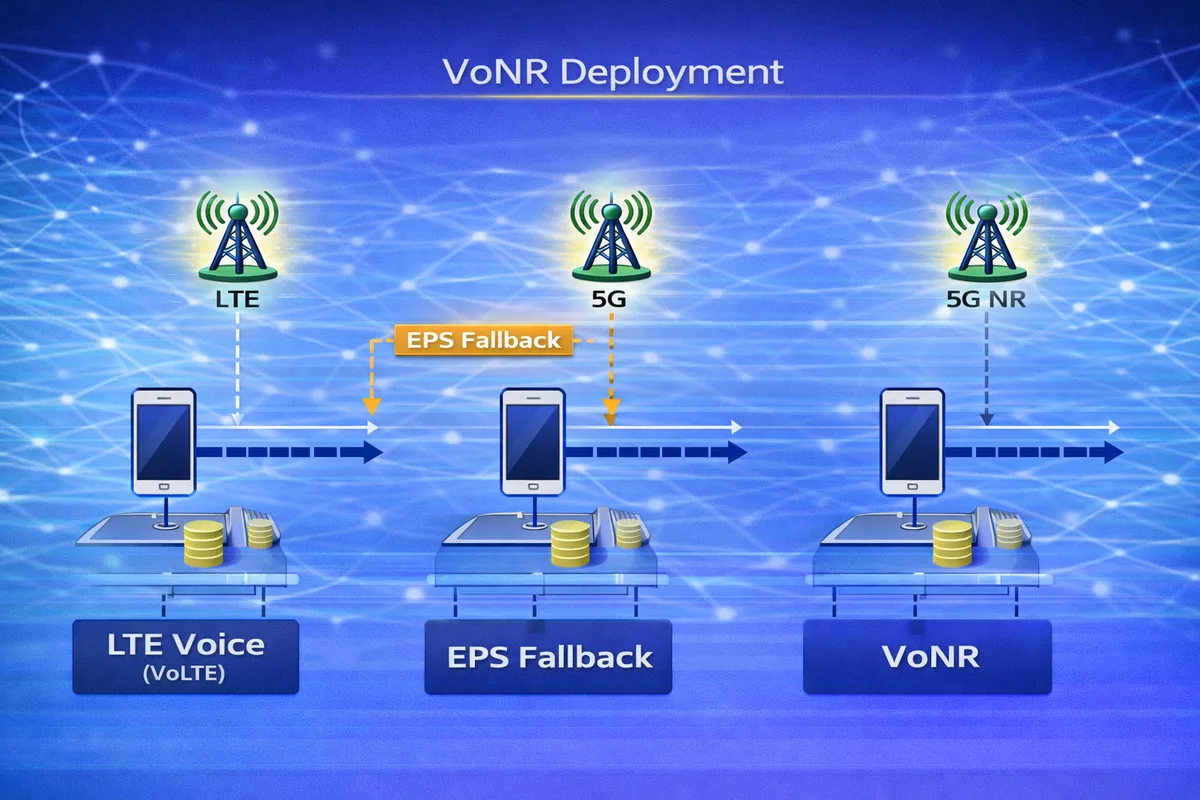
VoNR Deployment Requirements
For VoNR to work, the following components must support VoNR:
- 5G Standalone Core Network
- IMS platform
- VoNR-capable smartphones
- NR coverage for voice services
Why Operators Deploy VoNR
Benefits include:
- lower voice latency
- simplified voice architecture
- improved spectrum utilization
- better integration with 5G services
Many operators initially deploy EPS fallback before migrating fully to VoNR.
VoNR Call Flow Procedures
This tutorial series explains all VoNR signaling procedures used in 5G networks.
Each procedure is explained in a dedicated tutorial with detailed call flows and diagrams.
1. VoNR Registration
IMS registration over the 5G NR network.
Topics covered:
- IMS PDU session establishment
- SIP REGISTER procedure
- VoNR readiness
Read tutorial: VoNR Registration Procedure
2. VoNR Mobile Originated Call
Procedure when the UE initiates a voice call.
Topics covered:
- SIP INVITE flow
- call routing via IMS
- media session establishment
Read tutorial: VoNR Mobile Originated Call Flow
3. VoNR Mobile Terminated Call
Procedure when the UE receives an incoming call.
Topics covered:
- network paging
- SIP INVITE delivery
- call acceptance
Read tutorial: VoNR Mobile Terminated Call Flow
4. VoNR Call Termination
Procedure used to end a voice call session.
Topics covered:
- SIP BYE signaling
- session release
- media termination
Read tutorial: VoNR Call Termination Procedure
5. VoNR Call Hold / Resume
Procedure used when a user temporarily pauses or resumes a call.
Topics covered:
- SIP re-INVITE signaling
- SDP modification
- session updates
Read tutorial: VoNR Call Hold and Resume
6. VoNR Emergency Call
Special procedure used for emergency voice services.
Topics covered:
- emergency SIP INVITE
- priority network routing
- emergency service handling
Read tutorial: VoNR Emergency Call Flow
7. EPS Fallback
Fallback mechanism used when VoNR is unavailable.
Topics covered:
- handover to LTE
- voice call over VoLTE
- fallback triggers
Read tutorial: EPS Fallback Procedure
VoNR vs VoLTE
| Feature | VoNR | VoLTE |
|---|---|---|
| Radio Access | 5G NR | LTE |
| Core Network | 5G Core | EPC |
| Latency | Lower | Higher |
| Architecture | Pure 5G | LTE-based |
| Voice Media | RTP over 5G | RTP over LTE |
VoNR represents the future evolution of voice services in mobile networks.
Summary
VoNR enables native voice services in 5G Standalone networks, using IMS signaling and NR radio access.
Key VoNR procedures include:
| Procedure | Purpose |
|---|---|
| VoNR Registration | IMS registration over NR |
| Mobile Originated Call | UE initiates voice call |
| Mobile Terminated Call | UE receives voice call |
| Call Termination | End voice session |
| Call Hold / Resume | Modify voice session |
| Emergency Call | Emergency voice services |
| EPS Fallback | Voice fallback to LTE |
Together, these procedures form the complete VoNR call flow framework used in 5G networks.