VoNR Mobile Terminated Call Flow | Voice Over NR Incoming Call Tutorial
Introduction
A VoNR Mobile Terminated (MT) Call occurs when a User Equipment (UE) receives an incoming voice call over the 5G NR network.
In this scenario, the call is initiated by another subscriber and delivered through the IMS core network to the destination UE.
If the destination UE is in RRC Idle or RRC Inactive state, the network must first perform a paging procedure to locate the device before delivering the SIP INVITE message.
VoNR MT call procedures are defined by the 3rd Generation Partnership Project specifications:
- 3GPP TS 23.501
- 3GPP TS 23.502
- 3GPP TS 24.229
Network Elements Involved
The VoNR MT call flow involves several network components.
| Network Element | Function |
|---|---|
| Caller UE | Initiates the voice call |
| IMS Core | Handles SIP signaling |
| AMF | Handles mobility management |
| gNB | Provides NR radio connectivity |
| Called UE | Receives the voice call |
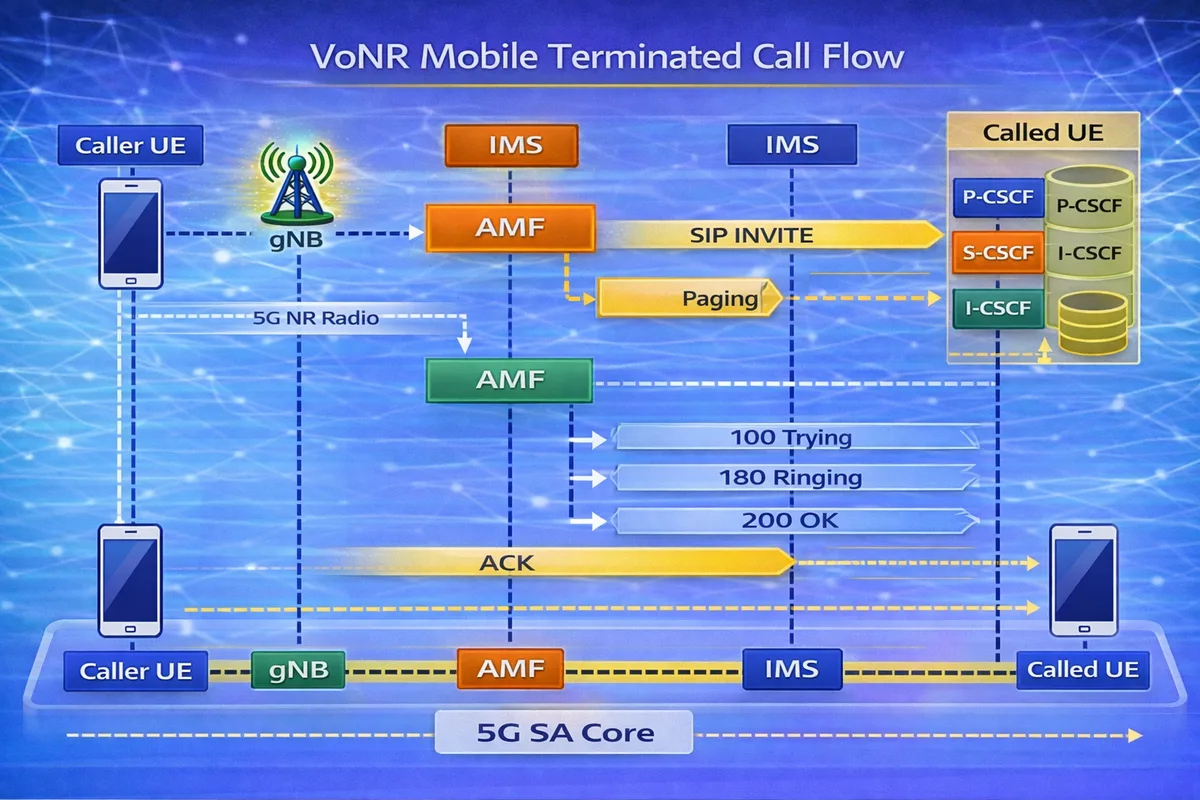
VoNR Mobile Terminated Call Signaling Flow
Caller UE      IMS        AMF        gNB        UE
    |           |          |          |         |
    |---SIP INVITE------->|          |         |
    |                     |          |         |
    |                     |----Paging------->|
    |                     |          |         |
    |<---100 Trying------|          |         |
    |<---180 Ringing-----|          |         |
    |<---200 OK----------|          |         |
    |----ACK------------>|          |         |
    |====== RTP Voice Media ======|
Step-by-Step VoNR MT Call Procedure
Step 1: Incoming SIP INVITE
The calling subscriber sends a SIP INVITE message through the IMS network.
The IMS core performs:
- subscriber authentication
- call routing
- destination lookup
The INVITE is then routed toward the destination UE.
Important parameters to check
| Parameter | Description |
|---|---|
| Request URI | Destination subscriber |
| SDP | Codec and media parameters |
| Caller Identity | Calling number |
Step 2: Paging the Destination UE
If the destination UE is not in RRC Connected state, the network must locate the device.
The AMF initiates a paging procedure across the tracking area.
Paging process:
- AMF sends Paging message to gNBs
- gNB broadcasts paging over NR
- UE detects paging and resumes connection
Important parameters to check
| Parameter | Description |
|---|---|
| Paging Identity | 5G-S-TMSI |
| Tracking Area | Paging broadcast area |
| DRX Cycle | UE paging monitoring interval |
Step 3: SIP INVITE Delivery
After the UE reconnects to the network, the SIP INVITE is delivered to the device.
The UE responds with:
| SIP Response | Description |
|---|---|
| 100 Trying | INVITE received |
| 180 Ringing | Device is ringing |
These responses are forwarded back to the calling party.
Step 4: Call Acceptance
When the user answers the call, the UE sends SIP 200 OK.
The calling UE then sends an ACK message.
This completes the call setup procedure.
Step 5: Voice Media Transmission
After the SIP handshake is completed, the voice session begins.
Voice media is transmitted using RTP (Real-Time Transport Protocol).
Media packets flow through the UPF in the 5G Core network.
Typical codecs include:
| Codec | Description |
|---|---|
| AMR-WB | Wideband voice |
| EVS | Enhanced voice services |
EVS provides high-definition voice quality for VoNR calls.
QoS Configuration for VoNR Calls
VoNR calls rely on dedicated QoS flows.
| Service | 5QI | Description |
|---|---|---|
| SIP Signaling | 5QI = 5 | Control signaling |
| Voice Media | 5QI = 1 | Conversational voice |
This ensures low latency and high reliability for voice traffic.
Troubleshooting VoNR MT Call Issues
Incoming Call Not Received
Possible causes:
- paging failure
- IMS routing issue
- UE not registered to IMS
Call Setup Failure
Possible reasons:
- SIP signaling error
- codec negotiation failure
- subscriber profile restrictions
Poor Voice Quality
Possible causes:
- incorrect QoS configuration
- packet loss in user plane
- radio interference
Summary
A VoNR Mobile Terminated Call allows a UE to receive voice calls directly over the 5G NR network.
The procedure includes:
- caller sending SIP INVITE
- network performing paging
- destination UE responding with 180 Ringing
- call acceptance with 200 OK
- voice media transmission via RTP
This mechanism enables native 5G voice services with lower latency and improved voice quality.