Synthetic teaching example, not a captured trace or encoder input.
The two NR CGI values illustrate a cell-scoped report; compare them with the DU served-cell inventory.
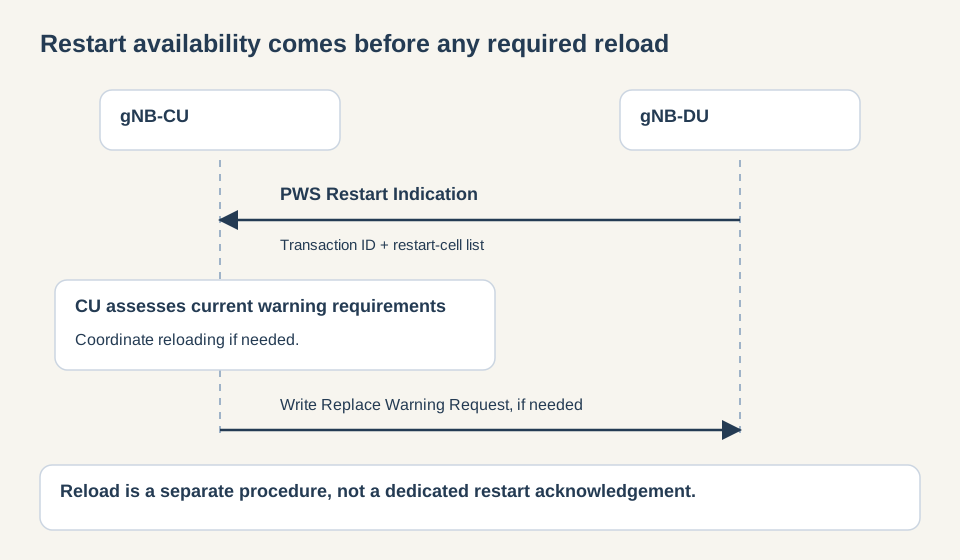
A later warning-delivery request is a separate procedure, not an acknowledgement of this indication.
Important Information Elements
IE
Presence
Description
Message Type
Mandatory
Identifies PWS RESTART INDICATION through the F1AP PDU envelope.
Transaction ID
Mandatory
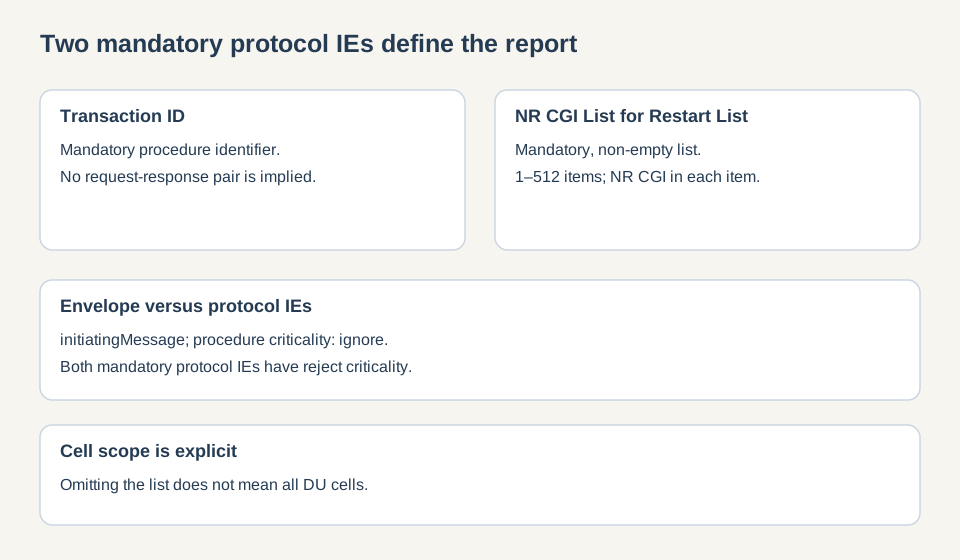
Identifies this F1AP procedure instance; its presence does not imply a request-response exchange.
NR CGI List for Restart List
Mandatory
Mandatory list of reported DU cells. Each item contains a mandatory NR CGI; Release 18 permits 1 to 512 items.
Detailed field explanation
Message Type
Identifies PWS RESTART INDICATION through the F1AP PDU envelope.
Presence: Mandatory
In practice: In practice, compare this field with the original request and with any later release-dependent optional fields so you can see whether the network accepted the same service model the UE asked for.
Transaction ID
Identifies this F1AP procedure instance; its presence does not imply a request-response exchange.
Presence: Mandatory
In practice: In practice, compare this field with the original request and with any later release-dependent optional fields so you can see whether the network accepted the same service model the UE asked for.
NR CGI List for Restart List
Mandatory list of reported DU cells. Each item contains a mandatory NR CGI; Release 18 permits 1 to 512 items.
Presence: Mandatory
In practice: In practice, compare this field with the original request and with any later release-dependent optional fields so you can see whether the network accepted the same service model the UE asked for.
What to check in logs and traces
Confirm DU-to-CU direction and procedureCode id-PWSRestartIndication.
Check Transaction ID and the mandatory, non-empty restart-cell list.
Map each NR CGI to the intended DU cell.
Compare the indication timestamp with DU and cell recovery logs.
Review current warning requirements before expecting new warning delivery.
If reloading occurs, trace the separate Write Replace Warning exchange and DU broadcast state.
Common Issues and Troubleshooting
No dedicated response follows the indication.
Likely cause: This is normal for this Class 2 procedure.
What to inspect: CU processing logs and any separate warning-reload activity.
Next step: Evaluate handling and recovery state rather than searching for a Restart Response message.
An expected cell is missing from the report.
Likely cause: The cell may not yet be available, may belong to another DU, or may be outside this report's scope.
What to inspect: NR CGI mapping, served-cell configuration, and cell recovery logs.
Next step: Reconcile the reported cells with the DU's current cell inventory.
Warnings remain unavailable after restart reporting.
Likely cause: Reload coordination, warning validity, or subsequent broadcast configuration may need investigation.
What to inspect: CU warning inventory, upstream recovery handling, and any new Write Replace Warning Request and Response.
Next step: Determine whether a valid warning required reloading, then locate the missing recovery step.
LTE / 5G / Variant Comparison
Compared with PWS Failure Indication
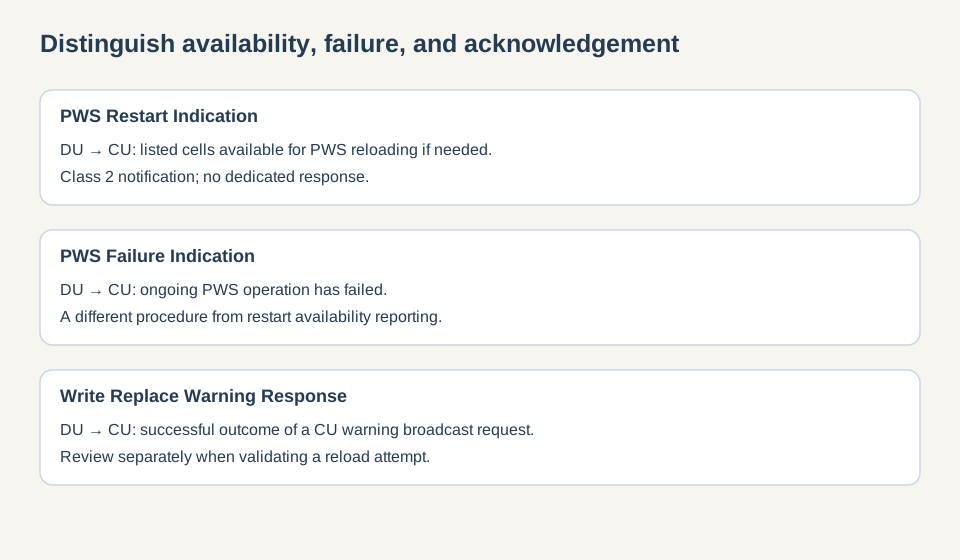
Restart reports cells available for possible reloading; Failure reports a failure of ongoing PWS operation.
Compared with Write Replace Warning Response
The warning response answers a CU broadcast request. Restart Indication is initiated independently by the DU.
Compared with PWS Cancel Response
Cancellation reporting concerns stopping warnings, while restart reporting concerns possible reloading.
FAQ
Who sends PWS Restart Indication in F1AP?
The gNB-DU sends it to the gNB-CU over F1-C.
Does it have a dedicated response?
No. It is a Class 2 notification procedure, even though Transaction ID is mandatory.
Can the restart-cell list be omitted to mean all DU cells?
No. The list is mandatory and must contain at least one NR CGI item.
Does this prove warning broadcasts have resumed?
No. Verify any required reload procedure and actual DU broadcast state separately.
References
3GPP TS 38.473 V18.8.0, sections 8.5.3, 9.2.4.5, and 9.3
Decode this message with the 3GPP Decoder, inspect the related message database, or open the matching call flow to see where this signaling step fits in the full procedure.