Write Replace Warning Request is the F1AP non-UE-associated message the gNB-CU sends to the gNB-DU to start or overwrite broadcast of public warning information over NR radio.
Message Fact Sheet
Protocol
f1ap
Network
5g
Spec
3GPP TS 38.473
Spec Section
Sections 8.5.1 and 9.2.4.1
Direction
gNB-CU -> gNB-DU initiatingMessage
Message Type
Public warning broadcast request
Full message name
Write Replace Warning Request
Protocol
F1AP
Technology
5G
Direction
gNB-CU -> gNB-DU initiatingMessage
Interface
F1-C
Signaling bearer / channel
Non-UE-associated F1AP signaling for public warning broadcast / SCTP carried F1AP initiatingMessage followed by Write Replace Warning Response
Typical trigger
A public warning event, ETWS event, CMAS alert, or warning update arrives at the CU and must be broadcast or replace an ongoing broadcast through one or more gNB-DU cells.
Main purpose
Starts or overwrites warning message broadcast, carries PWS system information defined by RRC, controls repetition and broadcast count, optionally scopes the broadcast to selected DU cells, and enables emergency warning delivery without a UE-associated context.
Main specification
3GPP TS 38.473, Sections 8.5.1 and 9.2.4.1
Release added
Release 15
Procedures where used
Earthquake alerts, Tsunami warnings, Severe weather notifications, Civil protection alerts, Public emergency broadcasts, CMAS alert delivery, Warning broadcast replacement
What is Write Replace Warning Request in simple terms?
Write Replace Warning Request is the F1AP non-UE-associated message the gNB-CU sends to the gNB-DU to start or overwrite broadcast of public warning information over NR radio.
Starts or overwrites warning message broadcast, carries PWS system information defined by RRC, controls repetition and broadcast count, optionally scopes the broadcast to selected DU cells, and enables emergency warning delivery without a UE-associated context.
Why this message matters
Write Replace Warning Request is the CU command that tells the DU to start or replace an emergency/public warning broadcast. Decode PWS System Information, repetition settings, and cell scope first.
Where this message appears in the call flow
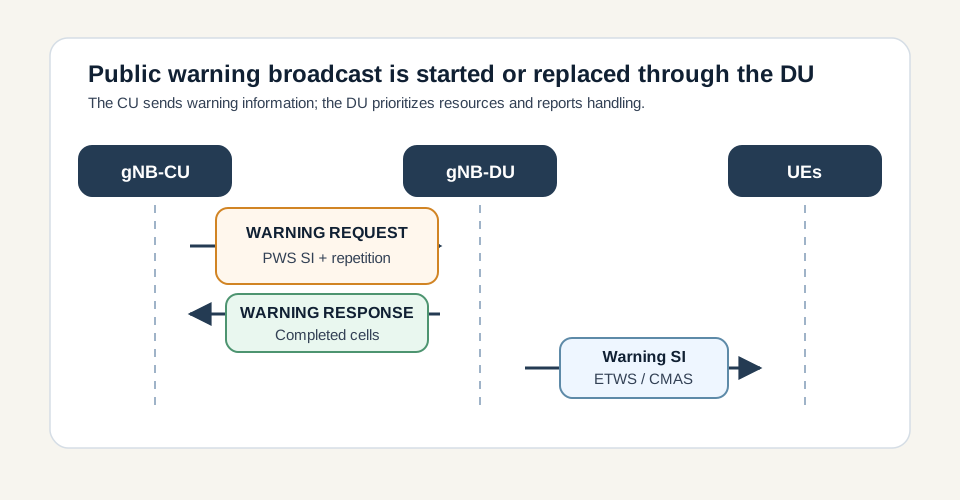
Write-Replace Warning
Procedure branch: the CU starts or overwrites warning broadcast and the DU acknowledges handling with a response.
Call flow position: The gNB-CU sends Write Replace Warning Request to start or overwrite warning broadcast in the DU.
Typical state: The DU prioritizes resources for warning handling, configures broadcast, and responds with Write Replace Warning Response.
Preconditions:
The F1 interface is operational.
The CU has received warning content or warning-system information to distribute.
PWS System Information contains valid notification and warning SI details.
Next likely message: Write Replace Warning Response
Warning broadcast scope
Decode branch: inspect PWS content, repetition settings, broadcast count, and NR cell scope.
Call flow position: The request may include Cells To Be Broadcast List to restrict warning broadcast to selected DU cells.
Typical state: If the cell list is absent, implementation behavior follows the warning procedure and DU-side broadcast scope rules.
Preconditions:
The CU has mapped the public warning area to DU cells.
NR CGI values are valid for cells served by the target DU.
Next likely message: DU broadcasts warning SI in the selected cells and reports completed cells in the response
Replacement and concurrent warning handling
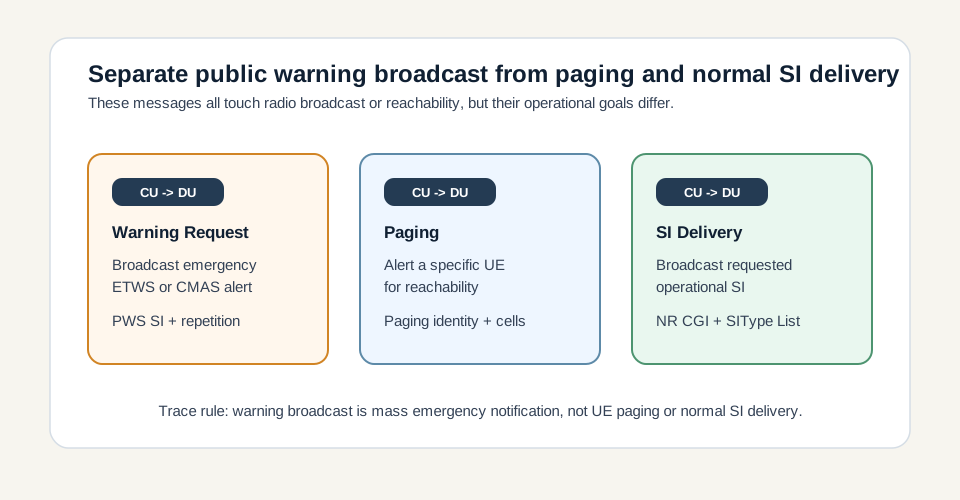
Scope branch: keep emergency broadcast, UE reachability paging, and operational SI delivery separate.
Call flow position: The DU uses notification information, SIB type, repetition period, and broadcast count to decide whether to replace or continue concurrent warning broadcasts.
Typical state: SIB8 warning behavior can be concurrent, while other SIB types may replace ongoing broadcast with the same SIB type.
Preconditions:
PWS System Information includes Notification Information.
The DU may already be broadcasting warning messages.
Next likely message: Write Replace Warning Response followed by warning SI broadcast
Call flow position
Previous message(s): Public warning distribution from higher layers, CBC or core-network warning event, Existing warning broadcast to be replaced
Next message(s): DU warning handling result, Radio broadcast of warning SI, Dedicated RRC delivery if UEs cannot receive SI from broadcast
Message direction and transport
Sender and receiver: gNB-CU -> gNB-DU initiatingMessage
Interface: F1-C
Domain: Public warning system, ETWS, CMAS, and emergency broadcast delivery
Signaling bearer: Non-UE-associated F1AP signaling for public warning broadcast
Logical channel: SCTP carried F1AP initiatingMessage followed by Write Replace Warning Response
Transport / encapsulation: F1AP over SCTP/IP between gNB-CU and gNB-DU
Security context: Write Replace Warning Request does not establish UE security. It distributes public warning broadcast information to cells rather than addressing a dedicated UE context.
Message Structure Overview
Write Replace Warning Request is a non-UE-associated initiatingMessage from gNB-CU to gNB-DU.
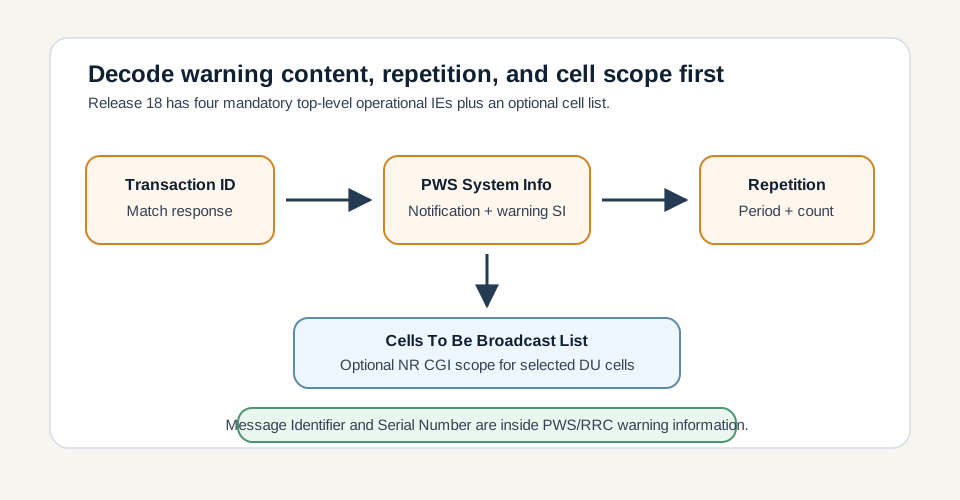
The top-level mandatory F1AP IEs are Transaction ID, PWS System Information, Repetition Period, and Number of Broadcasts Requested.
Cells To Be Broadcast List is optional and scopes warning broadcast to specific NR CGI values.
Message Identifier, Serial Number, warning type, warning contents, and data coding are part of the warning/RRC/PWS information rather than top-level F1AP IEs.
The DU acknowledges handling with Write Replace Warning Response and may report cells where broadcast completed.
This page follows TS 38.473 Release 18. Simplified PWS summaries often list Message Identifier and Serial Number as if they were top-level F1AP IEs; in this message they are carried within the PWS/RRC warning information.
Treat this as a teaching example based on the expected message structure, not as a captured network trace.
Start with Transaction ID, then decode PWS System Information and its notification information.
Check Repetition Period and Number of Broadcasts Requested before judging whether the warning stopped too soon or repeats too often.
Use Cells To Be Broadcast List to verify the intended DU cell scope.
Important Information Elements
IE
Presence
Description
Message Type
Mandatory
Identifies the F1AP PDU as WRITE-REPLACE WARNING REQUEST.
Transaction ID
Mandatory
Correlates the request with the later Write Replace Warning Response.
PWS System Information
Mandatory
Carries the public warning system information defined by RRC, including notification and warning SI content used for ETWS, CMAS, or other public warning broadcast.
Repetition Period
Mandatory
Defines the warning broadcast repetition interval.
Number of Broadcasts Requested
Mandatory
Defines how many broadcast repetitions are requested. With specific SIB8 conditions, zero can indicate indefinite broadcast when the repetition period is non-zero.
Cells To Be Broadcast List
Optional
Optional list of DU cells where the warning should be broadcast. Each item includes NR CGI.
Detailed field explanation
Message Type
Identifies the F1AP PDU as WRITE-REPLACE WARNING REQUEST.
Presence: Mandatory
In practice: In practice, compare this field with the original request and with any later release-dependent optional fields so you can see whether the network accepted the same service model the UE asked for.
Transaction ID
Correlates the request with the later Write Replace Warning Response.
Presence: Mandatory
In practice: In practice, compare this field with the original request and with any later release-dependent optional fields so you can see whether the network accepted the same service model the UE asked for.
PWS System Information
Carries the public warning system information defined by RRC, including notification and warning SI content used for ETWS, CMAS, or other public warning broadcast.
Presence: Mandatory
In practice: In practice, compare this field with the original request and with any later release-dependent optional fields so you can see whether the network accepted the same service model the UE asked for.
Repetition Period
Defines the warning broadcast repetition interval.
Presence: Mandatory
In practice: In practice, compare this field with the original request and with any later release-dependent optional fields so you can see whether the network accepted the same service model the UE asked for.
Number of Broadcasts Requested
Defines how many broadcast repetitions are requested. With specific SIB8 conditions, zero can indicate indefinite broadcast when the repetition period is non-zero.
Presence: Mandatory
In practice: In practice, compare this field with the original request and with any later release-dependent optional fields so you can see whether the network accepted the same service model the UE asked for.
Cells To Be Broadcast List
Optional list of DU cells where the warning should be broadcast. Each item includes NR CGI.
Presence: Optional
In practice: In practice, compare this field with the original request and with any later release-dependent optional fields so you can see whether the network accepted the same service model the UE asked for.
What to check in logs and traces
Confirm message direction is gNB-CU to gNB-DU.
Match Transaction ID with Write Replace Warning Response.
Decode PWS System Information, including notification information, SIB type, and warning payload.
Verify Message Identifier and Serial Number inside the warning/PWS information.
Check Repetition Period and Number of Broadcasts Requested.
Validate Cells To Be Broadcast List and NR CGI values when present.
Confirm DU prioritizes resources and broadcasts warning SI.
Check the response for Cells Broadcast Completed List and Dedicated SI Delivery Needed UE List.
Common Issues and Troubleshooting
Warning is not broadcast in all intended cells.
Likely cause: Cells To Be Broadcast List may be incomplete, NR CGI mapping may be wrong, or DU cell availability may prevent broadcast.
What to inspect: Check Cells To Be Broadcast List, DU served-cell inventory, response completed-cell list, and DU broadcast logs.
Next step: Correct the warning area mapping and resend the request if needed.
New warning unexpectedly replaces an ongoing broadcast.
Likely cause: Notification Information and SIB type handling may indicate replacement rather than concurrent broadcast.
What to inspect: Check PWS System Information, Notification Information, SIB Type, and ongoing warning messages in the DU.
Next step: Verify whether the warning should be concurrent or replace the existing broadcast.
UEs cannot receive the warning from broadcast.
Likely cause: Some UEs may be unable to receive system information from broadcast, or SI scheduling may be misconfigured.
What to inspect: Check Write Replace Warning Response for Dedicated SI Delivery Needed UE List and inspect RRC dedicated delivery handling.
Next step: Use dedicated RRC delivery for affected UEs when indicated by the response.
LTE / 5G / Variant Comparison
ETWS handling
ETWS warning handling is optimized for urgent disaster alerts such as earthquake and tsunami notifications. Validate warning type, security-related information, and rapid broadcast behavior inside the PWS/RRC content.
CMAS and public warning handling
CMAS or public warning alerts may include detailed warning text, data coding, and segmented warning content. Check payload encoding and cell scope carefully.
Compared with Paging
Paging alerts selected UE identities for reachability. Write Replace Warning Request targets broadcast areas or cells for mass public warning delivery.
Compared with System Information Delivery Command
System Information Delivery Command is for requested operational SI. Write Replace Warning Request is for emergency/public warning SI and has dedicated PWS response handling.
FAQ
What is Write Replace Warning Request in F1AP?
It is the F1AP message the gNB-CU sends to the gNB-DU to start or overwrite public warning broadcast over NR radio.
Who sends this message?
The gNB-CU sends Write Replace Warning Request to the gNB-DU over F1-C.
What is Message Identifier used for?
Message Identifier identifies the warning message inside the PWS/RRC warning information, together with Serial Number and notification information.
What is Cells To Be Broadcast List?
It is an optional F1AP list that identifies the DU cells, by NR CGI, where the warning should be broadcast.
What is the difference between ETWS and CMAS?
ETWS is optimized for urgent disaster warnings such as earthquake and tsunami alerts, while CMAS/public warning handling supports broader emergency alert text and public warning payloads.
How is this different from Paging?
Paging targets specific UE identities for reachability. Write Replace Warning Request targets broadcast areas or cells for public warning delivery.
How is this different from System Information Delivery Command?
System Information Delivery Command distributes requested operational SI. Write Replace Warning Request distributes emergency/public warning SI and expects Write Replace Warning Response.
How do you troubleshoot warning broadcast failures?
Check Transaction ID, PWS System Information, Message Identifier, Serial Number, repetition settings, cell broadcast scope, DU broadcast logs, and Write Replace Warning Response.
Decode this message with the 3GPP Decoder, inspect the related message database, or open the matching call flow to see where this signaling step fits in the full procedure.