Handover Notify is the target-NG-RAN-to-AMF message used in the Handover Notification procedure to confirm that the UE has arrived at the target cell and that handover execution completed successfully.
Message Fact Sheet
Protocol
ngap
Network
5g
Spec
3GPP TS 38.413
Spec Section
Clause 8.4.4 and clause 9.2.3.7 (Release 18 baseline)
Direction
Target NG-RAN node -> AMF
Message Type
UE Mobility Management Message
Full message name
5G NGAP - Handover Notify
Protocol
NGAP
Technology
5G
Direction
Target NG-RAN node -> AMF
Interface
N2 / NG-C
Signaling bearer / channel
UE-associated NGAP signaling / SCTP carried NGAP initiatingMessage from target NG-RAN to AMF in the handover-notification branch
Typical trigger
The UE successfully accesses the target cell and the target NG-RAN is ready to tell the AMF that handover execution completed.
Main purpose
Confirms that the UE has successfully reached the target side, updates the AMF with the new serving location, and marks the transition from handover execution into post-handover core-path handling such as path switching.
Handover Notify is the target-NG-RAN-to-AMF message used in the Handover Notification procedure to confirm that the UE has arrived at the target cell and that handover execution completed successfully.
Confirms that the UE has successfully reached the target side, updates the AMF with the new serving location, and marks the transition from handover execution into post-handover core-path handling such as path switching.
Why this message matters
Handover Notify is the target NG-RAN telling the AMF that the UE really arrived at the target cell and that the radio-level handover is finished.
Where this message appears in the call flow
Successful Handover Notification
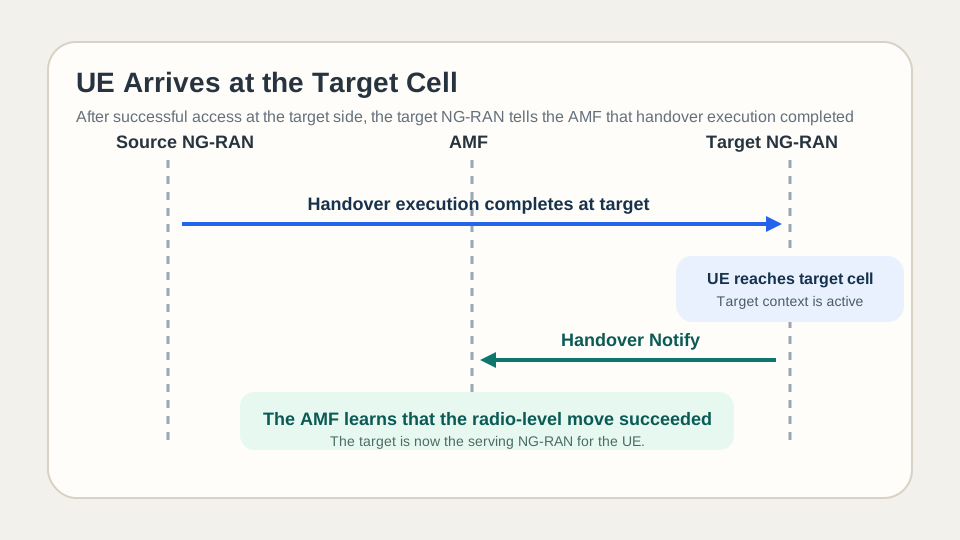
Completion branch: after the UE reaches the target side, the target NG-RAN confirms successful arrival with Handover Notify.
Call flow position: After the UE reaches the target cell and completes the handover execution branch, the target NG-RAN informs the AMF that the move succeeded.
Typical state: Radio-level handover is complete, the target is now serving the UE, and the core can proceed with the post-handover path update.
Preconditions:
The handover preparation and execution stages completed successfully.
The UE accessed the target cell and the target NG-RAN established the serving context.
The target NG-RAN can provide the AMF and target-side UE identity pair plus updated location information.
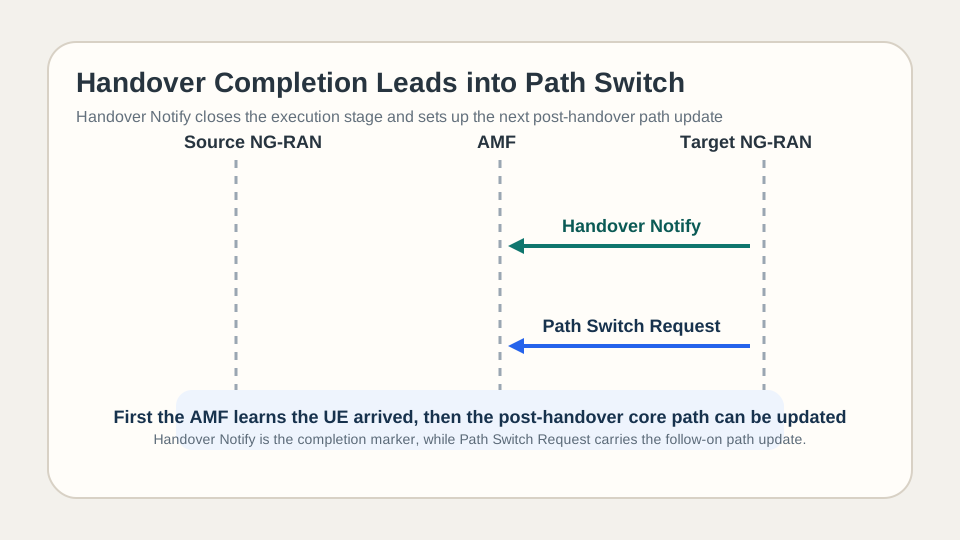
Next likely message: Path Switch Request or equivalent AMF-driven post-handover continuation
UE arrives at the target cell
Completion branch: after the UE reaches the target side, the target NG-RAN confirms successful arrival with Handover Notify.
Handover completion leads into path switch
Continuation branch: Handover Notify closes the radio-level move and leads into the core-side path-switch stage.
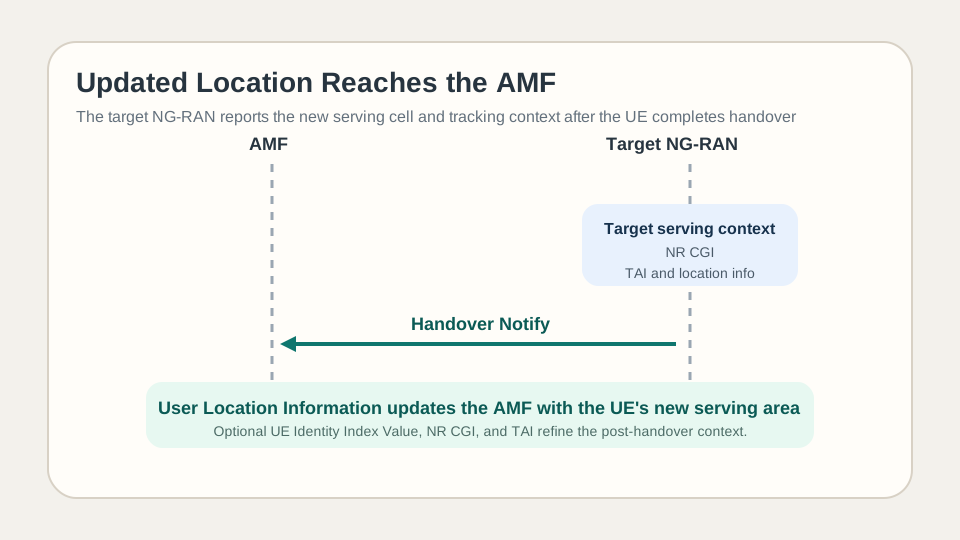
Updated location reaches the AMF
Location branch: the target reports the new serving location so the AMF can align mobility state with the completed handover.
Call flow position
Previous message(s):Handover Command, Target-side UE access and random access completion, Successful handover execution
Domain: UE mobility management and post-handover location update
Signaling bearer: UE-associated NGAP signaling
Logical channel: SCTP carried NGAP initiatingMessage from target NG-RAN to AMF in the handover-notification branch
Transport / encapsulation: NGAP over SCTP/IP between target NG-RAN and AMF
Security context: The message is sent after successful handover execution on an existing UE-associated signaling connection. Its role is mobility completion reporting rather than security establishment.
Message Structure Overview
Handover Notify is the target-NG-RAN-to-AMF mobility-completion message after successful handover execution.
The message confirms that the UE arrived at the target cell and that the target is now serving the UE.
AMF UE NGAP ID, RAN UE NGAP ID, and User Location Information are the core fields for correlating the new serving context.
Optional UE Identity Index Value, NR CGI, and TAI refine target-side paging or location context.
Operationally, this message bridges successful radio-level mobility to the later core-side path-switch stage.
Decode Handover Notify in three passes: first correlate the UE by using the AMF and RAN UE NGAP IDs, then confirm the new serving location through User Location Information, and finally inspect any optional paging or cell-context fields such as UE Identity Index Value, NR CGI, and TAI.
Treat this as a teaching example based on the spec structure, not as a captured trace.
The core payload is the identity pair plus updated serving location after handover completion.
Handover Notify confirms successful target arrival. It is not the message that carries the later path-switch tunnel update details.
If NR CGI and TAI appear separately, read them together with User Location Information rather than as unrelated location fields.
Important Information Elements
IE
Presence
Description
Message Type
Mandatory
Identifies the NGAP PDU as Handover Notify.
AMF UE NGAP ID
Mandatory
Mandatory AMF-side UE identifier used to correlate the completion report to the existing UE context.
RAN UE NGAP ID
Mandatory
Mandatory target-side UE identifier used by the target NG-RAN for the serving UE context after handover.
User Location Information
Mandatory
Mandatory updated serving-location information used by the AMF for mobility tracking and later procedures.
UE Identity Index Value
Optional
Optional value that can support paging-related optimization behavior.
NR CGI
Optional
Optional target cell identity information for the cell where the UE arrived.
TAI
Optional
Optional target tracking-area information for the UE after handover.
Detailed field explanation
Message Type
Identifies the NGAP PDU as Handover Notify.
Presence: Mandatory
In practice: In practice, compare this field with the original request and with any later release-dependent optional fields so you can see whether the network accepted the same service model the UE asked for.
AMF UE NGAP ID
Mandatory AMF-side UE identifier used to correlate the completion report to the existing UE context.
Presence: Mandatory
In practice: In practice, compare this field with the original request and with any later release-dependent optional fields so you can see whether the network accepted the same service model the UE asked for.
RAN UE NGAP ID
Mandatory target-side UE identifier used by the target NG-RAN for the serving UE context after handover.
Presence: Mandatory
In practice: In practice, compare this field with the original request and with any later release-dependent optional fields so you can see whether the network accepted the same service model the UE asked for.
User Location Information
Mandatory updated serving-location information used by the AMF for mobility tracking and later procedures.
Presence: Mandatory
In practice: In practice, compare this field with the original request and with any later release-dependent optional fields so you can see whether the network accepted the same service model the UE asked for.
UE Identity Index Value
Optional value that can support paging-related optimization behavior.
Presence: Optional
In practice: In practice, compare this field with the original request and with any later release-dependent optional fields so you can see whether the network accepted the same service model the UE asked for.
NR CGI
Optional target cell identity information for the cell where the UE arrived.
Presence: Optional
In practice: In practice, compare this field with the original request and with any later release-dependent optional fields so you can see whether the network accepted the same service model the UE asked for.
TAI
Optional target tracking-area information for the UE after handover.
Presence: Optional
In practice: In practice, compare this field with the original request and with any later release-dependent optional fields so you can see whether the network accepted the same service model the UE asked for.
What to check in logs and traces
Confirm Handover Notify is sent by the target NG-RAN after successful handover execution for the same UE context.
Match AMF UE NGAP ID and RAN UE NGAP ID against the earlier handover branch before reading location details.
Verify User Location Information reflects the intended target cell and tracking area.
Check whether Path Switch Request or equivalent post-handover continuation follows in the expected direction.
Treat a missing Handover Notify on an otherwise successful move as a control-plane completion problem, not just a radio issue.
Common Issues and Troubleshooting
The UE appears to have moved, but the AMF does not behave as if the handover completed.
Likely cause: Handover Notify may be missing, delayed, or correlated to the wrong UE context.
What to inspect: Check whether the target NG-RAN sent Handover Notify with the correct AMF UE NGAP ID and RAN UE NGAP ID after target-cell access completed.
Next step: Fix the control-plane completion reporting before debugging later path-switch behavior alone.
Post-handover paging or mobility tracking looks inconsistent.
Likely cause: The updated location or optional identity-index context may be wrong or incomplete.
What to inspect: Verify User Location Information first, then inspect optional UE Identity Index Value, NR CGI, and TAI if present.
Next step: Align the target-side location reporting with the actual target cell and tracking-area state.
Handover completed at radio level, but the user-plane path does not switch.
Likely cause: Handover Notify only confirms arrival at the target. The later path-switch stage may be missing or failing.
What to inspect: Verify Handover Notify first, then confirm that Path Switch Request follows with the expected UE context.
Next step: Debug the post-handover path-switch branch rather than treating Handover Notify as the final core-path update.
LTE / 5G / Variant Comparison
Compared with Handover Command
Handover Command is the AMF-to-source message that starts the execution stage. Handover Notify is the target-to-AMF message confirming that execution finished successfully.
Compared with Path Switch Request
Handover Notify confirms target arrival and updated location. Path Switch Request is the later post-handover message that asks the core to move the user-plane path.
Compared with Handover Failure
Handover Failure is the unsuccessful target-side resource-allocation result. Handover Notify is the success-side arrival report after the UE reached the target.
FAQ
What is Handover Notify in 5G NGAP?
It is the target-NG-RAN-to-AMF message used to confirm that the UE successfully arrived at the target cell after handover.
Who sends Handover Notify?
The target NG-RAN node sends Handover Notify to the AMF.
When is Handover Notify triggered?
It is triggered after the UE completes access to the target cell and handover execution has succeeded.
What does Handover Notify confirm?
It confirms radio-level handover completion at the target side and provides updated serving-location context.
What happens after Handover Notify?
The mobility branch continues into post-handover procedures such as Path Switch Request so the core can move the user-plane path.
What is User Location Information in Handover Notify?
It is the mandatory updated location context that tells the AMF where the UE is now being served after the move.
Does Handover Notify trigger path switch?
Operationally yes. It is the handover-completion signal that leads into the later path-switch stage, although the actual path update is handled by Path Switch Request.
What is the difference between Handover Notify and Handover Command?
Handover Command starts execution from the source side, while Handover Notify reports that the UE has already completed the move at the target side.
Decode this message with the 3GPP Decoder, inspect the related message database, or open the matching call flow to see where this signaling step fits in the full procedure.