Handover Command is the AMF-to-source-NG-RAN message used on the successful branch of Handover Preparation to confirm target-side readiness and deliver the information the source side needs to execute the handover.
UE-associated NGAP signaling / SCTP carried NGAP successfulOutcome in the handover preparation procedure
Typical trigger
The AMF has received successful target-side preparation results and must instruct the source NG-RAN to continue the handover execution branch.
Main purpose
Tells the source NG-RAN that target-side handover preparation succeeded and provides the handover type, target-to-source transfer information, admitted and rejected PDU session outcome, and optional inter-system security context needed for execution.
Handover Command is the AMF-to-source-NG-RAN message used on the successful branch of Handover Preparation to confirm target-side readiness and deliver the information the source side needs to execute the handover.
Tells the source NG-RAN that target-side handover preparation succeeded and provides the handover type, target-to-source transfer information, admitted and rejected PDU session outcome, and optional inter-system security context needed for execution.
Why this message matters
Handover Command is the AMF telling the source NG-RAN that the target is ready and that the source side should now execute the handover using the returned target-side information.
Where this message appears in the call flow
Successful outcome of Handover Preparation
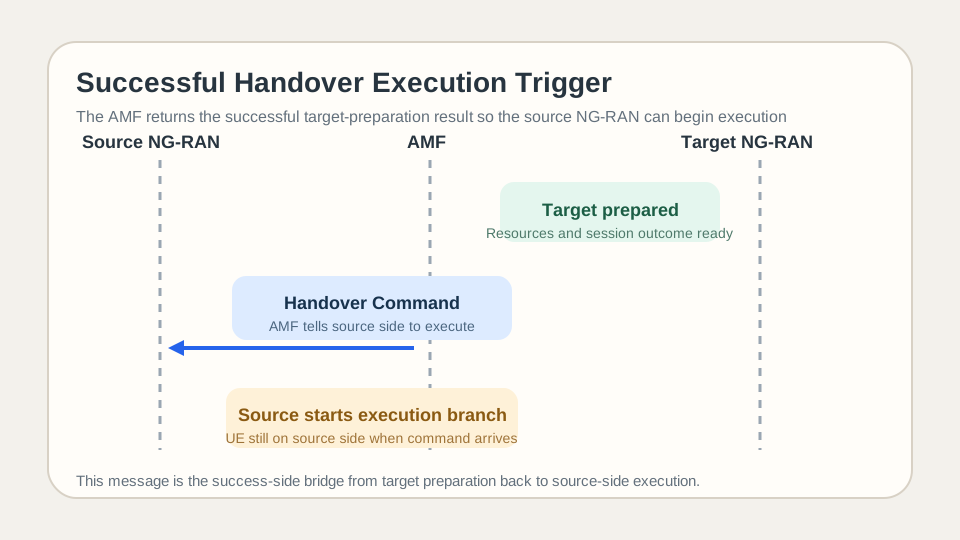
Execution trigger: after target-side preparation succeeds, the AMF sends Handover Command to the source NG-RAN so execution can begin.
Call flow position: The source NG-RAN already sent Handover Required, the AMF coordinated target-side preparation, and now the AMF returns the successful result to the source side.
Typical state: Target-side resources are prepared and the procedure is transitioning from preparation into execution.
Preconditions:
The source NG-RAN initiated Handover Preparation with Handover Required.
The AMF received successful target-side preparation information.
The UE is still served by the source side when Handover Command arrives.
Next likely message: Source-side execution followed by Handover Notify if the UE reaches the target successfully
Successful handover execution trigger
Execution trigger: after target-side preparation succeeds, the AMF sends Handover Command to the source NG-RAN so execution can begin.
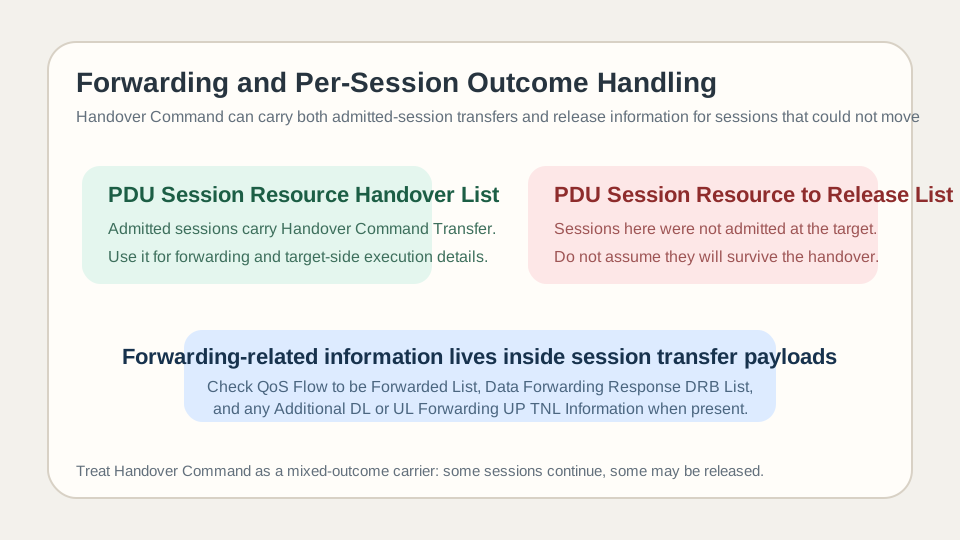
Forwarding and per-session outcome handling
Session branch: Handover Command can carry both admitted-session handover transfers and release information for non-admitted sessions, plus forwarding context when relevant.
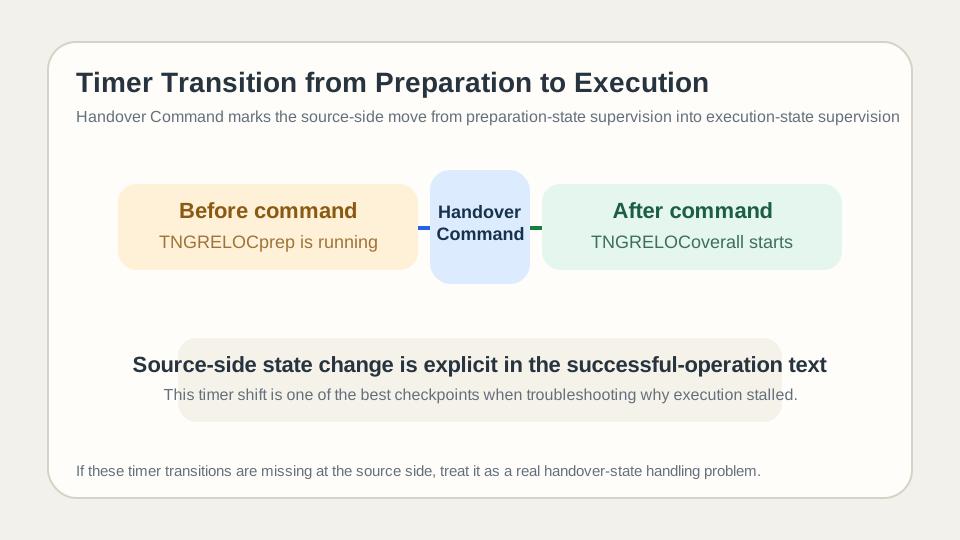
Timer transition from preparation to execution
Timer branch: Handover Command marks the handover shift from preparation into execution at the source side.
Domain: UE mobility management and AMF-mediated handover execution control
Signaling bearer: UE-associated NGAP signaling
Logical channel: SCTP carried NGAP successfulOutcome in the handover preparation procedure
Transport / encapsulation: NGAP over SCTP/IP between AMF and source NG-RAN
Security context: The message runs on an existing UE-associated NGAP context. In inter-system cases, NAS Security Parameters from NG-RAN may be included so the source side can apply the required TS 33.501 handling during execution.
Message Structure Overview
Handover Command is the AMF-to-source successful outcome of the Handover Preparation procedure.
AMF UE NGAP ID and RAN UE NGAP ID tie the message to the existing UE-associated NGAP context on the source side.
Handover Type is always mandatory and controls conditional handling, including inter-system security behavior.
Target to Source Transparent Container is mandatory because the source side cannot continue execution without the target-derived context.
PDU Session Resource Handover List carries admitted-session handover data, while PDU Session Resource to Release List carries sessions that must be released instead.
After receiving Handover Command, the source NG-RAN stops TNGRELOCprep and starts TNGRELOCoverall.
Read the message in three layers: first the UE identity pair and Handover Type, then the session-level handover and release lists, and finally the mandatory Target to Source Transparent Container. In inter-system cases, check whether NAS Security Parameters from NG-RAN is present because its inclusion changes how the source side should continue execution.
Treat this as a teaching example based on the spec structure, not as a captured trace.
The mandatory container is the execution bridge from successful target preparation back to the source side.
Do not assume all PDU sessions were admitted just because Handover Command exists. Check both the handover list and the release list.
For inter-system cases, look for NAS Security Parameters from NG-RAN and validate that the source side handles it according to TS 33.501.
Important Information Elements
IE
Presence
Description
Message Type
Mandatory
Identifies the NGAP PDU as Handover Command.
AMF UE NGAP ID
Mandatory
Mandatory AMF-side UE identifier used to correlate the successful outcome with the correct UE-associated handover branch.
RAN UE NGAP ID
Mandatory
Mandatory source-side UE identifier that anchors the command to the correct source NG-RAN context.
Handover Type
Mandatory
Mandatory handover mode indicator. It also drives conditional behavior such as inclusion of NAS Security Parameters from NG-RAN in inter-system cases.
NAS Security Parameters from NG-RAN
Optional
Conditionally present when Handover Type is 5GStoEPS or 5GtoUTRA. The source NG-RAN uses it according to TS 33.501.
PDU Session Resource Handover List
Optional
Optional list carrying per-session handover information for admitted sessions. Each item contains PDU Session ID and Handover Command Transfer. The Release 18 bound is maxnoofPDUSessions = 256.
PDU Session Resource to Release List
Optional
Optional list naming sessions that were not admitted at the target and therefore must be released instead of handed over. Each item carries PDU Session ID and Handover Preparation Unsuccessful Transfer.
Target to Source Transparent Container
Mandatory
Mandatory target-generated container that the source NG-RAN needs in order to continue execution after successful target-side preparation.
Criticality Diagnostics
Optional
Optional protocol diagnostics that can provide extra context around command construction or abnormal IE handling.
Detailed field explanation
Message Type
Identifies the NGAP PDU as Handover Command.
Presence: Mandatory
In practice: In practice, compare this field with the original request and with any later release-dependent optional fields so you can see whether the network accepted the same service model the UE asked for.
AMF UE NGAP ID
Mandatory AMF-side UE identifier used to correlate the successful outcome with the correct UE-associated handover branch.
Presence: Mandatory
In practice: In practice, compare this field with the original request and with any later release-dependent optional fields so you can see whether the network accepted the same service model the UE asked for.
RAN UE NGAP ID
Mandatory source-side UE identifier that anchors the command to the correct source NG-RAN context.
Presence: Mandatory
In practice: In practice, compare this field with the original request and with any later release-dependent optional fields so you can see whether the network accepted the same service model the UE asked for.
Handover Type
Mandatory handover mode indicator. It also drives conditional behavior such as inclusion of NAS Security Parameters from NG-RAN in inter-system cases.
Presence: Mandatory
In practice: In practice, compare this field with the original request and with any later release-dependent optional fields so you can see whether the network accepted the same service model the UE asked for.
NAS Security Parameters from NG-RAN
Conditionally present when Handover Type is 5GStoEPS or 5GtoUTRA. The source NG-RAN uses it according to TS 33.501.
Presence: Optional
In practice: In practice, compare this field with the original request and with any later release-dependent optional fields so you can see whether the network accepted the same service model the UE asked for.
PDU Session Resource Handover List
Optional list carrying per-session handover information for admitted sessions. Each item contains PDU Session ID and Handover Command Transfer. The Release 18 bound is maxnoofPDUSessions = 256.
Presence: Optional
In practice: In practice, compare this field with the original request and with any later release-dependent optional fields so you can see whether the network accepted the same service model the UE asked for.
PDU Session Resource to Release List
Optional list naming sessions that were not admitted at the target and therefore must be released instead of handed over. Each item carries PDU Session ID and Handover Preparation Unsuccessful Transfer.
Presence: Optional
In practice: In practice, compare this field with the original request and with any later release-dependent optional fields so you can see whether the network accepted the same service model the UE asked for.
Target to Source Transparent Container
Mandatory target-generated container that the source NG-RAN needs in order to continue execution after successful target-side preparation.
Presence: Mandatory
In practice: In practice, compare this field with the original request and with any later release-dependent optional fields so you can see whether the network accepted the same service model the UE asked for.
Criticality Diagnostics
Optional protocol diagnostics that can provide extra context around command construction or abnormal IE handling.
Presence: Optional
In practice: In practice, compare this field with the original request and with any later release-dependent optional fields so you can see whether the network accepted the same service model the UE asked for.
What to check in logs and traces
Confirm Handover Command follows Handover Required for the same AMF UE NGAP ID and RAN UE NGAP ID.
Verify the source NG-RAN stops TNGRELOCprep and starts TNGRELOCoverall after receiving the command.
Enumerate all admitted sessions in PDU Session Resource Handover List before assuming full service continuity.
Enumerate all non-admitted sessions in PDU Session Resource to Release List and track their follow-on cleanup.
Treat the Target to Source Transparent Container as mandatory and validate that it is present and decodable.
Inspect session transfer payloads for forwarding information when user-plane continuity matters.
For inter-system handover, verify conditional NAS Security Parameters from NG-RAN and valid GTP tunnel address pairs.
Common Issues and Troubleshooting
Handover continues, but some PDU sessions disappear after the move.
Likely cause: Some sessions may have been placed in PDU Session Resource to Release List instead of PDU Session Resource Handover List.
What to inspect: Compare the admitted-session list and the release list item by item before treating the issue as a generic execution failure.
Next step: Focus on per-session admission and release outcome rather than assuming the whole handover was accepted uniformly.
Forwarding behavior is missing or incomplete during execution.
Likely cause: The source side may not be decoding or applying forwarding details inside Handover Command Transfer.
What to inspect: Check for QoS Flow to be Forwarded List, Data Forwarding Response DRB List, and any Additional DL or UL Forwarding UP TNL Information inside the session transfer payload.
Next step: Fix session-level transfer decoding or forwarding policy handling before blaming the target preparation phase.
Execution timers or state transitions look wrong at the source NG-RAN.
Likely cause: The source side may not be stopping TNGRELOCprep or starting TNGRELOCoverall at the correct time.
What to inspect: Correlate the exact Handover Command arrival against source-side timer state changes.
Next step: Correct source-side timer sequencing because the command explicitly marks the shift from preparation into execution.
Inter-system execution fails with tunnel or security inconsistencies.
Likely cause: Conditional security parameters may be missing or at least one PDU session item may lack a valid GTP tunnel address pair.
What to inspect: For 5GStoEPS or 5GtoUTRA, check NAS Security Parameters from NG-RAN and validate that any required GTP-TEID and Endpoint IP Address pairs are both present.
Next step: Treat missing inter-system security or invalid tunnel pairs as logical handover-content errors, not just radio instability.
LTE / 5G / Variant Comparison
Compared with Handover Preparation Failure
Handover Command is the successful outcome that tells the source side to execute the move. Handover Preparation Failure is the unsuccessful outcome that stops the preparation branch.
Compared with Handover Request Acknowledge
Handover Request Acknowledge is the target-side result reported to the AMF. Handover Command is the AMF-to-source message that turns that successful target result into source-side execution.
Why the release list matters
Even when the overall handover succeeds, some PDU sessions may still fail admission and appear in PDU Session Resource to Release List. Treat Handover Command as a mixed-outcome carrier, not only as a blanket success flag.
FAQ
What is Handover Command in 5G NGAP?
It is the AMF-to-source-NG-RAN successful-outcome message used to tell the source side that target preparation succeeded and execution can continue.
Who sends Handover Command?
The AMF sends Handover Command to the source NG-RAN node.
When is Handover Command used?
It is used on the successful branch of Handover Preparation after the AMF has the target-side preparation result.
What is the difference between Handover Command and Handover Preparation Failure?
Handover Command means target-side resources were prepared successfully, while Handover Preparation Failure means the preparation could not be completed.
What is PDU Session Resource Handover List in Handover Command?
It is the per-session list of admitted sessions that can continue through the handover, with each item carrying Handover Command Transfer.
What is PDU Session Resource to Release List?
It is the list of PDU sessions that were not admitted at the target and therefore must be released instead of handed over.
What does Target to Source Transparent Container carry?
It carries target-generated information the source NG-RAN needs to continue handover execution after preparation succeeds.
What timer behavior changes after receiving Handover Command?
The source NG-RAN stops TNGRELOCprep and starts TNGRELOCoverall, which marks the shift from preparation into execution.
How does data forwarding work after Handover Command?
The source side should use forwarding-related information inside Handover Command Transfer, such as QoS-flow forwarding and forwarding TNL information, when those fields are present.
When is NAS Security Parameters from NG-RAN included?
It is conditionally included when Handover Type is 5GStoEPS or 5GtoUTRA.
Decode this message with the 3GPP Decoder, inspect the related message database, or open the matching call flow to see where this signaling step fits in the full procedure.