PDU Session Resource Modify Response is the NGAP message sent by the NG-RAN node to the AMF after processing PDU Session Resource Modify Request, reporting successful and failed per-session modification results.
Message Fact Sheet
Protocol
ngap
Network
5g
Spec
3GPP TS 38.413
Spec Section
Clause 8.2.3, clause 9.2.1.5, and clause 9.2.1.6 (Release 18 baseline)
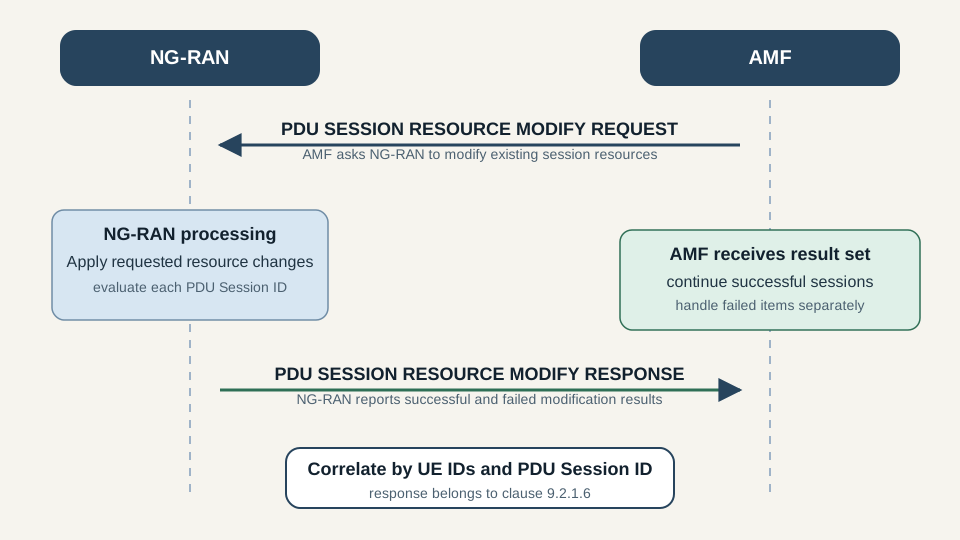
NG-RAN completes processing of PDU Session Resource Modify Request and reports the outcome to AMF.
Main purpose
Confirms processing of the AMF-requested PDU session resource modification, reports successfully modified PDU sessions, reports sessions that failed modification, and can carry Criticality Diagnostics for troubleshooting.
What is PDU Session Resource Modify Response in simple terms?
PDU Session Resource Modify Response is the NGAP message sent by the NG-RAN node to the AMF after processing PDU Session Resource Modify Request, reporting successful and failed per-session modification results.
Confirms processing of the AMF-requested PDU session resource modification, reports successfully modified PDU sessions, reports sessions that failed modification, and can carry Criticality Diagnostics for troubleshooting.
Why this message matters
PDU Session Resource Modify Response tells the AMF how NG-RAN handled a requested modification, session by session. It is a result report, not the message that starts the modification.
Where this message appears in the call flow
PDU Session Resource Modify result
Response branch: after the AMF asks for existing session resources to be modified, NG-RAN returns the result to AMF.
Call flow position: NG-RAN sends the response after AMF has requested modification of one or more existing PDU session resources.
Typical state: The UE context remains active while AMF learns which requested session-resource modifications succeeded and which failed.
Preconditions:
PDU Session Resource Modify Request was received and processed by NG-RAN.
AMF UE NGAP ID and RAN UE NGAP ID still identify the same UE-associated NGAP context.
At least one requested session item can be correlated by PDU Session ID.
Next likely message: AMF or SMF continuation for successful items and follow-up handling for failed items
Mixed per-session modification outcome
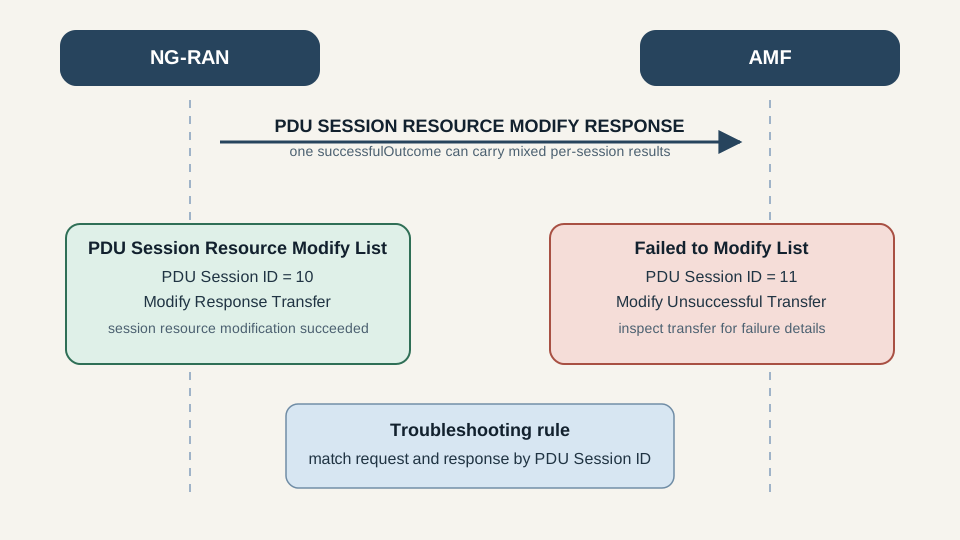
Per-session result branch: one PDU session can succeed while another fails, so troubleshoot by PDU Session ID.
Call flow position: The response can report successful and failed PDU session items in the same NGAP successfulOutcome message.
Typical state: One requested PDU session modification may be accepted while another is rejected, so the practical result is per-session rather than all-or-nothing.
Preconditions:
The original request listed one or more PDU session resource modify items.
NG-RAN evaluated each listed PDU Session ID independently.
Next likely message: Targeted retry, policy adjustment, or continuation based on each per-session result
Modify Response versus Modify Confirm
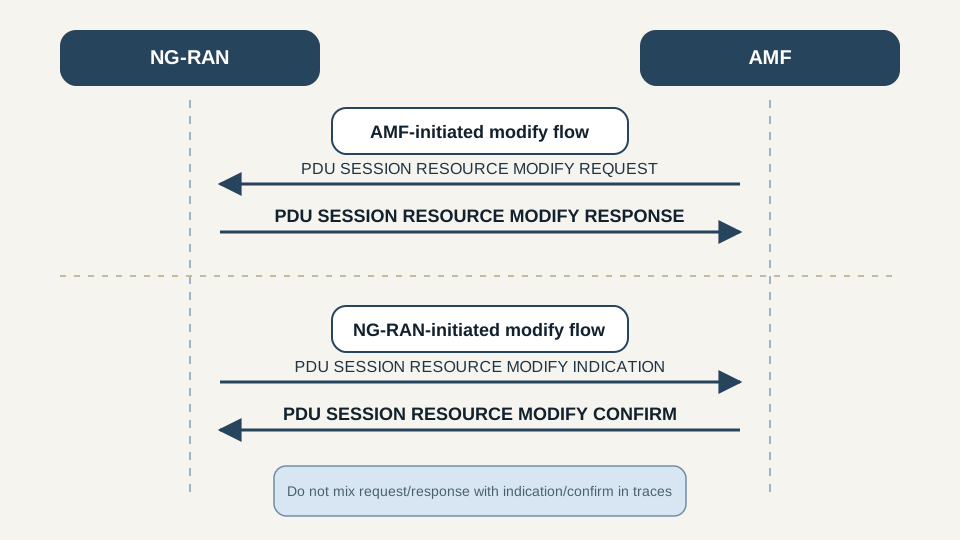
Branch distinction: Modify Response closes the AMF-initiated request branch; Modify Confirm closes the NG-RAN-initiated indication branch.
Call flow position: Modify Response belongs to the AMF-initiated modify request and response pair, while Modify Confirm belongs to the NG-RAN-initiated modify indication and confirm pair.
Typical state: Trace analysis must keep the AMF-initiated and NG-RAN-initiated modification branches separate.
Preconditions:
The preceding message is PDU Session Resource Modify Request for Modify Response.
The preceding message is PDU Session Resource Modify Indication for Modify Confirm.
Next likely message: Continue the matching modify branch, not the other pair
Transport / encapsulation: NGAP over SCTP/IP between NG-RAN and AMF
Security context: The response assumes an existing UE-associated NGAP context. It reports the result of modification processing and does not create the UE context or initiate modification by itself.
Message Structure Overview
PDU Session Resource Modify Response is the NG-RAN-to-AMF successfulOutcome message for the AMF-initiated PDU Session Resource Modify procedure.
AMF UE NGAP ID and RAN UE NGAP ID anchor the response to the earlier request and the live UE-associated NGAP context.
PDU Session Resource Modify List reports sessions successfully modified by NG-RAN.
PDU Session Resource Failed to Modify List reports sessions that NG-RAN could not modify.
Each success or failure item is correlated with the request by PDU Session ID.
The Release 18 list bound is maxnoofPDUSessions = 256.
ASN.1 for 5G NGAP - PDU Session Resource Modify Response
PDUSessionResourceModifyResponse ::= SEQUENCE {
  protocolIEs ProtocolIE-Container { {PDUSessionResourceModifyResponse-IEs} },
  ...
}

PDUSessionResourceModifyResponse-IEs NGAP-PROTOCOL-IES ::= {
  { ID id-AMF-UE-NGAP-ID                          CRITICALITY reject TYPE AMF-UE-NGAP-ID                          PRESENCE mandatory } |
  { ID id-RAN-UE-NGAP-ID                          CRITICALITY reject TYPE RAN-UE-NGAP-ID                          PRESENCE mandatory } |
  { ID id-PDUSessionResourceModifyListModRes      CRITICALITY ignore TYPE PDUSessionResourceModifyListModRes      PRESENCE optional  } |
  { ID id-PDUSessionResourceFailedToModifyListModRes CRITICALITY ignore TYPE PDUSessionResourceFailedToModifyListModRes PRESENCE optional } |
  { ID id-CriticalityDiagnostics                  CRITICALITY ignore TYPE CriticalityDiagnostics                  PRESENCE optional  },
  ...
}

PDUSessionResourceModifyItemModRes ::= SEQUENCE {
  pduSessionID PDU Session ID,
  pduSessionResourceModifyResponseTransfer OCTET STRING,
  ...
}

PDUSessionResourceFailedToModifyItemModRes ::= SEQUENCE {
  pduSessionID PDU Session ID,
  pduSessionResourceModifyUnsuccessfulTransfer OCTET STRING,
  ...
}
How to read this ASN.1
Decode the UE identity pair first, then inspect the success and failed-to-modify lists separately. The top-level successfulOutcome only means the response message completed; it does not mean every requested PDU session modification succeeded.
Treat this as a teaching example based on the spec structure, not as a captured network trace.
One response can contain both successful and failed session items.
A top-level successfulOutcome is not a promise that every session modification succeeded.
The unsuccessful transfer is where engineers should look for the actual failed-item details.
Important Information Elements
IE
Presence
Description
Message Type
Mandatory
Identifies the NGAP PDU as PDU SESSION RESOURCE MODIFY RESPONSE.
AMF UE NGAP ID
Mandatory
Mandatory AMF-side UE identifier used to correlate the response with the earlier Modify Request and the correct UE context.
RAN UE NGAP ID
Mandatory
Mandatory NG-RAN-side UE identifier used to bind the reported modification outcome to the correct radio-side UE context.
PDU Session Resource Modify List
Optional
Optional list of successfully modified sessions. Each item includes PDU Session ID and PDU Session Resource Modify Response Transfer.
PDU Session Resource Failed to Modify List
Optional
Optional list of sessions that NG-RAN could not modify. Each item includes PDU Session ID and PDU Session Resource Modify Unsuccessful Transfer.
Criticality Diagnostics
Optional
Optional diagnostics that can explain unusual IE processing, decode, or criticality-handling context.
Detailed field explanation
Message Type
Identifies the NGAP PDU as PDU SESSION RESOURCE MODIFY RESPONSE.
Presence: Mandatory
In practice: In practice, compare this field with the original request and with any later release-dependent optional fields so you can see whether the network accepted the same service model the UE asked for.
AMF UE NGAP ID
Mandatory AMF-side UE identifier used to correlate the response with the earlier Modify Request and the correct UE context.
Presence: Mandatory
In practice: In practice, compare this field with the original request and with any later release-dependent optional fields so you can see whether the network accepted the same service model the UE asked for.
RAN UE NGAP ID
Mandatory NG-RAN-side UE identifier used to bind the reported modification outcome to the correct radio-side UE context.
Presence: Mandatory
In practice: In practice, compare this field with the original request and with any later release-dependent optional fields so you can see whether the network accepted the same service model the UE asked for.
PDU Session Resource Modify List
Optional list of successfully modified sessions. Each item includes PDU Session ID and PDU Session Resource Modify Response Transfer.
Presence: Optional
In practice: In practice, compare this field with the original request and with any later release-dependent optional fields so you can see whether the network accepted the same service model the UE asked for.
PDU Session Resource Failed to Modify List
Optional list of sessions that NG-RAN could not modify. Each item includes PDU Session ID and PDU Session Resource Modify Unsuccessful Transfer.
Presence: Optional
In practice: In practice, compare this field with the original request and with any later release-dependent optional fields so you can see whether the network accepted the same service model the UE asked for.
Criticality Diagnostics
Optional diagnostics that can explain unusual IE processing, decode, or criticality-handling context.
Presence: Optional
In practice: In practice, compare this field with the original request and with any later release-dependent optional fields so you can see whether the network accepted the same service model the UE asked for.
What to check in logs and traces
Confirm the response follows a matching PDU Session Resource Modify Request.
Verify AMF UE NGAP ID and RAN UE NGAP ID match the earlier request and active UE context.
Compare requested PDU Session IDs with the success and failed-to-modify lists.
Decode PDU Session Resource Modify Response Transfer for successful items.
Decode PDU Session Resource Modify Unsuccessful Transfer for failed items.
Check Criticality Diagnostics when present.
Keep Modify Response separate from Modify Confirm in trace analysis.
Common Issues and Troubleshooting
The NGAP PDU is successfulOutcome, but one PDU session still did not change.
Likely cause: The response may contain a failed-to-modify item even though the overall NGAP procedure completed successfully.
What to inspect: Read PDU Session Resource Modify List and PDU Session Resource Failed to Modify List separately, then correlate each item by PDU Session ID.
Next step: Troubleshoot only the failed PDU Session ID instead of repeating or rolling back all session modifications.
The AMF or SMF appears to handle the wrong session after the response.
Likely cause: Request and response correlation may have been done at UE level only, without matching each PDU Session ID.
What to inspect: Compare AMF UE NGAP ID, RAN UE NGAP ID, and every PDU Session ID across the request and response.
Next step: Fix the per-session correlation path before diagnosing transfer-container content.
A failed modification has no obvious reason in the top-level IE list.
Likely cause: The actual failure details are carried inside PDU Session Resource Modify Unsuccessful Transfer, not in the top-level message name.
What to inspect: Decode the unsuccessful transfer for the failed item and check any associated cause or session-level detail.
Next step: Use the transfer content to decide whether the next step is retry, policy adjustment, or release handling.
Trace analysis mixes up Modify Response and Modify Confirm.
Likely cause: The AMF-initiated request/response pair and NG-RAN-initiated indication/confirm pair are being treated as the same flow.
What to inspect: Check whether the preceding message is Modify Request or Modify Indication and keep the matching response branch with it.
Next step: Analyze Modify Response only as the response to AMF-initiated Modify Request.
LTE / 5G / Variant Comparison
Compared with PDU Session Resource Modify Request
Modify Request carries the AMF instruction set. Modify Response reports how NG-RAN processed those requested session-resource changes.
Compared with PDU Session Resource Modify Confirm
Modify Response belongs to the AMF-initiated request/response pair. Modify Confirm belongs to the NG-RAN-initiated indication/confirm pair.
Compared with PDU Session Resource Setup Response
Setup Response reports creation of session resources. Modify Response reports changes to session resources that already exist.
FAQ
What is PDU Session Resource Modify Response in NGAP?
It is the NG-RAN-to-AMF response message used to report the result of processing PDU Session Resource Modify Request.
Who sends PDU Session Resource Modify Response?
The NG-RAN node sends PDU Session Resource Modify Response to the AMF.
What is the response to PDU Session Resource Modify Request?
PDU Session Resource Modify Response is the response to PDU Session Resource Modify Request.
Can one Modify Response contain both success and failure?
Yes. One response can contain successfully modified session items and failed-to-modify session items at the same time.
What is PDU Session Resource Failed to Modify List?
It is the optional list of PDU sessions that NG-RAN could not modify, with one failed item per PDU Session ID.
Where is the failure cause carried?
Failure details are carried inside PDU Session Resource Modify Unsuccessful Transfer for the failed item.
What is the difference between Modify Response and Modify Confirm?
Modify Response belongs to the AMF-initiated Modify Request flow. Modify Confirm belongs to the NG-RAN-initiated Modify Indication flow.
How do you correlate Modify Request and Modify Response?
Match AMF UE NGAP ID and RAN UE NGAP ID first, then correlate each requested item with response results by PDU Session ID.
Decode this message with the 3GPP Decoder, inspect the related message database, or open the matching call flow to see where this signaling step fits in the full procedure.