PWS Cancel Response is the NGAP warning message sent by the NG-RAN node to the AMF to report the result of a PWS Cancel Request, including completed and failed warning cancellation areas.
Message Fact Sheet
Protocol
ngap
Network
5g
Spec
3GPP TS 38.413
Spec Section
Warning Message Transmission Messages and PWS Cancel Response
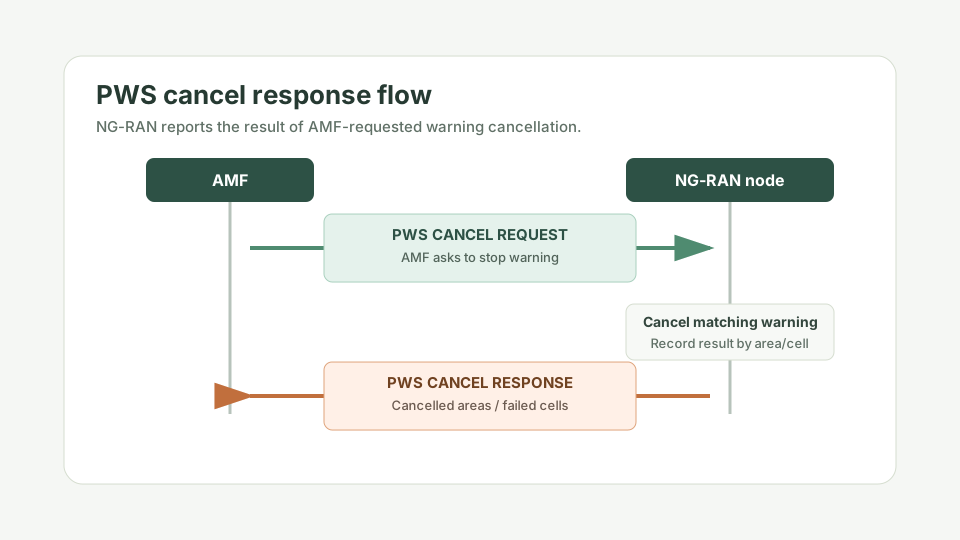
NG-RAN has processed a PWS Cancel Request and reports the cancellation result to AMF.
Main purpose
Reports the result of warning cancellation, correlates to the original warning using Message Identifier and Serial Number, can report where cancellation completed, can report where cancellation failed, and completes the PWS Cancel request/response pair.
PWS Cancel Response is the NGAP warning message sent by the NG-RAN node to the AMF to report the result of a PWS Cancel Request, including completed and failed warning cancellation areas.
Reports the result of warning cancellation, correlates to the original warning using Message Identifier and Serial Number, can report where cancellation completed, can report where cancellation failed, and completes the PWS Cancel request/response pair.
Why this message matters
PWS Cancel Response is the gNB's answer to AMF's warning cancellation request. Match Message Identifier and Serial Number, then check cancelled areas and failed cells.
Where this message appears in the call flow
PWS Cancel
NG-RAN responds to the AMF cancellation request and reports warning cancellation status.
Call flow position: NG-RAN sends this response after processing an AMF PWS Cancel Request.
Typical state: AMF learns whether warning cancellation completed and inspects any cancelled-area or failed-cell information.
Preconditions:
A matching PWS Cancel Request was sent by AMF.
Message Identifier and Serial Number match the warning instance being cancelled.
NG-RAN processed the cancellation scope.
Next likely message: AMF warning cancellation status tracking
Warning cancellation result reporting
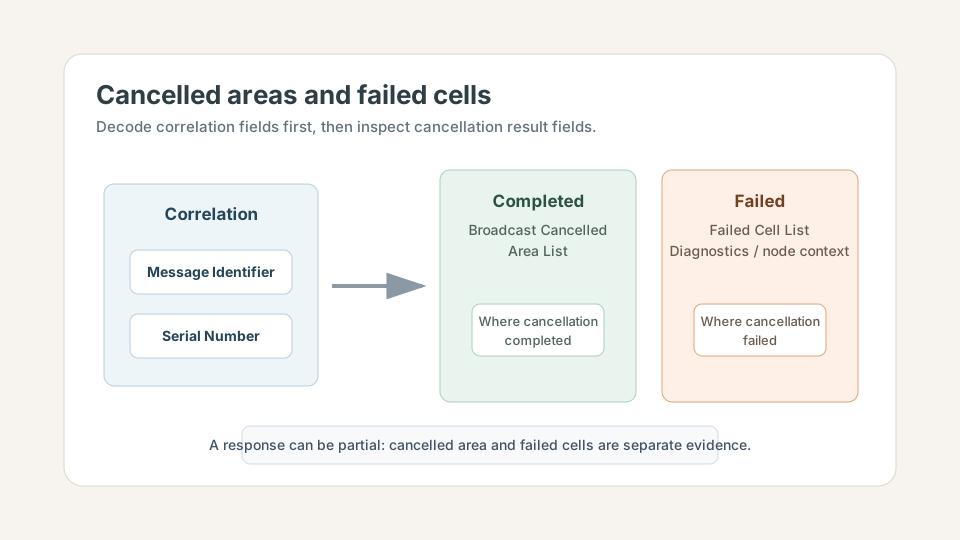
Cancelled-area and failed-cell information must be decoded separately.
Call flow position: The response can report where cancellation completed and where it failed.
Typical state: AMF differentiates completed, partial, and failed cancellation handling.
Preconditions:
Broadcast Cancelled Area List is decoded if present.
Failed Cell List is decoded if present.
Next likely message: Follow-up handling for failed cells or areas
Warning message distinction
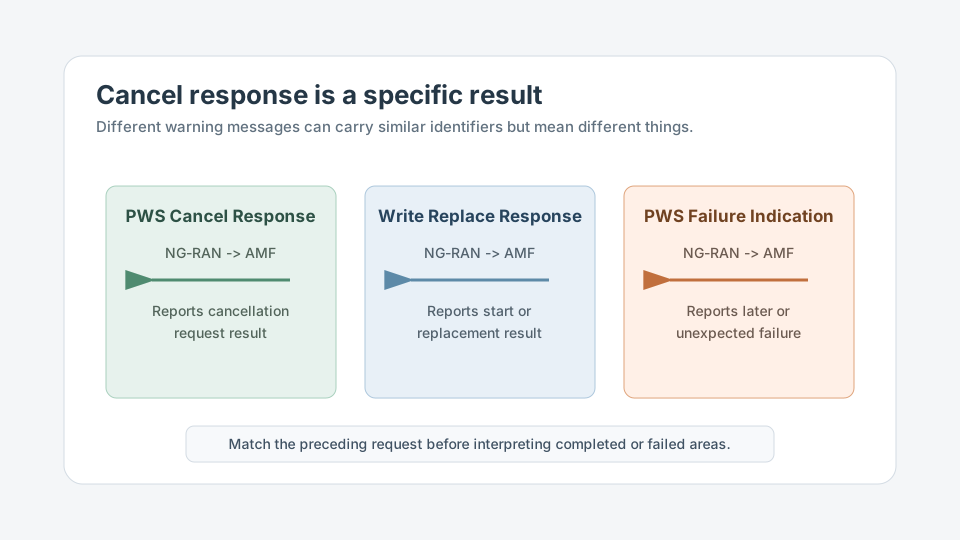
PWS Cancel Response reports cancellation result, not warning start/replacement result or later failure reporting.
Call flow position: The response is different from Write Replace Warning Response and PWS Failure Indication.
Typical state: Trace analysis treats this as the immediate response to cancellation, not warning start or later failure reporting.
Preconditions:
Procedure name, trigger, and warning identifiers are checked.
Next likely message: Correct warning-procedure interpretation
Call flow position
Previous message(s):PWS Cancel Request, Public warning broadcast is active or known to NG-RAN
Transport / encapsulation: NGAP over SCTP/IP between NG-RAN and AMF
Security context: The message reports public warning cancellation status and may include cancelled-area, failed-cell, diagnostics, or RAN node context.
Message Structure Overview
PWS Cancel Response is an NG-RAN-to-AMF response message for public warning cancellation.
Message Identifier and Serial Number correlate the response to the cancel request and warning instance.
Broadcast Cancelled Area List can report where cancellation completed.
Failed Cell List can report cells where cancellation failed.
Criticality Diagnostics and Global RAN Node ID provide troubleshooting context when present.
ASN.1 for 5G NGAP - PWS Cancel Response
PWSCancelResponse ::= SEQUENCE {
  protocolIEs ProtocolIE-Container { {PWSCancelResponse-IEs} },
  ...
}

PWSCancelResponse-IEs NGAP-PROTOCOL-IES ::= {
  { ID id-MessageIdentifier             CRITICALITY reject TYPE MessageIdentifier             PRESENCE mandatory } |
  { ID id-SerialNumber                  CRITICALITY reject TYPE SerialNumber                  PRESENCE mandatory } |
  { ID id-BroadcastCancelledAreaList    CRITICALITY ignore TYPE BroadcastCancelledAreaList    PRESENCE optional } |
  { ID id-CriticalityDiagnostics        CRITICALITY ignore TYPE CriticalityDiagnostics        PRESENCE optional } |
  { ID id-WarningAreaList               CRITICALITY ignore TYPE WarningAreaList               PRESENCE optional } |
  { ID id-FailedCellList                CRITICALITY ignore TYPE FailedCellList                PRESENCE optional } |
  { ID id-GlobalRANNodeID               CRITICALITY ignore TYPE GlobalRANNodeID               PRESENCE optional },
  ...
}
How to read this ASN.1
Decode Message Identifier and Serial Number first, then inspect cancelled-area, failed-cell, diagnostics, and RAN node context. A response does not automatically mean cancellation succeeded everywhere.
Treat this as a teaching example based on the expected message structure, not as a captured network trace.
Message Identifier and Serial Number must match the PWS Cancel Request.
Failed Cell List should be decoded separately from Broadcast Cancelled Area List.
Global RAN Node ID is useful when many NG-RAN nodes respond to warning procedures.
Important Information Elements
IE
Presence
Description
Message Type
Mandatory
Identifies the NGAP PDU as PWS CANCEL RESPONSE.
Message Identifier
Mandatory
Mandatory warning message category or type identifier used to correlate with the cancel request.
Serial Number
Mandatory
Mandatory warning instance identifier used to correlate with the cancel request.
Broadcast Cancelled Area List
Optional
Optional area where warning broadcast cancellation has completed.
Criticality Diagnostics
Optional
Optional protocol diagnostics for IE handling or criticality issues.
Warning Area List
Optional
Optional warning area associated with the cancellation response.
Failed Cell List
Optional
Optional cells where cancellation could not be completed successfully.
Global RAN Node ID
Optional
Optional RAN node identity context for the response.
Detailed field explanation
Message Type
Identifies the NGAP PDU as PWS CANCEL RESPONSE.
Presence: Mandatory
In practice: In practice, compare this field with the original request and with any later release-dependent optional fields so you can see whether the network accepted the same service model the UE asked for.
Message Identifier
Mandatory warning message category or type identifier used to correlate with the cancel request.
Presence: Mandatory
In practice: In practice, compare this field with the original request and with any later release-dependent optional fields so you can see whether the network accepted the same service model the UE asked for.
Serial Number
Mandatory warning instance identifier used to correlate with the cancel request.
Presence: Mandatory
In practice: In practice, compare this field with the original request and with any later release-dependent optional fields so you can see whether the network accepted the same service model the UE asked for.
Broadcast Cancelled Area List
Optional area where warning broadcast cancellation has completed.
Presence: Optional
In practice: In practice, compare this field with the original request and with any later release-dependent optional fields so you can see whether the network accepted the same service model the UE asked for.
Criticality Diagnostics
Optional protocol diagnostics for IE handling or criticality issues.
Presence: Optional
In practice: In practice, compare this field with the original request and with any later release-dependent optional fields so you can see whether the network accepted the same service model the UE asked for.
Warning Area List
Optional warning area associated with the cancellation response.
Presence: Optional
In practice: In practice, compare this field with the original request and with any later release-dependent optional fields so you can see whether the network accepted the same service model the UE asked for.
Failed Cell List
Optional cells where cancellation could not be completed successfully.
Presence: Optional
In practice: In practice, compare this field with the original request and with any later release-dependent optional fields so you can see whether the network accepted the same service model the UE asked for.
Global RAN Node ID
Optional RAN node identity context for the response.
Presence: Optional
In practice: In practice, compare this field with the original request and with any later release-dependent optional fields so you can see whether the network accepted the same service model the UE asked for.
What to check in logs and traces
Confirm the response follows a matching PWS Cancel Request.
Match Message Identifier and Serial Number to the request.
Check Broadcast Cancelled Area List if present.
Decode Failed Cell List if present.
Review Criticality Diagnostics if present.
Check Global RAN Node ID in multi-node traces if present.
Look for later PWS Failure Indication if warning problems continue.
Common Issues and Troubleshooting
Response is correlated to the wrong warning.
Likely cause: Message Identifier or Serial Number may not match the original PWS Cancel Request.
What to inspect: Compare both fields across request and response.
Next step: Rebuild warning-instance correlation before judging cancellation handling.
Cancellation is assumed to have succeeded everywhere.
Likely cause: Failed Cell List or cancelled-area details may be ignored.
What to inspect: Decode Failed Cell List and Broadcast Cancelled Area List separately.
Next step: Treat the response as cancellation status, not proof that every intended cell stopped broadcasting.
Some cells continue warning broadcast after response.
Likely cause: The response may include failed cells, or the warning state may differ across NG-RAN nodes.
What to inspect: Check Failed Cell List, Warning Area List, and Global RAN Node ID.
Next step: Investigate affected cells and compare active warning state against the cancel request.
Response is confused with Write Replace Warning Response.
Likely cause: Both responses use Message Identifier and Serial Number, but their procedures differ.
What to inspect: Check the procedure code and preceding request message.
Next step: Use PWS Cancel Response for cancellation result and Write Replace Warning Response for start or replacement result.
Response is confused with PWS Failure Indication.
Likely cause: Both can carry failure-related warning context but have different triggers.
What to inspect: Check whether the message directly follows PWS Cancel Request or appears later as NG-RAN failure reporting.
Next step: Use PWS Cancel Response for immediate cancellation result and PWS Failure Indication for later failure conditions.
LTE / 5G / Variant Comparison
Compared with PWS Cancel Request
Request asks NG-RAN to cancel an active warning. Response reports the cancellation result.
Compared with Write Replace Warning Response
Write Replace Warning Response reports start or replacement handling. PWS Cancel Response reports cancellation handling.
Compared with PWS Failure Indication
PWS Cancel Response is the immediate response to an AMF cancellation request. PWS Failure Indication reports NG-RAN-originated warning failure conditions.
FAQ
What is PWS Cancel Response in NGAP?
It is the NG-RAN-to-AMF response message used to report the result of a PWS Cancel Request.
Who sends PWS Cancel Response?
The NG-RAN node sends PWS Cancel Response to the AMF.
What message triggers PWS Cancel Response?
It is triggered by a preceding PWS Cancel Request from the AMF.
What do Message Identifier and Serial Number identify?
Message Identifier identifies the warning category or type, while Serial Number identifies the specific warning instance being cancelled.
What is Broadcast Cancelled Area List?
Broadcast Cancelled Area List reports the area where warning cancellation has completed.
What is Failed Cell List?
Failed Cell List identifies cells where warning cancellation could not be completed successfully.
Does PWS Cancel Response mean cancellation succeeded everywhere?
No. Engineers should check Broadcast Cancelled Area List and Failed Cell List before assuming cancellation succeeded across all target cells.
How is it different from PWS Failure Indication?
PWS Cancel Response is the immediate response to an AMF cancellation request. PWS Failure Indication is an NG-RAN-initiated report of warning broadcast failure.
How is it different from Write Replace Warning Response?
Write Replace Warning Response reports start or replacement request handling. PWS Cancel Response reports cancellation request handling.
How do you troubleshoot PWS Cancel Response?
Match Message Identifier and Serial Number to the cancel request, decode cancelled areas and failed cells, inspect diagnostics, and group responses by Global RAN Node ID when needed.
Decode this message with the 3GPP Decoder, inspect the related message database, or open the matching call flow to see where this signaling step fits in the full procedure.