5G Network Architecture Explained
5G architecture often feels harder than LTE on the first read because there are more functions, more interfaces, and more deployment variants to keep track of. A simple way to make sense of it is to read it as one flow: UE -> NG-RAN -> 5G Core -> IMS or external data networks.
Once that mental picture is clear, the details become much easier. The NG-RAN gets the UE onto the network, the 5GC handles registration, session control, policy, and forwarding, and IMS commonly provides the service layer for voice over NR. This page is written to make that whole map easier to scan before you jump into the deeper node, interface, and call-flow pages.
Quick facts
| Best use | Start here when you need the big picture before diving into RAN, 5GC, interfaces, or call flows. |
|---|---|
| Access side | UE plus NG-RAN, typically centered on the gNB and often split into CU and DU functions. |
| Core side | 5GC with AMF, SMF, UPF, and service-based control functions such as UDM, AUSF, PCF, NRF, and NSSF. |
| Main control paths | N1 for 5G NAS, N2 for NGAP, and service-based interactions inside the 5GC. |
| Main user-plane paths | N3 from gNB to UPF, N4 from SMF to UPF control, N6 toward data networks, and N9 between UPFs when used. |
| Voice layer | IMS usually sits above the 5G transport path for VoNR and related voice services. |
How to think about it
| Part of the system | Simple way to remember it |
|---|---|
| UE | The device starts access, sends 5G NAS signaling, and consumes the final service. |
| NG-RAN | The radio side. It gets the UE connected, carries RRC, and bridges control and user plane into the core. |
| 5GC control plane | The decision layer. It handles mobility, registration, authentication, policy, discovery, and session control. |
| 5GC user plane | The traffic path. It forwards packets through the UPF toward applications and data networks. |
| IMS | The service layer commonly used for VoNR and SIP-based voice sessions. |
If you keep those five ideas in mind, most 5G procedures become much easier to place. Registration mostly tells you how the UE enters the control plane. PDU session setup tells you how the user plane is built. VoNR tells you how IMS uses that transport path for voice service.
Complete architecture diagram
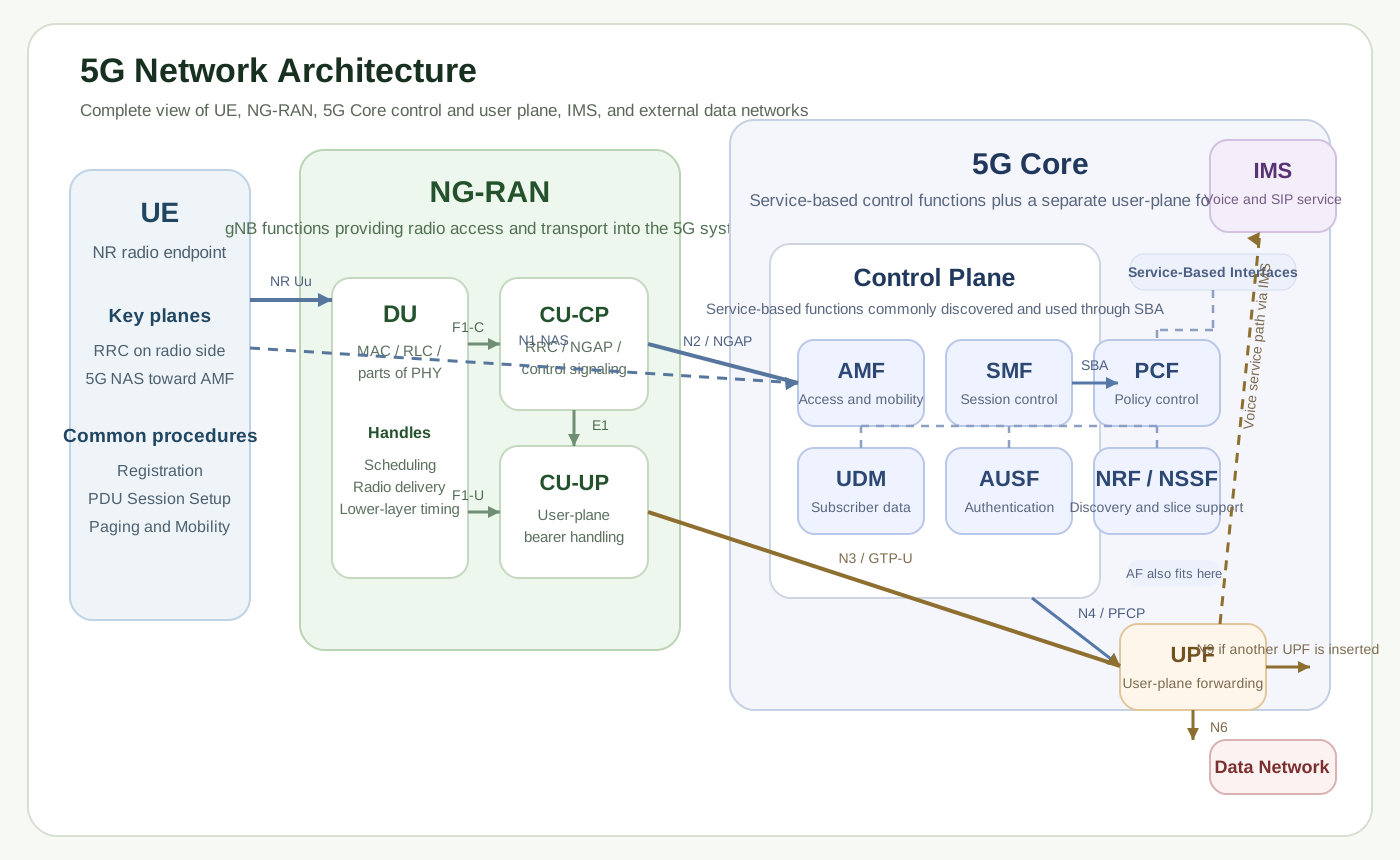
Use the diagram in two passes. First, follow the control path: UE to AMF over N1 and N2, then across the service-based functions inside the core. Second, follow the user path: gNB to UPF over N3, then onward over N6 or across N9 if the deployment inserts more than one UPF.
Child pages in this section
5G Architecture Overview
Use this for the shorter conceptual version when you want the architecture map without as much commentary.
5G RAN (NG-RAN) Architecture
Go deeper on gNB structure, CU-DU split, mobility, dual connectivity, and radio-bearer architecture.
5G Core Network (5GC)
Go deeper on AMF, SMF, UPF, policy, authentication, subscriber data, and service-based control functions.
5G Interfaces
Switch to an interface-first view for N1, N2, N3, N4, N6, N9, F1, E1, Xn, and SBA links.
5G Protocol Stack
Map architecture into RRC, NAS, NGAP, PFCP, GTP-U, and the service-based core signaling model.
VoNR Architecture
Follow how the 5G architecture connects to IMS for voice service, session control, and continuity behavior.
Core Components of 5G Architecture
UE
The UE runs NR access procedures, RRC on the radio side, and 5G NAS toward the core. It is where registration, paging response, and service continuity start.
NG-RAN
The NG-RAN is the 5G radio access network. In many deployments it is not one flat node, but a gNB split across DU, CU-CP, and CU-UP functions.
5GC
The 5G Core contains the control functions that decide what should happen and the UPF that actually forwards user traffic.
IMS and service networks
IMS commonly supports voice services such as VoNR, while generic application traffic exits the 5G system toward external data networks.
Main functions
| Function | Why it matters |
|---|---|
| gNB | The main 5G radio node. It handles access-side control and forwards traffic and signaling toward the 5GC. |
| CU / DU split | Explains why some RAN issues live inside split interfaces such as F1 or E1 instead of looking like one simple base-station problem. |
| AMF | The access and mobility management function. If registration or reachability is failing, AMF is often central. |
| SMF | The session management function. It controls how PDU sessions are built and how UPF forwarding should behave. |
| UPF | The user-plane function. It is the part of the 5G Core that actually carries traffic toward data networks. |
| UDM / AUSF / PCF / NRF / NSSF | These functions supply subscriber data, authentication, policy, service discovery, and slice-related support inside the core. |
The most practical split to remember is this: AMF and related functions decide, SMF programs, and UPF forwards.
What the full 5G architecture includes
The simplified diagram is a good starting point, but the full 5G system defined in 3GPP TS 23.501 includes more than just the UE, gNB, AMF, SMF, and UPF. In the standard reference architecture, the 5G Core uses service-based interactions between control-plane functions and can include additional functions such as NEF, NRF, NSSF, UDR, UDSF, NWDAF, and CHF, depending on the deployment, service model, and operator design.
| Spec-backed architecture point | Why it matters on this page |
|---|---|
| Service-based interfaces are used within the control plane | 5G core control functions are not just point-to-point boxes. This is one of the main architectural differences from LTE EPC and explains why the core feels more modular. |
| The full 5GS includes more functions than most teaching diagrams show | Functions such as NEF, UDR, UDSF, NWDAF, CHF, and slice-related functions matter when the question moves into exposure, analytics, data storage, charging, or slicing. |
| SCP may be deployed for indirect NF communication | TS 23.501 notes that SCP can be used for indirect communication between NFs and NF services, but it does not expose services itself. That matters in modern cloud-native core deployments. |
| Non-roaming is only the starting reference model | The standard also defines roaming architectures, including control-plane protection through inter-PLMN security edge concepts such as SEPP. |
| 5GS is not limited to 3GPP access | Release 18 architecture also covers trusted and untrusted non-3GPP access, so a complete 5G architecture view eventually includes functions such as N3IWF, TNGF, TWIF, or W-AGF when relevant. |
| Data storage is part of the architecture model | TS 23.501 explicitly separates structured and unstructured storage concepts through UDR and UDSF, which is useful when thinking about scale-out core implementations. |
Interfaces that matter most
| Interface | What to remember |
|---|---|
| N1 | UE-to-core NAS signaling path, logically toward the AMF. |
| N2 | gNB-to-AMF control-plane path, commonly where NGAP appears. |
| N3 | gNB-to-UPF user-plane path, commonly where GTP-U carries service traffic. |
| N4 | SMF-to-UPF control path, commonly using PFCP to program forwarding behavior. |
| N6 | UPF-to-data-network edge of the 5G system. |
| F1 / E1 / Xn | The extra interfaces that make modern 5G access architecture more distributed than LTE. |
For daily troubleshooting, start with N1, N2, N3, and N4. Add F1, E1, Xn, N6, N9, or the service-based interfaces when the symptom clearly points that way.
Used in procedures
- Initial registration is the cleanest way to understand the control-plane path into the AMF and the wider 5GC.
- Authentication procedure shows where AUSF and subscriber-related functions fit.
- PDU session setup shows how SMF and UPF extend the architecture into the user plane.
- Paging shows how NG-RAN and 5GC coordinate UE reachability.
- Inter-AMF mobility shows why function placement inside the 5GC matters operationally.
- VoNR and IMS shows how voice service sits on top of the same transport foundation.
Troubleshooting view
If registration fails
Look first at access setup, N1/N2 signaling, AMF handling, and subscriber or authentication functions.
If data service fails
Look at N3, N4, UPF forwarding, PDU session state, and the N6-facing exit toward data networks.
If mobility fails
Look at measurement and RRC behavior first, then the relevant RAN and core mobility interfaces such as Xn or inter-AMF control paths.
If voice fails
Confirm whether the deployment is using VoNR, EPS fallback, or another continuity path before assuming the issue is purely in SIP or purely in RAN.
Standards map
If you want this page to line up cleanly with the 3GPP stack, these are the specs that matter most and what they contribute.
| Specification | Why it belongs in the 5G architecture reading path |
|---|---|
| TS 23.501 | Main system architecture specification for the 5G System. This is the core architecture anchor for this page. |
| TS 23.502 | Procedure specification that turns the architecture into registration, mobility, paging, and PDU session sequences. |
| TS 24.501 | Stage 3 NAS specification for 5GS. Use it when the architecture question becomes message-level NAS behavior on N1. |
| TS 38.300 | Overall NR and NG-RAN stage-2 description. Use it when the architecture question moves from 5GC into the radio-access side. |
| TS 32.240 | Charging architecture and principles. Important when policy, charging, monetization, or charging-function placement becomes part of the architecture view. |
| TS 22.261 | Service requirements for the 5G system. Useful for understanding why the architecture needs to support slicing, diverse latency targets, non-public use cases, and service differentiation. |
| TS 22.173 and IMS-related service specs | Important when you move from transport architecture into IMS multimedia telephony and VoNR service behavior. |
| TS 22.185 / TS 22.186 | Useful when the architecture question extends into V2X and enhanced V2X service requirements. |
In practice, the quickest way to use the standards is: TS 23.501 for the boxes, TS 23.502 for the flows, TS 24.501 for NAS details, and TS 38.300 for NG-RAN context.
Start here next
Go to NG-RAN
Best next step if your question is about gNBs, CU-DU split, radio bearers, measurements, or handover.
Go to 5GC
Best next step if your question is about AMF, SMF, UPF, policy, discovery, or slicing support.
Go to interfaces
Best next step if you are reading traces, captures, ladders, or vendor logs and need an interface-first map.
Go to RRC
Best next step if the issue begins before stable service and still looks primarily access-side.
FAQ
What are the two main blocks of 5G architecture?
The two main blocks are the NG-RAN and the 5G Core.
What makes 5G architecture harder to read than LTE at first?
There are more named functions, more interface types, and more common deployment splits, especially inside the RAN and the core.
Which interfaces should I learn first?
Start with N1, N2, N3, and N4. Those cover a large share of real registration and data-service work.
Where does IMS fit in 5G architecture?
IMS usually sits above the transport architecture and uses the 5G access and core path to deliver voice services such as VoNR.
Key takeaways
- Read 5G architecture first as a simple chain: UE -> NG-RAN -> 5GC -> IMS or external data network.
- The most useful operational split is control plane versus user plane.
- AMF, SMF, and UPF form the backbone of registration, session control, and traffic forwarding.
- N1, N2, N3, and N4 are the quickest interfaces to learn if you want the architecture to become practical fast.