AMF Configuration Update Acknowledge is the NG-RAN-to-AMF successful-outcome message used to confirm that the NG-RAN successfully updated configuration data received in AMF Configuration Update for an NG-C interface instance.
Message Fact Sheet
Protocol
ngap
Network
5g
Spec
3GPP TS 38.413
Spec Section
Clause 8.7.3.2 and clause 9.2.6.8 (Release 18 baseline)
The NG-RAN successfully updates configuration data received in AMF Configuration Update and needs to confirm completion of the procedure back to the AMF.
Main purpose
Confirms that the NG-RAN accepted and applied the AMF-driven configuration refresh on the successful branch of the AMF Configuration Update procedure and, when relevant, reports per-association TNL setup success or failure back to the AMF.
AMF Configuration Update successful operation, NG-C interface maintenance, AMF and NG-RAN configuration synchronization, TNL association setup result reporting, Node-level AMF identity and slice refresh confirmation
What is AMF Configuration Update Acknowledge in simple terms?
AMF Configuration Update Acknowledge is the NG-RAN-to-AMF successful-outcome message used to confirm that the NG-RAN successfully updated configuration data received in AMF Configuration Update for an NG-C interface instance.
Confirms that the NG-RAN accepted and applied the AMF-driven configuration refresh on the successful branch of the AMF Configuration Update procedure and, when relevant, reports per-association TNL setup success or failure back to the AMF.
Why this message matters
AMF Configuration Update Acknowledge is the NG-RAN telling the AMF that the requested node-level configuration refresh succeeded, and it can also report which requested TNL associations were set up successfully or failed.
Where this message appears in the call flow
Successful confirmation of AMF-driven configuration refresh
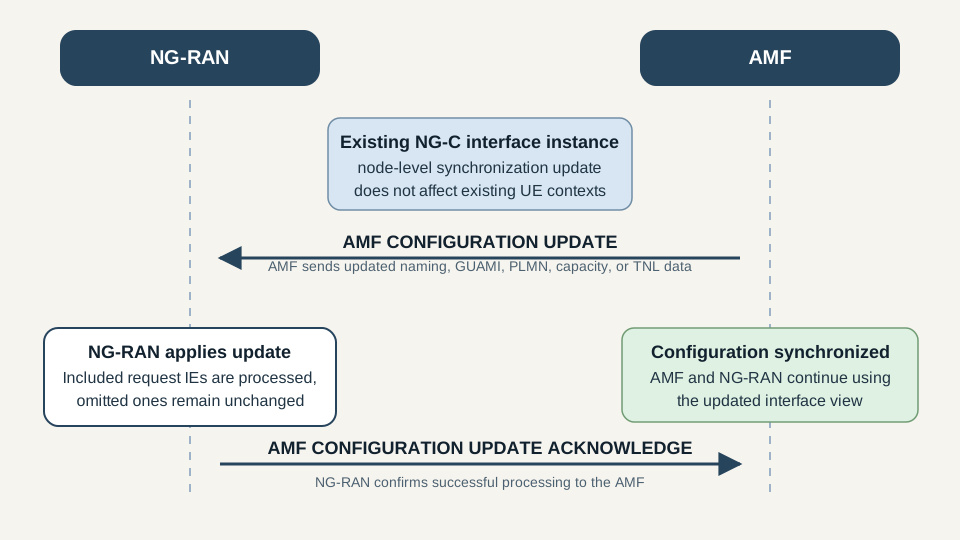
Success branch: the AMF sends updated configuration for an existing NG-C interface instance, the NG-RAN applies the accepted changes, and then confirms completion with AMF Configuration Update Acknowledge.
Call flow position: The NG-C interface instance already exists, the AMF has sent updated configuration data, and the NG-RAN has successfully applied the accepted configuration changes.
Typical state: The procedure is on the successful branch and the NG-RAN is ready to confirm completion back to the AMF.
Preconditions:
AMF Configuration Update reached the NG-RAN successfully.
The NG-RAN accepted the included node-level changes.
The procedure remains non-UE-associated and does not disturb existing UE-related contexts.
Next likely message: Normal NGAP operation continues with synchronized AMF and NG-RAN configuration
TNL association setup outcome reporting
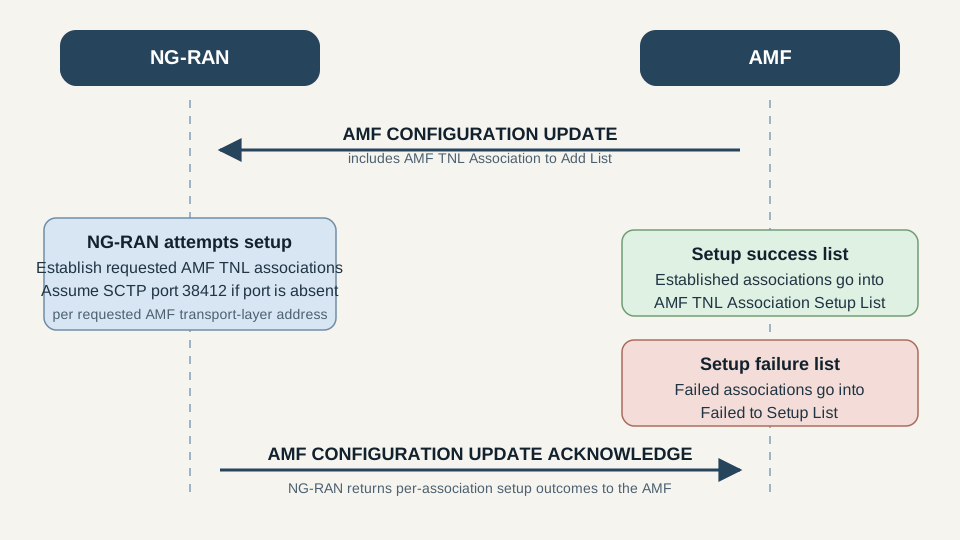
Reporting branch: when the request asked for AMF TNL association setup, the acknowledge can return both the successful-setup list and the failed-to-setup list.
Call flow position: The AMF Configuration Update included AMF TNL Association to Add List, so the NG-RAN attempted to establish one or more requested control-plane TNL associations before sending the successful outcome.
Typical state: The NG-RAN has per-association results to report rather than only a binary success indication.
Preconditions:
AMF TNL Association to Add List was present in the request.
The NG-RAN attempted setup using the signalled address information.
If the AMF address omitted a port number, the NG-RAN assumed SCTP port 38412.
Next likely message: The acknowledge reports AMF TNL Association Setup List and or AMF TNL Association Failed to Setup List
Success branch versus failure branch
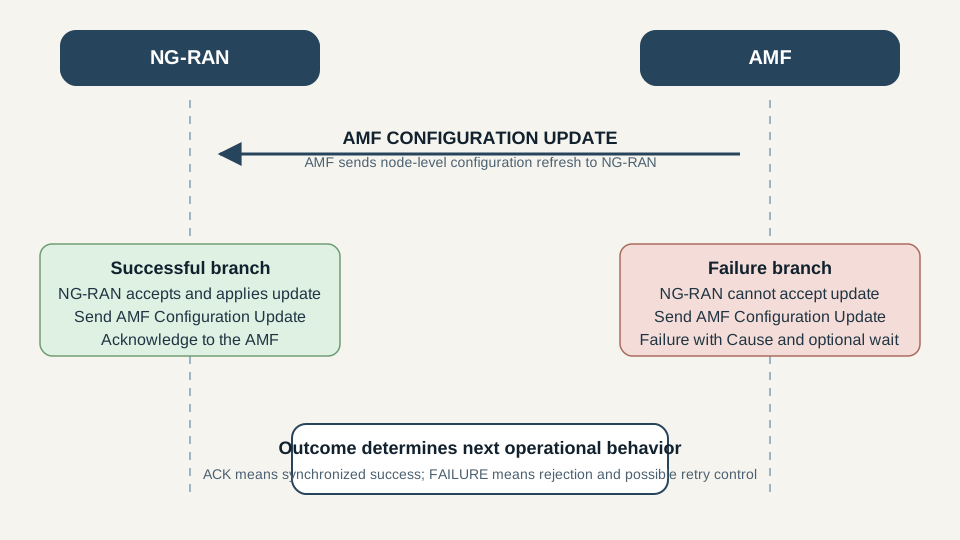
Outcome branch: acknowledgment means the configuration refresh succeeded, while the failure message is used when the NG-RAN cannot accept the update and needs to reject it.
Call flow position: The NG-RAN chooses AMF Configuration Update Acknowledge instead of AMF Configuration Update Failure because the update was accepted and processed successfully.
Typical state: The configuration refresh ends with acceptance rather than rejection and retry handling.
Preconditions:
The update content did not trigger rejection.
No Cause-based failure reporting or Time to Wait backoff is needed.
Next likely message: Configuration remains synchronized until a later interface-management change
Transport / encapsulation: NGAP over SCTP/IP between NG-RAN and AMF
Security context: AMF Configuration Update Acknowledge does not create, release, or modify UE-specific security context. It is a node-level successful-outcome message, and the parent procedure does not affect existing UE-related contexts.
Message Structure Overview
AMF Configuration Update Acknowledge is a non-UE-associated successfulOutcome in the Interface Management family.
The sender is the NG-RAN node and the receiver is the AMF on the N2 or NG-C interface.
The message confirms successful processing of AMF-driven configuration changes for one NG-C interface instance.
Unlike a truly empty acknowledge, this message can return AMF TNL Association Setup List, AMF TNL Association Failed to Setup List, and optional Criticality Diagnostics.
If an IE was omitted in the earlier AMF Configuration Update request, the corresponding stored configuration remains unchanged at the NG-RAN.
If the request carried full replacement lists such as Served GUAMI List or PLMN Support List, successful acknowledgment implies the NG-RAN is now operating with the overwritten values.
ASN.1 for 5G NGAP - AMF Configuration Update Acknowledge
AMFConfigurationUpdateAcknowledge ::= SEQUENCE {
  protocolIEs ProtocolIE-Container { {AMFConfigurationUpdateAcknowledge-IEs} },
  ...
}

AMFConfigurationUpdateAcknowledge-IEs NGAP-PROTOCOL-IES ::= {
  { ID id-AMFTNLAssociationSetupList           CRITICALITY reject TYPE AMFTNLAssociationSetupList           PRESENCE optional } |
  { ID id-AMFTNLAssociationFailedToSetupList   CRITICALITY ignore TYPE AMFTNLAssociationFailedToSetupList   PRESENCE optional } |
  { ID id-CriticalityDiagnostics               CRITICALITY ignore TYPE CriticalityDiagnostics               PRESENCE optional },
  ...
}

AMFTNLAssociationSetupList ::= SEQUENCE (SIZE (1..maxnoofTNLAssociations)) OF AMFTNLAssociationSetupItem

AMFTNLAssociationSetupItem ::= SEQUENCE {
  aMFTNLAssociationAddress CPTransportLayerInformation,
  ...
}
How to read this ASN.1
This successfulOutcome is richer than a simple empty ACK. Its main operational value comes from the optional per-association TNL setup result lists, especially when the AMF asked the NG-RAN to add new control-plane TNL associations.
5G NGAP - AMF Configuration Update Acknowledge - Example Dump
Treat this as a teaching example based on the spec structure, not as a captured network trace.
The acknowledge can be more than a plain success flag because it may also report detailed TNL association setup outcomes.
If the AMF TNL association address in the request omits a port number, the NG-RAN assumes SCTP port 38412 when attempting setup.
Read the acknowledge together with the earlier AMF Configuration Update to understand which configuration blocks were actually changed and which omitted blocks stayed unchanged.
Important Information Elements
IE
Presence
Description
Message Type
Mandatory
Identifies the NGAP PDU as AMF Configuration Update Acknowledge in the successfulOutcome branch.
AMF TNL Association Setup List
Optional
Optional list reporting which requested AMF TNL associations were established successfully. The list contains AMF TNL Association Setup Item entries carrying AMF TNL Association Address information, with a maximum of 32 associations.
AMF TNL Association Failed to Setup List
Optional
Optional list reporting which requested AMF TNL associations failed to be established, so the acknowledge can expose granular setup outcome rather than only generic success.
Criticality Diagnostics
Optional
Optional diagnostics that can provide additional context about protocol handling or IE-level processing details encountered during the update.
Detailed field explanation
Message Type
Identifies the NGAP PDU as AMF Configuration Update Acknowledge in the successfulOutcome branch.
Presence: Mandatory
In practice: In practice, compare this field with the original request and with any later release-dependent optional fields so you can see whether the network accepted the same service model the UE asked for.
AMF TNL Association Setup List
Optional list reporting which requested AMF TNL associations were established successfully. The list contains AMF TNL Association Setup Item entries carrying AMF TNL Association Address information, with a maximum of 32 associations.
Presence: Optional
In practice: In practice, compare this field with the original request and with any later release-dependent optional fields so you can see whether the network accepted the same service model the UE asked for.
AMF TNL Association Failed to Setup List
Optional list reporting which requested AMF TNL associations failed to be established, so the acknowledge can expose granular setup outcome rather than only generic success.
Presence: Optional
In practice: In practice, compare this field with the original request and with any later release-dependent optional fields so you can see whether the network accepted the same service model the UE asked for.
Criticality Diagnostics
Optional diagnostics that can provide additional context about protocol handling or IE-level processing details encountered during the update.
Presence: Optional
In practice: In practice, compare this field with the original request and with any later release-dependent optional fields so you can see whether the network accepted the same service model the UE asked for.
What to check in logs and traces
Confirm the acknowledge follows a valid AMF Configuration Update on the same non-UE-associated interface path.
Check which request IEs were present, because any omitted IE in the update means the corresponding configuration remained unchanged.
If AMF TNL Association to Add List was present, verify that each requested association appears in either AMF TNL Association Setup List or AMF TNL Association Failed to Setup List.
Validate port handling carefully when the AMF transport-layer address omitted a port number, because the NG-RAN should assume SCTP port 38412.
For Served GUAMI List and PLMN Support List, confirm the NG-RAN treated included lists as full overwrites rather than incremental additions.
If Criticality Diagnostics is present, decode it alongside the initiating AMF Configuration Update to understand any reporting context.
Common Issues and Troubleshooting
The acknowledge is treated like an empty success message and TNL setup results are missed.
Likely cause: The implementation or trace review may be assuming all successfulOutcome messages are minimal, even though this one can carry detailed AMF TNL association result lists.
What to inspect: Check whether AMF TNL Association Setup List or AMF TNL Association Failed to Setup List is present before concluding that the acknowledge carries no operational payload.
Next step: Use the result lists to reconcile which requested control-plane endpoints actually became usable and which did not.
The AMF believes configuration is synchronized, but some requested TNL associations still are not operational.
Likely cause: Some requested associations may have failed during setup and were reported in the failed-to-setup list rather than the success list.
What to inspect: Compare the original AMF TNL Association to Add List with the acknowledge-side success and failure reporting, including endpoint and port details.
Next step: Troubleshoot only the failed associations instead of assuming the whole update failed.
Post-update behavior is inconsistent for PLMN, GUAMI, or slice selection.
Likely cause: The NG-RAN may have overwritten whole lists from the request, or reviewers may be reading the update as a delta instead of a full replacement.
What to inspect: Compare the complete pre-update and post-update PLMN Support List and Served GUAMI List rather than looking for single appended entries.
Next step: Treat included list IEs as overwrite semantics and verify that the AMF sent complete intended replacements.
LTE / 5G / Variant Comparison
Compared with AMF Configuration Update
AMF Configuration Update carries the actual node-level AMF configuration changes. AMF Configuration Update Acknowledge confirms successful processing of that update and can also report TNL association setup results.
Compared with AMF Configuration Update Failure
The acknowledge is the success branch and confirms the NG-RAN applied the update. AMF Configuration Update Failure is the rejection branch and carries Cause plus optional Time to Wait and Criticality Diagnostics.
Why this acknowledge is not empty
Some NGAP acknowledge messages only confirm success and carry no payload. This message can still serve as success confirmation, but it may additionally carry AMF TNL Association Setup List and AMF TNL Association Failed to Setup List, which makes it a richer operational response.
FAQ
What is AMF Configuration Update Acknowledge in 5G NGAP?
It is the NG-RAN-to-AMF successful-outcome message used to confirm that the NG-RAN successfully processed a previously received AMF Configuration Update.
Who sends AMF Configuration Update Acknowledge?
The NG-RAN node sends AMF Configuration Update Acknowledge to the AMF.
When is AMF Configuration Update Acknowledge used?
It is used after the NG-RAN successfully updates the received AMF-side configuration data for the existing NG-C interface instance.
Does this message contain only an acknowledgement, or can it carry more information?
It can carry more than a simple success confirmation because it may include AMF TNL Association Setup List, AMF TNL Association Failed to Setup List, and optional Criticality Diagnostics.
What is AMF TNL Association Setup List?
It is the optional IE that reports which requested AMF TNL associations the NG-RAN established successfully.
What is AMF TNL Association Failed to Setup List?
It is the optional IE that reports which requested AMF TNL associations could not be established.
Why can this message include Criticality Diagnostics?
Criticality Diagnostics can be included optionally to provide additional protocol-handling or IE-processing context related to the update.
What is the difference between AMF Configuration Update Acknowledge and AMF Configuration Update Failure?
The acknowledge means the NG-RAN successfully updated the configuration, while the failure message means the update could not be accepted and may carry Cause and Time to Wait.
What happens if the AMF TNL association address has no port number?
The NG-RAN assumes SCTP port 38412 when attempting to establish that requested TNL association.
Does this procedure affect existing UE contexts?
No. The AMF Configuration Update procedure is non-UE-associated and does not affect existing UE-related contexts.
Decode this message with the 3GPP Decoder, inspect the related message database, or open the matching call flow to see where this signaling step fits in the full procedure.